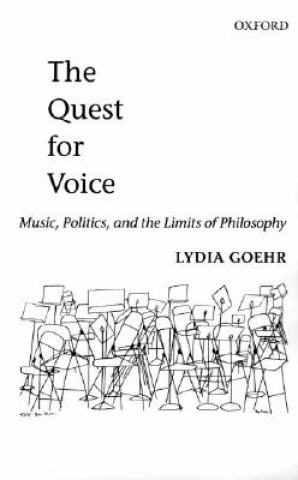
Code: 04476865
Quest for Voice
by Goehr
What is musical meaning? Where does it reside and how can it be known? Does it make a difference to its meaning if the music is composed with or without words, as a symphony or a song? Why is it claimed that music can express h ... more


- Language:
 English
 - Binding: Paperback
- Number of pages: 224
Publisher: Oxford University Press, 2002
- More about this


You might also like
-

Haunted Weather
13.31 € -25 % -

So Far So Good
20.17 € -14 % -

So Far So Good
14.92 € -25 % -

Giuliano da Sangallo e le arti. Disegno, scultura, architettura e ingegneria militare a cavallo del 1500
39.44 € -

Living Room
13.41 € -9 % -

Living Room
27.23 € -

MR-9: Secret Agent
12.50 €
Give this book as a present today
- Order book and choose Gift Order.
- We will send you book gift voucher at once. You can give it out to anyone.
- Book will be send to donee, nothing more to care about.
More about Quest for Voice
You get 297 loyalty points
 Book synopsis
What is musical meaning? Where does it reside and how can it be known? Does it make a difference to its meaning if the music is composed with or without words, as a symphony or a song? Why is it claimed that music can express human feelings with an immediacy not possible in other languages or arts? What is contained in the claim that music is autonomous, or that it is prophetic and can articulate a 'politics for the future'? Concentrating on the music, politics, and philosophy of Richard Wagner, Lydia Goehr addresses these classic questions of German Romanticism. On the way, she offers an account of the peculiar relation that was established between philosophy and music in the nineteenth century; a philosophical and political reading of Wagner's opera Die Meistersinger; an account of the Wagner-Hanslick debate on musical formalism; an argument for resituating musical autonomy, in the spirit of Wagner's Gesamtkunstwerk; an account of the competing performance ideals embodied in Wagner's Bayreuth, and an interpretation of Wagner's legacy as experienced by composers exiled from Nazi Germany. Goehr's historical and musicological enquiries are unified by a philosophical study of the impact of the transcendental or critical perspective on philosophical theory. She argues that philosophy needs to take its limits seriously to accommodate the primacy of music's practice.
Book details
Book category Books in English The arts Music Music: styles & genres
122.59 €
- Full title: Quest for Voice
- Author: Goehr
- Language: English
- Binding: Paperback
- Number of pages: 224
- EAN: 9780198166962
- ISBN: 0198166966
- ID: 04476865
- Publisher: Oxford University Press
- Weight: 324 g
- Dimensions: 216 × 140 × 14 mm
- Date of publishing: 17. January 2002
Trending among others
-

Moonwalk
14.02 € -14 % -

Dancing The Dream
19.87 € -31 % -

Michael Jackson
21.38 € -24 % -

Just Kids
13.81 € -20 % -

In the Studio with Michael Jackson
34.40 € -

I Am Ozzy
13.01 € -25 % -

Cured
12.91 € -25 % -

Queen Unseen - My Life with the Greatest Rock Band of the 20th Century: Revised and with Added Material
11.80 € -25 % -

Real Frank Zappa Book
16.14 € -25 % -

Our Band Could Be Your Life
18.05 € -27 % -

Everybody Loves Our Town
14.52 € -27 % -

18 and Life on Skid Row
12.20 € -30 % -
Jazz Theory & Workbook
18.05 € -22 % -

Official Truth, 101 Proof
14.62 € -28 % -

Touch And Go
28.45 € -25 % -

Burning Britain
21.58 € -25 % -

Dream Brother
15.23 € -20 % -

Jazz Ballads
18.05 € -22 % -

George Frideric Handel: Volume 2, 1725-1734
243.78 € -

Love in Vain
21.58 € -25 % -

Miles Davis
19.57 € -25 % -

Madonna Confessions
35.61 € -10 % -

Sundog
16.44 € -17 % -

To Be, or Not . . . to Bop
18.56 € -9 % -

Linkin Park
29.05 € -1 % -

Histories of Heinrich Schutz
126.93 € -

Jazz Anecdotes
18.25 € -24 % -

This Is The Noise That Keeps Me Awake
34.50 € -22 % -

Ambient Century
31.17 € -

Michael Jackson
12 € -25 % -

Isaac Albeniz
157 € -

Real Book
37.43 € -21 % -

My Friend Michael
18.25 € -29 % -

Michael Jackson King of Pop 1958-2009
13.92 € -1 % -

Elvis and Me
8.26 € -29 % -

M Train
13.01 € -20 % -

Scales and Finger Exercises
10.48 € -19 % -

Standing in the Shadows of Motown
44.49 € -

Jazz Theory Book
56.60 € -10 % -

Jazzology
30.56 € -16 % -

Kiss and Make-Up
13.92 € -24 % -
Ravel: Sheet Music for Piano
15.73 € -9 % -

Lords Of Chaos - 2nd Edition
20.88 € -6 % -

The Long Hard Road Out Of Hell
13.31 € -29 % -

Yann Tiersen - Piano Works
26.43 € -24 % -

A Perfect Union of Contrary Things
15.33 € -43 % -

I'm with the Band
12.70 € -24 % -

Iron Man
16.14 € -25 % -

Twentieth-Century Harmony
52.56 €
Collection points Bratislava a 12986 dalších
Copyright ©2008-26 najlacnejsie-knihy.sk All rights reservedPrivacyCookies

 25976 collection points
 Delivery 2.99 €
 02/210 210 99 (8-15.30h)