Code: 09526627
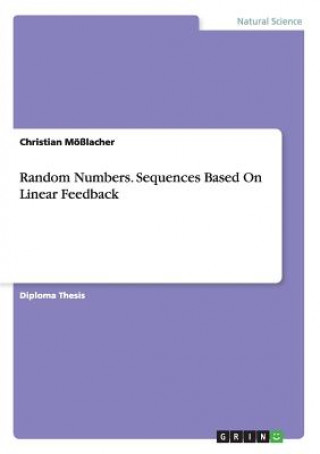
Random Numbers. Sequences Based On Linear Feedback
by Christian Mößlacher
Diploma Thesis from the year 2012 in the subject Mathematics - Stochastics, grade: 2, Klagenfurt University (Institut für Statistik), language: English, abstract: 7 is definately not a random number. In fact, we would probably say ... more


- Language:
 English
 - Binding: Paperback
- Number of pages: 134
Publisher: Grin Publishing, 2015
- More about this

42.55 €
RRP: 49.91 €
You save 7.36 €

In stock at our supplier
Shipping in 5 - 8 days
You might also like
-

Bliss Club
13.87 € -24 % -

To Catch a Firefly
19.70 € -2 % -

Psychologia Kluczowe koncepcje Tom 1 Podstawy psychologii
18.70 € -1 % -

Great American Hunting Stories
17.89 € -

Kouzla rodu Thornů
17.19 € -6 % -
Theatrical Notebooks of Samuel Beckett
39.62 € -27 % -

Stoic Freedom: Epictetus' Discourses Book 4
13.98 € -6 % -

Cambridge Reading Adventures Green Band Pack
59.33 € -

Theatres of Immanence
56.41 € -10 % -

Magick and the Bible: Is Magick Compatible with the Bible?
8.04 € -7 % -

River God, 1
13.67 € -25 % -

Quantum Kinetics in Transport and Optics of Semiconductors
197.42 € -

Digital Media Use in Early Childhood
40.02 € -

Financial Management Operations: Field Manual FM 1-06
15.59 € -6 % -

Les Werner
10.15 € -

Colita
25.23 € -

Das Lexikon für die digitale Welt
22.32 € -11 % -

Pitching in the Promised Land
14.67 € -25 % -

Tolle Lehrer sind schwer zu finden, aber unmöglich zu vergessen: liniertes A5 Notizbuch mit 100 Seiten als Abschiedsgeschenk für einen Lehrer
9.25 € -7 % -

Beginning and Intermediate Algebra with Applications & Visualization MyMathLab Update with eText - Access Card Package
240.26 € -2 % -

Romanesque Architecture In France
22.42 € -2 % -

La Crisis: Testimonios y Perspectivas
11.76 € -

Malay Archipelago
64.66 € -

Solar Flare
18.50 € -9 % -

Poems
16.48 € -

Osteoporosis Prevention Guide
10.55 € -9 % -

Cinéma anglophone et politique
38.31 € -

Henry James's Permanent Adolescence
55.71 € -

Italians in Haverhill
25.74 € -20 % -

British Intelligence and Hitler's Empire in the Soviet Union, 1941-1945
184.45 € -

Te Amo
8.94 € -6 % -

Disability and Equality Law in Britain
86.79 € -

Choix d'Eloges Francais Les Plus Estimes
21.01 € -1 % -

Невеста
13.97 € -11 % -

Genres et rhetorique des discours mediatiques
6.63 € -72 % -

Best of ICCAD
306.64 € -7 % -

Illustrations of Medical Evidence and Trial by Jury in Scotland
17.20 € -2 % -
Chess
14.67 € -2 % -

The End Of Forever: A Deranged Love Affair
8.04 € -7 % -

Cluster of Cancers
19.30 € -

Nordfriesische Wintergeschichten. Life is a Story - story.one
16.08 € -11 % -

The Masterpiece
16.48 € -2 % -

I Remember: Indianapolis Youth Write about Their Lives 2017
14.28 € -

Mathematics Curriculum, Teacher Professionalism, and Supporting Policies in Korea and the United States: Summary of a Workshop
49.98 € -

Castleford Case.
22.72 € -25 % -

Eloge d'Antoine Petit, Docteur-Regent de la Faculte de Medecine de l'Universite de Paris
12.06 € -1 % -

Planificacion estrategica y bioseguridad
176.30 € -14 % -

Huile de Ricinodendron heudelotii (Bail.):propriétés et métabolisme
46.05 € -11 % -

SVT 1RE L TAVERNIER 2001
33.08 € -

Al-Ghazali on the Lawful and the Unlawful
57.42 € -24 % -

Jeux vidéo : l'industrie culturelle du XXIe siècle ?
22.72 € -

Einleitung Zur Berechnung Der Leibrenten Und Anwartschaften Die Vom Leben Und Tode Einer Oder Mehrerer Personen Abhangen (1785)
45.17 € -1 % -

Blind Love
23.12 € -14 % -

Gene Wars Second Edition
6.83 € -20 % -
Networks, Topology and Dynamics
102.38 € -7 % -

Quantum Probability And Infinite-dimensional Analysis: Proceedings Of The Conference
171.57 € -

Fairies Coloring Book For Kids Ages 4-8
8.94 € -6 % -

Connect Dots and Build Colorful Rangoli Patterns
7.23 € -6 % -

La Republique Americaine: Etats-Unis, Institutions de l'Union, Institutions d'Etat. Volume 1
34.79 € -

The Best American Short Stories 2016
11.25 € -24 % -

Take Charge and Change Your Life Today!
18.09 € -25 % -

For The Love of Art
30.67 € -10 % -

Rechtsfragen der Venture Capital-Finanzierung.
84.27 € -6 % -

Etude de la Langue Tai, Precedee d'Une Notice Sur Les Races Des Hautes Regions Du Tonkin
23.93 € -

Plant based vaccine adjuvants
31.97 € -14 % -

Adventures of a Real-Life Cable Guy
13.77 € -2 % -

Eurolab Francais-Plus
30.36 € -15 % -

Esclavos de un motivo
21.21 € -

BAND TIME CHRISTMAS
8.64 € -10 % -

Fragmented Citizens
107.20 € -

Andre-Marie Ampere Et Jean-Jacques Ampere V1: Correspondance Et Souvenirs, De 1805 A 1864 (1875)
38.93 € -1 % -

Processamento, secagem e armazenamento na qualidade de cafes
44.24 € -14 % -

Debajo Del Agua Libro De Ninos Para Colorear (Spanish Edition)
9.95 € -24 % -

Intimate Moments
17.09 € -2 % -

Dante Now
39.92 € -

Teenage Traveller
25.74 € -

The Boys' Life Of Christ (1905)
30.78 € -2 %
Give this book as a present today
- Order book and choose Gift Order.
- We will send you book gift voucher at once. You can give it out to anyone.
- Book will be send to donee, nothing more to care about.
More about Random Numbers. Sequences Based On Linear Feedback
You get 104 loyalty points
 Book synopsis
Diploma Thesis from the year 2012 in the subject Mathematics - Stochastics, grade: 2, Klagenfurt University (Institut für Statistik), language: English, abstract: 7 is definately not a random number. In fact, we would probably say that the sequence 7, 2, 13, 9, 5, 8, ... is random. Within mathematics a sequence of random numbers should not display a pattern or show any form of regularity. Sequences of random numbers are generated by an algorithm that determines a succeeding number using one or more given§numbers. Numbers yielded by an algorithm are called pseudo-random numbers which can be denoted mathematically. Multidimensional equidistribution and a large period are important properties required from a sequence in order to acknowledge it as random numbers. The algorithms to produce random numbers can be roughly grouped into two families§- congruential generators and generators based on feedback shift registers (FSR). We will focus on the latter family. An FSR-based generator can be described by a characteristic§polynomial which has to be primitive in order to ensure the best quality with respect to randomness. Often sparse polynomials are used to reduce computing costs. The algorithms used produce random sequences that might have some deficiencies. However, the quality of randomness can be improved by several measurements; as are modifying the feedback, filtering the output sequences or combining two or more generators.
Book details
Book category Books in English Mathematics & science Mathematics Probability & statistics
42.55 €
- Full title: Random Numbers. Sequences Based On Linear Feedback
- Author: Christian Mößlacher
- Language: English
- Binding: Paperback
- Number of pages: 134
- EAN: 9783668014572
- ISBN: 3668014574
- ID: 09526627
- Publisher: Grin Publishing
- Weight: 181 g
- Dimensions: 210 × 148 × 8 mm
- Date of publishing: 20. August 2015
Trending among others
-
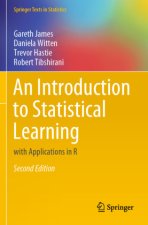
Introduction to Statistical Learning
60.23 € -9 % -

Theory of Open Quantum Systems
84.17 € -

Manga Guide To Statistics
18.60 € -25 % -

First Course in Probability, Global Edition
93.02 € -
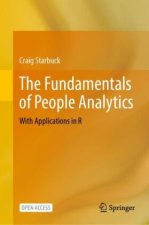
The Fundamentals of People Analytics
41.13 € -7 % -

Using Multivariate Statistics
82.26 € -14 % -
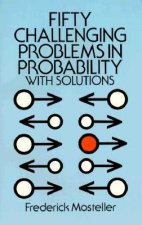
Fifty Challenging Problems in Probability with Solutions
8.74 € -24 % -

Naked Statistics
12.96 € -28 % -
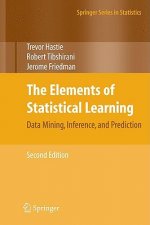
Elements of Statistical Learning
88.40 € -
How to Lie with Statistics
10.85 € -25 % -
How to Lie with Statistics
13.27 € -28 % -

Statistical Thermodynamics
8.04 € -25 % -
Probability Theory
8.04 € -25 % -

Introduction to Probability, Second Edition
112.63 € -
Statistics: A Very Short Introduction
10.75 € -24 % -

Probability Theory
146.43 € -
Probability: A Very Short Introduction
10.75 € -24 % -
Statistics
66.67 € -4 % -
Measurement: A Very Short Introduction
9.44 € -30 % -
Elementary Decision Theory
16.69 € -25 % -

Outlier Analysis
55.21 € -9 % -

40 Puzzles and Problems in Probability and Mathematical Statistics
50.18 € -9 % -

Probability Through Problems, 1
110.12 € -9 % -
Probability and Statistics for Data Science
86.08 € -
Introduction to Causal Inference
9.75 € -9 % -
Time-Series Forecasting
156.59 € -

Generalized Additive Models for Location, Scale, and Shape
69.69 € -

Robust Statistics 2e
143.91 € -9 % -
Stochastic Processes and Filtering Theory
16.18 € -29 % -
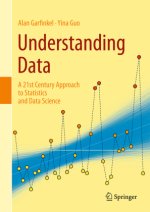
Understanding Data
71 € -14 % -

Cambridge International AS & A Level Mathematics Probability and Statistics 1 Student's Book
32.48 € -
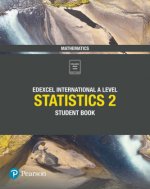
Pearson Edexcel International A Level Mathematics Statistics 2 Student Book
42.33 € -

Statistics Done Wrong
24.23 € -7 % -

Theory That Would Not Die
18.50 € -
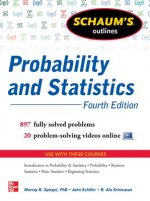
Schaum's Outline of Probability and Statistics
18.80 € -25 % -

Collected Works of C.G. Jung
20.21 € -24 % -
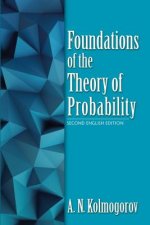
Foundations of the Theory of Probability: Second English
11.35 € -27 % -
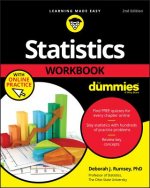
Statistics Workbook For Dummies, 2nd Edition with Online Practice
17.69 € -28 % -
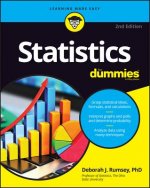
Statistics For Dummies, 2nd Edition
18.19 € -24 % -

Manga Guide To Regression Analysis
17.59 € -31 % -
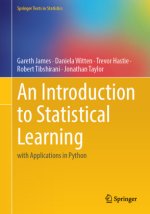
An Introduction to Statistical Learning
123.09 € -

Foundations of the Theory of Probability
6.53 € -25 % -
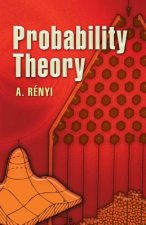
Probability Theory
24.94 € -25 % -
Continued Fractions
7.33 € -25 % -

Foundations of Modern Probability
100.16 € -9 % -

Probability and Computing
84.27 € -

Probability Essentials
70.19 € -9 % -
Basic Probability Theory
17.19 € -24 % -

Unfinished Game
23.12 €
Collection points Bratislava a 13578 dalších
Copyright ©2008-26 najlacnejsie-knihy.sk All rights reservedPrivacyCookies

 27160 collection points
 Delivery 2.99 €
 02/210 210 99 (8-15.30h)