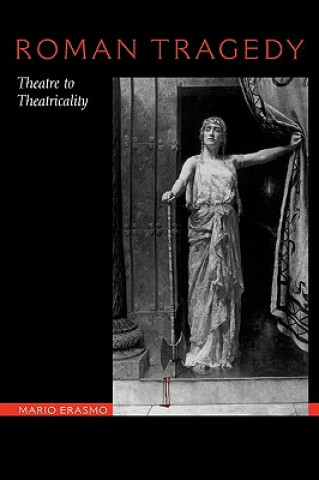
Code: 04873015
Roman Tragedy
by Mario Erasmo
Roman tragedies were written for over three hundred years, but only fragments remain of plays that predate the works of Seneca in the mid-first century C.E., making it difficult to define the role of tragedy in ancient Roman cultu ... more


- Language:
 English
 - Binding: Paperback
- Number of pages: 223
Publisher: University of Texas Press, 2004
- More about this


You might also like
-

A Light in the Attic
19.79 € -30 % -

The Disney Book New Edition: A Celebration of the World of Disney: Centenary Edition
28.68 € -26 % -

Deliria
16.05 € -

Uncovering African Agency
254.84 € -
Le roman d'un non-mort
21.61 €
Give this book as a present today
- Order book and choose Gift Order.
- We will send you book gift voucher at once. You can give it out to anyone.
- Book will be send to donee, nothing more to care about.
More about Roman Tragedy
You get 69 loyalty points
 Book synopsis
Roman tragedies were written for over three hundred years, but only fragments remain of plays that predate the works of Seneca in the mid-first century C.E., making it difficult to define the role of tragedy in ancient Roman culture. Nevertheless, in this pioneering book, Mario Erasmo draws on all the available evidence to trace the evolution of Roman tragedy from the earliest tragedians to the dramatist Seneca and to explore the role played by Roman culture in shaping the perception of theatricality on and off the stage. Performing a philological analysis of texts informed by semiotic theory and audience reception, Erasmo pursues two main questions in this study: how does Roman tragedy become metatragedy, and how did off-stage theatricality come to compete with the theatre? Working chronologically, he looks at how plays began to incorporate a rhetoricized reality on stage, thus pointing to their own theatricality. And he shows how this theatricality, in turn, came to permeate society, so that real events such as the assassination of Julius Caesar took on theatrical overtones, while Pompey's theatre opening and the lavish spectacles of the emperor Nero deliberately blurred the lines between reality and theatre. Tragedy eventually declined as a force in Roman culture, Erasmo suggests, because off-stage reality became so theatrical that on-stage tragedy could no longer compete.
Book details
Book category Books in English Literature & literary studies Literature: history & criticism Literary studies: general
28.68 €
- Full title: Roman Tragedy
- Subtitle: Theatre to Theatricality
- Author: Mario Erasmo
- Language: English
- Binding: Paperback
- Number of pages: 223
- EAN: 9780292722200
- ISBN: 0292722206
- ID: 04873015
- Publisher: University of Texas Press
- Weight: 356 g
- Dimensions: 229 × 152 × 13 mm
- Date of publishing: 01. July 2004
Trending among others
-
How to Read a Book
14.64 € -7 % -

Karamazov Brothers
9.79 € -29 % -

The Picture of Dorian Gray
7.16 € -17 % -

Moveable Feast
8.58 € -30 % -

Saga of Tanya the Evil, Vol. 3
12.21 € -14 % -
If Not, Winter: Fragments Of Sappho
18.07 € -25 % -
Macbeth
11.81 € -14 % -
Odyssey
10.19 € -23 % -

Memoirs of a Dutiful Daughter
14.13 € -23 % -
Birth of Tragedy
10.80 € -24 % -

Devils
9.28 € -24 % -

Germinal
7.16 € -25 % -

Mysteries of Udolpho
10.39 € -30 % -
Iliad
10.60 € -25 % -

Essential Writings of Ralph Waldo Emerson
18.27 € -24 % -

Serpent Power
28.58 € -24 % -

Walden
9.28 € -24 % -

Bleak House
9.08 € -30 % -
Complete Poems of Philip Larkin
26.35 € -25 % -
Greek Epic Fragments
33.83 € -
Girl with the Golden Eyes and Other Stories
9.89 € -25 % -
Coriolanus
12.62 € -15 % -
Mimesis
20.29 € -24 % -
Two Treatises of Government
7.87 € -24 % -
Beowulf Manuscript
36.56 € -13 % -
Scarlet Letter
5.85 € -24 % -
Collected Tales and Poems of Edgar Allan Poe
19.59 € -25 % -
How to Read Literature
14.03 € -14 % -

Our Mutual Friend
9.08 € -25 % -
Obsolete Objects in the Literary Imagination
91.71 € -
Cambridge Companion to Irish Modernism
34.43 € -

Unimaginable Mathematics of Borges' Library of Babel
32.21 € -
Writing of the Disaster
29.79 € -
Miserable Miracle
13.73 € -26 % -
Macrobii Ambrosii Theodosii Saturnalia
64.33 € -
Scraps Of The Untainted Sky
80.70 € -

Love Itself - In the Letterbox
22.21 € -

Portable Edgar Allan Poe
16.05 € -30 % -

T. S. Eliot
13.02 € -1 % -
Bacchae and Other Plays
10.39 € -26 % -

Collected Poems: Dylan Thomas
11 € -30 % -

Weird and the Eerie
13.42 € -
Dubliners
8.98 € -29 % -
Count of Monte Cristo
10.19 € -28 % -
Zofloya or The Moor
10.39 € -24 % -

SEOUL University Korean 1B Workbook (QR), m. 1 Audio
34.03 € -
Metamorphoses
7.16 € -25 % -
Edda
7.87 € -24 % -
The Iliad - Penguin Classics Deluxe Edition
15.65 € -24 %
Collection points Bratislava a 12824 dalších
Copyright ©2008-26 najlacnejsie-knihy.sk All rights reservedPrivacyCookies

 25652 collection points
 Delivery 2.99 €
 02/210 210 99 (8-15.30h)