Code: 04550480
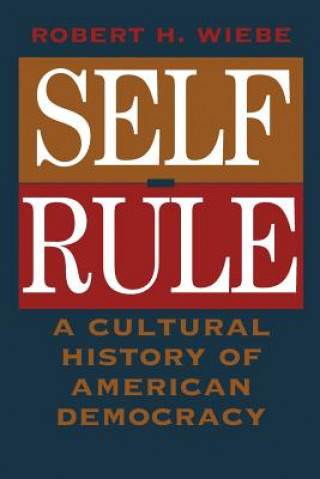
Self-Rule
by Robert H. Wiebe
Something important occurred in early 19th century America that came to be called democracy. Since then hundreds of millions of people worldwide have operated on the assumption that democracy exists. Yet definitions of democracy a ... more


- Language:
 English
 - Binding: Paperback
- Number of pages: 332
Publisher: The University of Chicago Press, 1996
- More about this


You might also like
-

Swords Against Wizardry
15.37 € -18 % -

Came To Believe
19.92 € -

Wonder
16.28 € -29 % -

West African Folktales
10.01 € -22 % -

T-34 vs StuG III
16.48 € -20 % -

Puzzle 1500 Wiejski domek C-151998-2
8.79 € -6 % -

UNCANNY XMEN OMNI V02
117.26 € -24 % -

Putin, game master?
22.15 € -18 % -

El exclaustrado
18.71 € -2 % -

Rainshadow Road
29.94 € -

Socratic Paradox and Its Enemies
38.44 € -

Shadow Saga Omnibus
21.95 € -9 % -

Le Bro Code
10.01 € -

Social Health of the Nation
85.08 € -

Miller Plays: 3
35.91 € -

Zweites Internationales Symposium ber Neurosekretion
53.11 € -4 % -

General and Madam de Lafayette
22.15 € -18 % -

Historia de Zoya
15.37 € -

Vermin-Killer
18.20 € -2 % -

LA ANATOMÍA DEL ESPIRITU
18.61 € -16 % -

to Z of Industrial Relations in the Caribbean Workplace
36.21 € -

Eminent Victorian Women
10.82 € -24 % -

Hidden Faces of Courage
28.62 € -24 % -

Queen Victoria's Secrets
144.88 € -4 % -

Do communities hold the key to sustainability?
49.97 € -3 % -

New Waves in Philosophy of Action
55.74 € -

Forces spéciales et unités d'élite - Des parcours d'exception
24.98 € -

"Pedlar in Divinity"
53.41 € -

Tabla de contenido en fibra de los alimentos
7.48 € -

Lernen an Stationen als Chance fur den Religionsunterricht der Mittelschule
38.34 € -11 % -

Pourquoi vacciner ?
12.03 € -25 % -

Histoire Romaine de Tite Live. I. Notice Sur Tite Live (Ed.1830-1835)
28.02 € -6 % -

Make Difficult People Disappear
16.18 € -24 % -

Teaching Secondary School Mathematics
58.88 € -

Nature of Socialist Economics
113.31 € -

Traitor: Versatile Layer book 6
10.61 € -7 % -

500.000 historias de amor
17.80 € -6 % -

Psicologia dei media digitali
40.76 € -

Adieu to God - Why Psychology Leads to Atheism
30.95 € -2 % -

Laugh Oh My Soul
12.33 € -

Huainanzi and Liu an's Claim to Moral Authority
94.19 € -

Solid Waste Processing and Resource Recovery
154.39 € -7 % -

Progressivism
25.28 € -

Keywords in Australian Politics
62.92 € -

Les assises du corps transforme Le corps sportif
50.48 € -

Heterostructure Epitaxy and Devices - HEAD'97
216.41 € -

Criminal Trials in Scotland, from A.D. M.CCCC.LXXXVIII to A.D. M.DC.XXIV, Embracing the Entire Reigns of James IV, and V., Mary Queen of Scots, and Ja
30.04 € -2 % -

Man Who Knew Hitchcock
59.89 € -

Good King Wenceslas
4.54 € -15 %
Give this book as a present today
- Order book and choose Gift Order.
- We will send you book gift voucher at once. You can give it out to anyone.
- Book will be send to donee, nothing more to care about.
More about Self-Rule
You get 91 loyalty points
 Book synopsis
Something important occurred in early 19th century America that came to be called democracy. Since then hundreds of millions of people worldwide have operated on the assumption that democracy exists. Yet definitions of democracy are surprisingly vague and remarkably few reckon with its history. In this work, Robert Wiebe suggests that only in appreciating that history can we recognize how breathtaking democracy's arrival was, how extraordinary its spread has been, and how uncertain its prospects are. American democracy arrived abruptly in the 19th century and changed just as dramatically early in the 20th century. Hence, this book divides the history of American democracy into two halves: a 19th century half covering the 1820s to the present, and a 20th century half, with a major transition from the 1890s to the 1920s between them. As Wiebe explains why the original democracy of the early 19th century represented a sharp break from the past, he recreates the way European visitors contrasted the radical character of American democracy with their own societies. He then discusses the operation of various 19th century democratic publics, including a nationwide public, the People. Finally, he places democracy's white fraternal world of equals in a larger environment where other Americans who differed by class, race, and gender, developed their own relations to democracy. Wiebe then picks up the history of democracy in the 1920s and carries it to the present. Individualism, once integrated with collective self-governance in the 19th century, becomes the driving force behind 20th century democracy. During those same years, other ways of defining good government and sound public policy shunt majoritarian practices to one side. Late in the 20th century, these two great themes in the history of American democracy - individualism and majoritarianism - turn on one another in modern democracy's war on itself. Finally, this text assesses the polarized state of contemporary American democracy. Putting the judgments of over 60 commentators from Kevin Phillips and E.J. Dionne to Robert Bellah and Benjamin Barber to the test of history, Wiebe offers his own suggestions on the meaning and direction of today's democracy. This sweeping work explains how the history of American democracy has brought the country to its current position and how that same history could invite one to create a different future.
Book details
Book category Books in English Humanities History Regional & national history
37.43 €
- Full title: Self-Rule
- Subtitle: A Cultural History of American Democracy
- Author: Robert H. Wiebe
- Language: English
- Binding: Paperback
- Number of pages: 332
- EAN: 9780226895635
- ISBN: 0226895637
- ID: 04550480
- Publisher: The University of Chicago Press
- Weight: 534 g
- Dimensions: 231 × 194 × 21 mm
- Date of publishing: 15. November 1996
Trending among others
-

Hundred Years' War on Palestine
13.14 € -20 % -

Plantagenets
13.95 € -24 % -

On China
18.81 € -27 % -

Europe's Tragedy
20.73 € -26 % -

History of Venice
20.12 € -25 % -

Rubicon
15.07 € -26 % -

Genghis Khan
17.09 € -24 % -

Decline and Fall of the Roman Empire
6.57 € -25 % -

Easy Company Soldier
14.86 € -24 % -
Religion and the Decline of Magic
18.81 € -30 % -

Inheritance of Rome
18.81 € -30 % -

City of Fortune
12.94 € -30 % -

The Thirteenth Tribe
12.23 € -

History of the Middle East
18.51 € -23 % -

U.S. Aviation and Naval Warfare in the Vietnam War
29.63 € -24 % -

MI6
21.64 € -20 % -

Glorious Cause
21.74 € -24 % -

Making of the English Working Class
21.44 € -24 % -

Black Hawk Down
14.86 € -24 % -

Battle for Spain
15.17 € -28 % -

Florence
56.55 € -24 % -

Brief History of Korea
12.03 € -25 % -

History of Japan to 1334
41.57 € -12 % -

Millennium
14.46 € -29 % -

A History Of Scotland
13.95 € -24 % -

Pompeii
12.84 € -25 % -

Age of the Vikings
22.35 € -5 % -

States and Power in Africa
32.87 € -1 % -

Conjuring Hitler
37.32 € -2 % -

Third Reich at War
19.82 € -30 % -

Thracians 700BC-46AD
15.37 € -14 % -

Oxford History of Medieval Europe
18.81 € -17 % -

Crete
14.86 € -30 % -

Churchill Factor
24.47 € -19 % -

World at Arms
33.48 € -24 % -

British Light Cruisers 1939-45
15.77 € -15 % -

Life of Alexander the Great
9.70 € -26 % -

Empire Project
29.94 € -25 % -

Later Roman Empire
15.17 € -26 % -

Empire of Liberty
21.74 € -24 % -

Waverley
10.41 € -24 % -

As I Crossed a Bridge of Dreams
12.94 € -30 % -

Dubai
11.83 € -25 % -

Cannibalism in High Medieval English Literature
55.74 € -

Richthofen's Flying Circus
18.30 € -20 % -

Alberta
17.09 € -24 % -

Swords Around a Throne
25.99 € -17 % -

Black Prince
13.95 € -24 % -

Civilization of the Renaissance in Italy
12.74 € -25 %
Collection points Bratislava a 12848 dalších
Copyright ©2008-26 najlacnejsie-knihy.sk All rights reservedPrivacyCookies

 25700 collection points
 Delivery 2.99 €
 02/210 210 99 (8-15.30h)