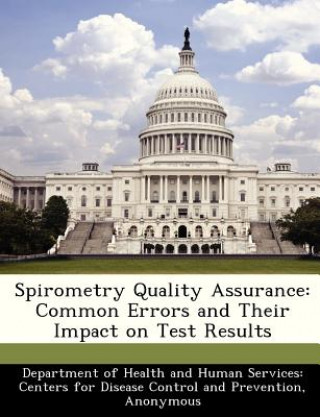
Code: 08258294
Spirometry Quality Assurance
by Department of Health and Human Services, National Institute for Occupational Safe
Spirometry is the most common pulmonary function test (PFT) and it plays a central role in occupational respiratory disease surveillance programs. Accurate spirometry testing, interpretation, and follow-up are critical to effectiv ... more


- Language:
 English
 - Binding: Paperback
- Number of pages: 38
Publisher: Bibliogov, 2013
- More about this

15.44 €
RRP: 15.80 €
You save 0.36 €

In stock at our supplier
Shipping in 9 - 15 days
You might also like
-

Small Pleasures Of Life
13.72 € -19 % -

Pro C# 7
49.16 € -24 % -

PUS Zestaw kontrolny PUS
12.91 € -

Entity Framework 6 Recipes
65.42 € -9 % -

Don Camillo und Peppone - Der Häuptling, der vom Himmel fiel
12.71 € -16 % -

How to Be a Founder
15.74 € -15 % -

Game Guide of Solo Leveling Arise Overdrive
14.02 € -7 % -

Mezi setbou a sklizní
8.47 € -16 % -

Future Directions of Nonlinear Dynamics in Physical and Biological Systems
205.36 € -7 % -
Spirometry
26.85 € -6 % -

Operaciones básicas y servicios en bar y cafetería
36.54 € -

Day My Fart Followed Santa Up The Chimney
14.02 € -7 % -
Spirometry Testing in Occupational Health Programs: Best Practices for Healthcare Professionals
14.93 € -6 % -

Oxford Handbook of Deaf Studies, Language, and Education, Vol. 2
191.13 € -

Macbeth, Macbeth
16.65 € -1 % -

Tu palabra es el amor
21.60 € -

Married Life
28.26 € -

Catarino Garza's Revolution on the Texas-Mexico Border
41.08 € -

Droit des sociétés DCG Epreuve 2 Corrigés des applications 2017
23.01 € -

Purse and the Sword
127.51 € -

A-Z musical instruments: Learning the ABC with the help of the musical instruments of the world (musical alphabet) (A-Z early learning Book 1)
9.38 € -6 % -

Delivering Successful Projects with TSP(SM) and Six Sigma
83.59 € -

The Exterior of the Great Pyramid: An Altar to the Lord in the Midst of the Land of Egypt
17.46 € -2 % -

CATALOGUE OF A PART OF THE LIBRARY OF TH
28.26 € -1 % -

El final del Gallo Negro
19.28 € -

Niosh Spirometry Training Guide
25.33 € -2 % -

Miscues Not Mistakes: Reading Assessment in the Classroom
59.36 € -

What Does It Do? Crane
23.11 € -24 % -

650 - The Sound of Music: True Stories of Beats, Bach, and The Beatles
9.78 € -6 % -

Rights and Urban Controversies in Hong Kong
123.27 € -7 % -

Why Won't the Courts Give Kids a Shot?
48.86 € -14 % -

BIZANCIO
29.47 € -

Performatives Lehren Lernen Forschen - Performative Teaching Learning Research
15.24 € -16 % -

Five Streams of Blessing: The Overview
9.78 € -6 % -

Through the Eyes of a Child
7.76 € -2 %
Give this book as a present today
- Order book and choose Gift Order.
- We will send you book gift voucher at once. You can give it out to anyone.
- Book will be send to donee, nothing more to care about.
More about Spirometry Quality Assurance
You get 37 loyalty points
 Book synopsis
Spirometry is the most common pulmonary function test (PFT) and it plays a central role in occupational respiratory disease surveillance programs. Accurate spirometry testing, interpretation, and follow-up are critical to effective screening and surveillance of workers exposed to respiratory hazards and to the management of patients in the clinical setting.Spirometry quality assurance includes examination of test values and evaluation of both the volume-time and flow-volume curves for evidence of technical errors. Technically poor spirometry may have little value and may even provide misleading information. When erroneous curves are detected, additional maneuvers are often needed. During testing, technicians should attempt to record a valid test, which is composed of at least 3 acceptable maneuvers with consistent ("repeatable") results for both FVC and FEV1. Achieving repeatability during testing means that the difference between the largest and second largest values for both FVC and for FEV1 are within 0 .15 l (150 ml). Additional maneuvers can be attempted, up to a maximum of 8, to meet these criteria for a valid test. Even tests that have 3 acceptable maneuvers of which at least 2 are repeatable may not represent an individual's maximum effort. Ideally, there should be 3 maximal effort curves with the same size and shape.
Book details
Book category Books in English Society & social sciences Politics & government
15.44 €
- Full title: Spirometry Quality Assurance
- Subtitle: Common Errors and Their Impact on Test Results
- Author: Department of Health and Human Services, National Institute for Occupational Safe
- Language: English
- Binding: Paperback
- Number of pages: 38
- EAN: 9781288501571
- ISBN: 9781288501571
- ID: 08258294
- Publisher: Bibliogov
- Weight: 86 g
- Dimensions: 246 × 189 × 2 mm
- Date of publishing: 02. January 2013
Trending among others
-

The Wretched of the Earth
10.39 € -30 % -

Politics: A Very Short Introduction
9.99 € -24 % -

Maestro
15.34 € -18 % -

Workers' Councils
13.42 € -24 % -

Fugitive Days
17.56 € -10 % -

Without You, There Is No Us
16.04 € -29 % -

Flash Boys - A Wall Street Revolt
12.51 € -29 % -

Children of the Matrix
12.81 € -39 % -

The Trigger
21.40 € -27 % -

State and Revolution
7.26 € -24 % -

Master of the Senate
18.27 € -24 % -

Politically Incorrect Guide to Islam (And the Crusades)
16.15 € -25 % -

Undercommons
19.17 € -24 % -

Case Against the Sexual Revolution
14.73 € -25 % -

Xi Jinping: The Governance of China
25.13 € -15 % -

City of Quartz
15.74 € -15 % -

Values
16.15 € -7 % -

Yoga of Eating
10.59 € -25 % -

Against Civilization
12.01 € -25 % -

Every Man A King
19.88 € -18 % -

My Autobiography
11.30 € -24 % -

Devil's Knot
14.02 € -25 % -

The Lords of Poverty: The Power, Prestige, and Corruption of the International Aid Business
12.71 € -25 % -

American Lion
26.65 € -27 % -

No Turning Back
11 € -30 % -

Lineages of Modernity - A History of Humanity from the Stone Age to Homo Americanus
72.38 € -4 % -

Political Masculinity: How Incels, Fundamentalists and Authoritarians Mobilise for Patriarchy
17.15 € -26 % -

International Relations Since 1945
55.42 € -

Woman's Work
13.92 € -24 % -

The Red Army Faction: a Documentary History
25.03 € -25 % -

Control of Air Pollution from Aircraft and Aircraft Engines
15.44 € -2 % -

Mice;Int Pol Science Afric Pr
11.50 € -10 % -

Lee Kuan Yew
18.06 € -27 % -

Sandworm
23.31 € -25 % -

Time for a Turning Point
20.99 € -24 % -

Alien Agenda
14.02 € -25 % -

Nuclear Weapons and Foreign Policy
18.37 € -18 % -

Out of the Wreckage
11.50 € -19 % -

Strangers In Their Own Land
24.42 € -20 % -

STRANGE DEATH OF EUROPE
14.83 € -24 % -

Political Brain
16.04 € -24 % -

Palestine Peace Not Apartheid. Palästina, Frieden, nicht Apartheid, English Edition
13.42 € -24 % -

Report From Iron Mountain
11.60 € -18 % -

Thomas Sowell Reader
25.03 € -25 % -

Weapons of the Weak
20.28 € -24 % -

Authoritarian Dynamic
25.03 € -25 % -

Decadent Society
12.71 € -25 % -

Kennedys - After Camelot
17.86 € -23 % -

Geometry of Imperialism
19.88 € -18 %
Collection points Bratislava a 12824 dalších
Copyright ©2008-26 najlacnejsie-knihy.sk All rights reservedPrivacyCookies

 25652 collection points
 Delivery 2.99 €
 02/210 210 99 (8-15.30h)