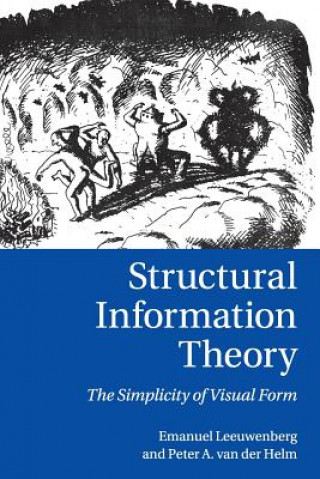
Code: 09219355
Structural Information Theory
by Emanuel L. J. Leeuwenberg, Peter A. van der Helm
Structural information theory is a coherent theory about the way the human visual system organises a raw visual stimulus into objects and object parts. To humans, a visual stimulus usually has one clear interpretation even though, ... more


- Language:
 English
 - Binding: Paperback
- Number of pages: 340
Publisher: Cambridge University Press, 2015
- More about this


You might also like
-

Pexeso na cesty s omalovánkami Farma
3.83 € -33 % -

Easy Book On How To Build a Tube Amp 1 Watt To 75 Watt: Easy Book On How To Build a Tube Amp 1 Watt To 75 Watt
10.60 € -7 % -

LEGO Harry Potter - Mágikus kincstár
26.05 € -

Paula
11.81 € -

Disturbing Beauty
15.75 € -15 % -

Aperture 234: Earth
22.82 € -9 % -

Chléb a koláče pro štíhlejší postavu
9.89 € -31 % -

The Bronze Age: Bronze & Ancient Civilizations
18.27 € -7 % -

Becoming Neolithic
56.66 € -

Lecons Theoriques Et Cliniques Sur La Syphilis Et Les Syphilides. 2e Edition
30.70 € -

Gedichte
20.50 € -11 % -

Deutsche Grammatik
28.48 € -11 % -

Product Management
52.82 € -

Professor Bloomer's No-Nonsense First Phonetic Reader: Teacher's Guide
8.07 € -7 % -

Secrets of Outstanding Persons
26.66 € -

Introducing the New Testament - Leader's Guide
14.94 € -6 % -

Písničky Malý čtenář
4.74 € -13 % -

Cybersecurity in the Transportation Industry
191.10 € -10 % -

Doteky zabitých
13.73 € -16 % -

Abandoned Industries of New York City: From Rust to Retail and Recreation
19.48 € -22 % -

From Birth to Bridal.
23.53 € -25 %
Give this book as a present today
- Order book and choose Gift Order.
- We will send you book gift voucher at once. You can give it out to anyone.
- Book will be send to donee, nothing more to care about.
More about Structural Information Theory
You get 113 loyalty points
 Book synopsis
Structural information theory is a coherent theory about the way the human visual system organises a raw visual stimulus into objects and object parts. To humans, a visual stimulus usually has one clear interpretation even though, in theory, any stimulus can be interpreted in numerous ways. To explain this, the theory focuses on the nature of perceptual interpretations rather than on underlying process mechanisms and adopts the simplicity principle which promotes efficiency of internal resources rather than the likelihood principle which promotes veridicality in the external world. This theoretically underpinned starting point gives rise to quantitative models and verifiable predictions for many visual phenomena, including amodal completion, subjective contours, transparency, brightness contrast, brightness assimilation and neon illusions. It also explains phenomena such as induced temporal order, temporal context effects and hierarchical dominance effects, and extends to evaluative pattern qualities such as distinctiveness, interestingness and beauty.
Book details
Book category Books in English Society & social sciences Psychology Cognition & cognitive psychology
46.76 €
- Full title: Structural Information Theory
- Subtitle: The Simplicity of Visual Form
- Author: Emanuel L. J. Leeuwenberg, Peter A. van der Helm
- Language: English
- Binding: Paperback
- Number of pages: 340
- EAN: 9781107531758
- ISBN: 1107531756
- ID: 09219355
- Publisher: Cambridge University Press
- Weight: 490 g
- Dimensions: 230 × 154 × 24 mm
- Date of publishing: 02. July 2015
Trending among others
-

Thinking, Fast and Slow
15.95 € -25 % -

Thinking, Fast and Slow
15.04 € -26 % -
How Emotions Are Made
12.62 € -7 % -

The Art of Thinking Clearly
9.28 € -24 % -

Courage to Create
11.30 € -24 % -

Gift of Fear
23.73 € -17 % -
Eye and Brain
22.41 € -5 % -

Detecting Lies and Deceit - Pitfalls and Opportunities 2e
60.90 € -10 % -

Art of Memory
37.06 € -

Memory: A Very Short Introduction
9.99 € -24 % -

Gödel, Escher, Bach
18.07 € -25 % -

The Paradox of Choice
15.55 € -16 % -

250 Brief, Creative & Practical Art Therapy Techniques250 Brief, Creative & Practical Art Therapy Techniques
26.45 € -25 % -

Shadows Of The Mind
15.95 € -25 % -

Risk Savvy
12.21 € -17 % -
Frames of Mind
18.27 € -24 % -

Love & Will
13.42 € -24 % -
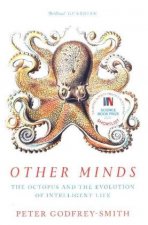
Other Minds
11.51 € -22 % -

Ego and the Id - First Edition Text
6.86 € -

Getting Started with EEG Neurofeedback
54.13 € -5 % -

WHY WE LOVE
15.44 € -25 % -
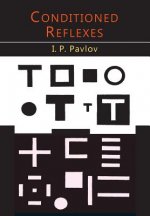
Conditioned Reflexes
19.38 € -
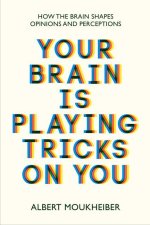
Your Brain Is Playing Tricks On You
18.48 € -

Meme Machine
15.04 € -20 % -

Zig Zag - The Surprising Path to Greater Creativity
25.34 € -19 % -
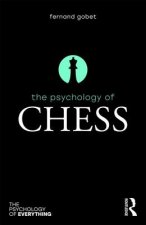
Psychology of Chess
20.29 € -

Uses of Argument
38.27 € -
Theory of Cognitive Dissonance
37.77 € -

Judgment under Uncertainty
65.95 € -

Medieval Craft of Memory
31.10 € -6 % -

Choices, Values, and Frames
102.62 € -

Consciousness Speaks
22.92 € -2 % -

LSD, Spirituality and the Creative Process
18.07 € -9 % -

Mind's Staircase
54.64 € -

Views into the Chinese Room
86.46 € -
Multiple Intelligences
21.20 € -

Trauma and Memory
10.80 € -49 % -

How We Learn
14.43 € -29 % -

Biggest Bluff
9.69 € -29 % -

Theory of Human Motivation
5.65 € -17 % -
On Creativity
26.86 € -4 % -

Where Good Ideas Come From
11.10 € -29 % -

Power of Mindful Learning
14.03 € -25 % -

Hare Brain, Tortoise Mind
16.15 € -17 % -
Mind in Motion
27.97 € -27 % -

Trust the Process
16.76 € -25 % -
Noise
24.43 € -
Enigma of Reason
13.53 € -14 % -
Chaos, Creativity, and Cosmic Consciousness
12.92 € -23 %
Collection points Bratislava a 12824 dalších
Copyright ©2008-26 najlacnejsie-knihy.sk All rights reservedPrivacyCookies

 25652 collection points
 Delivery 2.99 €
 02/210 210 99 (8-15.30h)