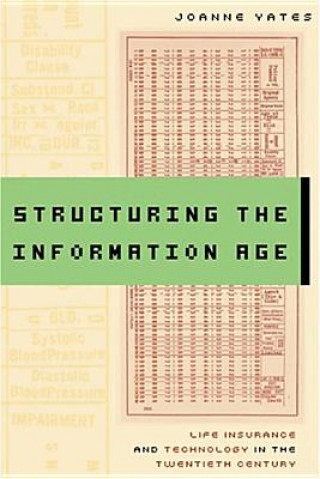
Code: 04709530
Structuring the Information Age
by JoAnne Yates
Structuring the Information Age provides insight into the largely unexplored evolution of information processing in the commercial sector and the underrated influence of corporate users in shaping the history of modern technology. ... more


- Language:
 English
 - Binding: Hardback
- Number of pages: 364
Publisher: Johns Hopkins University Press, 2005
- More about this

64.59 €

Low in stock at our supplier
Shipping in 11 - 15 days
Potřebujete více kusů?Máte-li zájem o více kusů, prověřte, prosím, nejprve dostupnost titulu na naši zákaznické podpoře.
Add to wishlist
You might also like
-

Ian
60.95 € -27 % -

Going Deeper with Biblical Hebrew: An Intermediate Study of the Grammar and Syntax If the Old Testament
35.47 € -24 % -

Slouching Towards Utopia
16.97 € -20 % -

Zábudlivé Ginko
9.19 € -28 % -

Green Voices: Understanding Contemporary Nature Poetry
17.68 € -6 % -

North Korean Ideology
115.64 € -

Beginning HCL Programming
35.47 € -24 % -

Venus as a Boy
22.13 € -

Restituta; Or, Titles, Extracts, and Characters of Old Books in English Literature, Revived Volume 3
38.20 € -1 % -

Controversies in Clinical Thyroidology
90.87 € -

Ecologies of the Moving Image
59.64 € -

Emotional Intelligence
14.04 € -25 % -

Tolerance Trap
117.46 € -

Optimisation Du Plan D Exploitation d'Une Carri re de Cimenterie
58.73 € -14 % -

SOM journal 3
32.34 € -

A Very Beary Christmas
9.80 € -6 % -

ICT and Language Learning
53.37 € -
![La Geva, E Una Canzone Inedita, E Il Torricello a Geva [ed. by Z]....](https://media.libris.to/jacket/16966641t.jpg "La Geva, E Una Canzone Inedita, E Il Torricello a Geva [ed. by Z]....")
La Geva, E Una Canzone Inedita, E Il Torricello a Geva [ed. by Z]....
13.23 € -25 % -

Rhetoric and Reality in Early Modern Spain
125.95 € -

Success in Sight
101.89 € -

Reading Fluency
28.40 €
Give this book as a present today
- Order book and choose Gift Order.
- We will send you book gift voucher at once. You can give it out to anyone.
- Book will be send to donee, nothing more to care about.
More about Structuring the Information Age
You get 156 loyalty points
 Book synopsis
Structuring the Information Age provides insight into the largely unexplored evolution of information processing in the commercial sector and the underrated influence of corporate users in shaping the history of modern technology. JoAnne Yates examines how life insurance firms-where good record-keeping and repeated use of massive amounts of data were crucial-adopted and shaped information processing technology through most of the twentieth century. The book analyzes this process beginning with tabulating technology, the most immediate predecessor of the computer, and continuing through the 1970s with early computers. Yates elaborates two major themes: the reciprocal influence of information technology and its use, and the influence of past practices on the adoption and use of new technologies. In the 1950s, insurance industry leaders recognized that computers would enable them to integrate processes previously handled separately, but they also understood that they would have to change their ways of working profoundly to achieve this integration. When it came to choosing equipment and applications, most companies ultimately preferred a gradual, incremental migration to an immediate and radical transformation. In tracing this process, Yates shows that IBM's successful transition from tabulators to computers in part reflected that vendor's ability to provide large customers such as insurance companies with the necessary products to allow gradual change. In addition, this detailed industry case study helps explain information technology's so-called productivity paradox, showing that firms took roughly two decades to achieve the initial computerization and process integration that the industry set as objectives in the 1950s.
Book details
64.59 €
- Full title: Structuring the Information Age
- Subtitle: Life Insurance and Technology in the Twentieth Century
- Author: JoAnne Yates
- Language: English
- Binding: Hardback
- Number of pages: 364
- EAN: 9780801880865
- ISBN: 0801880866
- ID: 04709530
- Publisher: Johns Hopkins University Press
- Weight: 635 g
- Dimensions: 229 × 152 × 30 mm
- Date of publishing: 15. June 2005
Trending among others
-

Market Wizards
21.62 € -22 % -

How to Make Money in Stocks
17.58 € -24 % -

Fooled by Randomness
13.84 € -20 % -

The Little Book That Still Beats the Market
20.31 € -24 % -

Study Guide to Technical Analysis of the Financial Markets
27.99 € -27 % -

The Alchemy of Finance
20.51 € -24 % -

Financial Intelligence for Entrepreneurs
23.04 € -25 % -

What Every Real Estate Investor Needs to Know About Cash Flow... And 36 Other Key Financial Measures, Updated Edition
21.73 € -24 % -

The Snowball
19.80 € -17 % -

New Market Wizards
13.33 € -29 % -

Most Important Thing Illuminated
21.62 € -25 % -

Security Analysis: The Classic 1940 Edition
51.95 € -24 % -

Trading Price Action Trends: Technical Analysis of Price Charts Bar by Bar for the Serious Trader
53.97 € -25 % -

Intelligent Investor
24.66 € -30 % -
Art of Execution
21.22 € -24 % -

How to Speak Money
20.92 € -22 % -

Dividends Still Don't Lie
26.48 € -25 % -

Art and Science of Technical Analysis - Market Structure, Price Action, and Trading Strategies
68.73 € -26 % -

Common Stocks and Uncommon Profits and Other Writings
20.51 € -24 % -

House of Morgan
17.58 € -24 % -

House of Rothschild
19 € -29 % -

Expected Returns - An Investor's Guide to Harvesting Market Rewards
60.75 € -10 % -

Complete TurtleTrader
13.94 € -24 % -

How to Trade In Stocks
20.31 € -24 % -

Learn to Earn
14.04 € -25 % -

Reminiscences of a Stock Operator
17.78 € -29 % -

House of Rothschild
19.80 € -33 % -

Reminiscences of a Stock Operator, Annotated Edition - With New Commentary and Insights on the Life and Times of Jesse Livermore
30.01 € -26 % -

Systematic Trading
47.30 € -24 % -

Little Book That Builds Wealth - The Knockout Formula for Finding Great Investments
20.31 € -24 % -

Option Volatility and Pricing: Advanced Trading Strategies and Techniques
92.79 € -29 % -

New Trading for a Living - Psychology, Discipline, Trading Tools and Systems, Risk Control and Trade Management
57.92 € -25 % -

Jesse Livermore - World's Greatest Stock Trader
23.04 € -25 % -

Options, Futures, and Other Derivatives, Global Edition
80.46 € -14 % -

When Genius Failed
11.01 € -25 % -

Daily Trading Coach - 101 Lessons for Becoming Your Own Trading Psychologist
33.45 € -26 % -

Mind Over Markets, Updated Edition - Power Trading with Market Generated Information
51.95 € -24 % -

Rich Dad's Guide to Investing
14.75 € -25 % -
Algorithmic Trading + Website - Winning Strategies and Their Rationale
55.19 € -26 % -

Elliott Wave Principle - Key to Market Behavior
52.66 € -10 % -
Getting Started in Chart Patterns
20.51 € -26 % -

Den of Thieves
15.96 € -25 % -

Trades About to Happen - A Modern Adaptation of the Wyckoff Method
53.37 € -24 % -

Fundamentals of Investing, Global Edition
27.99 € -69 % -

Evaluation and Optimization of Trading Strategies 2e
76.72 € -25 % -

Stan Weinstein's Secrets For Profiting in Bull and Bear Markets
18.29 € -24 % -

Value Investing - From Graham to Buffett and Beyond, Second Edition
26.78 € -24 % -

Trade Your Way to Financial Freedom
29.91 € -25 % -

ABCs of Real Estate Investing
17.28 € -28 %
Collection points Bratislava a 13265 dalších
Copyright ©2008-26 najlacnejsie-knihy.sk All rights reservedPrivacyCookies

 26534 collection points
 Delivery 2.99 €
 02/210 210 99 (8-15.30h)