Code: 01614807
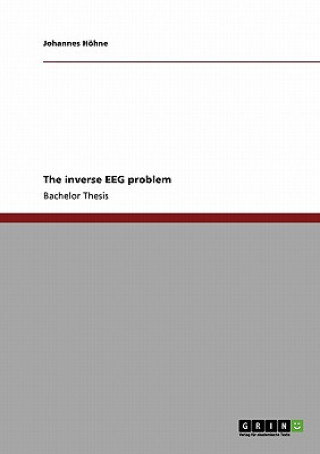
The inverse EEG problem
by Johannes Höhne
Bachelor Thesis from the year 2007 in the subject Computer Science - Miscellaneous, grade: 1.0, Free University of Berlin (Institute of Mathematics and Informatics, Department Bioinfomatics), 37 entries in the bibliography, langua ... more


- Language:
 English
 - Binding: Paperback
- Number of pages: 68
Publisher: Grin Verlag, 2008
- More about this

38.33 €
RRP: 44.97 €
You save 6.64 €

In stock at our supplier
Shipping in 5 - 8 days
You might also like
-

Normal People
9.50 € -23 % -

Metamorphosis
11.83 € -13 % -

Systems Performance
58.76 € -14 % -

In The Miso Soup
10.11 € -29 % -

Mermaid Tarot
23.26 € -26 % -

I Stay Calm. I Wait My Turn!
10 € -24 % -

Reflected in You
14.05 € -25 % -

Around the World in 80 Trees
27.91 € -10 % -

Plataea 479 BC
20.52 € -14 % -

The Summons
9.70 € -9 % -

First Reading Flashcards
5.35 € -55 % -

Annie Besant - Autobiografía
28.01 € -9 % -

Principles of Marketing
252.58 € -

The Shrinking Goddess
19.31 € -19 % -

The Dance of Mayan Energies
20.93 € -6 % -

Lucarne
25.28 € -

The Tarkakaumudi: Being An Introduction To The Principles Of The Vaisheshika And The Nyaya Philosophies (1886)
20.22 € -1 % -

Intangible Heritage and the Museum
216.06 € -

Graphing Story Problems
12.03 € -9 % -

My Life's Journey
20.32 € -

Handbuch Pflanzenschutz im Biogarten
37.72 € -16 %
Give this book as a present today
- Order book and choose Gift Order.
- We will send you book gift voucher at once. You can give it out to anyone.
- Book will be send to donee, nothing more to care about.
More about The inverse EEG problem
You get 93 loyalty points
 Book synopsis
Bachelor Thesis from the year 2007 in the subject Computer Science - Miscellaneous, grade: 1.0, Free University of Berlin (Institute of Mathematics and Informatics, Department Bioinfomatics), 37 entries in the bibliography, language: English, abstract: Abstract:The inverse EEG problem is a well-studied, ill-posed problem in mathematics and neuroinformatics. Given a record of a limited number of electrodes (e.g. 21) that are placed on scalp, it is the task to estimate a three dimensional distribution of neural currents in the brain. The actual thesis deals with this problem and proposes a propabilistic Bayesian approach that assumes the distribution of neural currents to be heterogeneous - active and inactive regions in the brain are expected. This can be formalized with a mixture distribution. Furthermore, an expectation-maximization (EM) algorithm is presented that performs simultaneous classification and computation of neural currents, given an EEG measurement.Zusammenfassung:Diese Bachelorarbeit thematisiert das inverse EEG Problem. Dies ist ein umfangreich beschriebenes, schlecht gestelltes mathematisches Problem in der medizinischen Visualisierung. Bei einer EEG-Messung werden eine bestimmte Anzahl (z.B. 21) Elektroden an der Kopfhaut angebracht und elektrische Ströme dort detektiert. Das hier beschriebene Problem besteht darin, aus dieser Messung eine dreidimensionales Verteilung neuronaler Gehirnströme zu rekonstruieren. Es wird ein propabilistischer Bayesianischer Ansatz vorgestellt, um dieses Problem zu lösen. Dabei wird angenommen, dass die Verteilung neuronaler Ströme heterogen ist - es gibt aktive und nicht-aktive Bereiche im Gehirn. Dies wird mathematisch mit einer Mischverteilung formalisiert. Dieser Ansatz ermöglicht Gehirnströme sowohl zu berechnen, also auch zu klassifizieren. Ein entsprechender EM Algorithmus, der dies simultan durchführt, wird vorgestellt.
Book details
Book category Books in English Law Laws of Specific jurisdictions Wills & probate / Succession
38.33 €
- Full title: The inverse EEG problem
- Author: Johannes Höhne
- Language: English
- Binding: Paperback
- Number of pages: 68
- EAN: 9783640185238
- ISBN: 3640185234
- ID: 01614807
- Publisher: Grin Verlag
- Weight: 112 g
- Dimensions: 210 × 148 × 5 mm
- Published: 2008
Trending among others
-
Dilemmas of Family Wealth - Insights on Succession, Cohesion, and Legacy
35.50 € -24 % -

Succession, Wills and Probate
81.83 € -

Ancient, Curious and Famous Wills
34.48 € -

How to Plan and Settle Estates
15.77 € -9 % -

Erbrecht
26.09 € -7 % -

Dynamics, Magnitude and Scope of MRSA Health Care Associated Infection Concomitant with the Politics in the NHS on the Health Act 2006
16.18 € -14 % -
Ancient, Curious, and Famous Wills (1911)
41.77 € -2 % -

Wills, Trusts, and Estates Administration
182.17 € -

How to Put Your Assets in Trust, Even in Wills!
18.10 € -

Das richtige Testament für Geschiedene und Patchworkfamilien
19.51 € -7 % -

EU Succession
363.85 € -5 % -

Practice Notes on Wills
60.99 € -

Complete Guide to Trust & Estate Management
18.60 € -9 % -

Magnetically Targeted Drug Delivery System
25.08 € -14 % -

Current Issues in Succession Law
134.12 € -
Orthopaedic problems, physiologic disorders and disease with spine, arms and legs
14.46 € -14 % -

Die Testamentsvollstreckung
65.14 € -6 % -

Fathers of Conscience
100.03 € -

Death, Money and the Vultures (Routledge Revivals)
18.30 € -

Fathers of Conscience
37.62 € -

Practitioner's Guide to Probate and the Administration of Estates
130.58 € -

Handbuch Verlassenschaftsverfahren
124.82 € -

Die Vollmacht vor und nach dem Erbfall
46.32 € -6 % -

Ancient, Curious and Famous Wills (1911)
36.41 € -2 % -

Law of Succession in South Africa
40.76 € -

Der Erbnachweis gegenüber Kreditinstituten in der Dogmatik des deutschen Privatrechts
75.25 € -6 % -

Understanding Your Living Will
11.02 € -21 % -

Internationales Erbrecht
124.11 € -7 % -

Perfect Last Impression
14.05 € -25 % -

Probate Wars of the Rich and Famous
21.64 € -25 % -

Parry and Kerridge: The Law of Succession
50.67 € -

Die Doppelausschlagung werthaltiger Nachlässe im Namen des Minderjährigen als Instrument zur Lenkung der Erbrechtsnachfolge
137.97 € -

Vorsorge - Ein notwendiges Übel?!
13.54 € -10 % -

Wills, Trusts, and Estate Administration
180.35 € -14 % -

Die angemessene Vergütung des Testamentsvollstreckers nach § 2221 BGB
95.38 € -7 % -

Zum Schutz der überlebenden Ehefrau
138.47 € -7 % -

Das aktuelle Erbrecht
15.26 € -10 % -

Das sogenannte Supervermächtnis
42.68 € -10 % -

Deathbed Gifts
89.31 € -

Death, Deeds, and Descendents
66.85 € -

What Every Future Widow Should Know
21.94 € -2 % -
Haematology Practice In Distressed Economy
14.46 € -14 % -

Non-Contentious Probate Practice in the English Speaking Caribbean
48.24 € -

Das Benachrichtigungsverfahren in Nachlasssachen
94.07 € -6 % -

My Lifeprint
23.86 € -1 % -

Everything Executor and Trustee Book
18.10 € -9 % -

Tristram and Coote's Probate Practice
1121.42 € -5 % -

Love & Money
20.12 € -25 % -

Probate Handbook
45.41 € -4 %
Collection points Bratislava a 12892 dalších
Copyright ©2008-26 najlacnejsie-knihy.sk All rights reservedPrivacyCookies

 25788 collection points
 Delivery 2.99 €
 02/210 210 99 (8-15.30h)