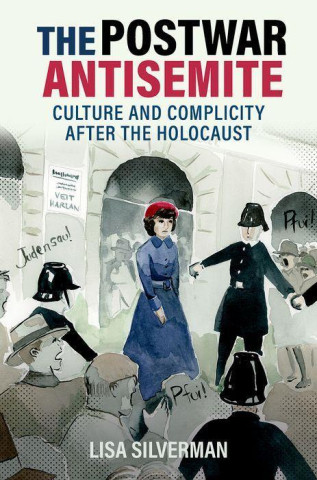
Code: 48387985
The Postwar Antisemite
by Silverman, Lisa (Professor of History and Jewish Studies, Professor of History and Jewish Studies, University of Wisconsin-Milwaukee)
In his influential Anti-Semite and Jew, French philosopher Jean-Paul Sartre observed "If the Jew did not exist, the anti-Semite would invent him." In doing so he articulated the figure of an Antisemite responsible for imagining th ... more


- Language:
 English
 - Binding: Hardback
- Number of pages: 352
Publisher: Oxford University Press, 2025
- More about this


You might also like
-

Prisoners of Geography
11.19 € -17 % -

Wędrówka dusz
11.50 € -15 % -

Italian Workbook For Dummies, 2nd Edition
15.13 € -26 % -

Dom Casmurro
11.80 € -25 % -

Schindler
14.62 € -15 % -

The Lack of Light: A Novel of Georgia
20.98 € -29 % -

Seeking Wisdom
18.76 € -22 % -

Fallout: The Official Tiny Tarot Deck and Guidebook
16.14 € -20 % -

Farmlife
47.02 € -

Coloriage mystère Fabuleux paysages
19.87 € -

Tinkerbell, Besuche die Welt der Feen, 1 DVD
10.49 € -

Kulturowa historia alkoholu
20.18 € -12 % -

Wo ist Bommel? (2. Klasse)
8.27 € -8 % -

Te llamare Viernes
21.29 € -

Langenscheidt Diccionario Básico Francés
13.72 € -4 % -

Steuern beim Erben und Schenken
55.50 € -6 % -

Royal Witches
27.04 € -10 % -

Chanteuse du Cotentin
19.47 € -

Melzo E Gorgonzola E Loro Dintorni
20.07 € -25 % -

Passion for Facts
93.55 € -

Teaching Spelling
167.03 €
Give this book as a present today
- Order book and choose Gift Order.
- We will send you book gift voucher at once. You can give it out to anyone.
- Book will be send to donee, nothing more to care about.
More about The Postwar Antisemite
You get 92 loyalty points
 Book synopsis
In his influential Anti-Semite and Jew, French philosopher Jean-Paul Sartre observed "If the Jew did not exist, the anti-Semite would invent him." In doing so he articulated the figure of an Antisemite responsible for imagining the Jew in a formulation that has lasted for decades. This figure became an indispensable trope in the period immediately after the war. It enabled Germans and Austrians to navigate a radically changed political and cultural landscape and reestablish lives upended by war by denying complicity in perpetuating antisemitic ideology. The deeply ingrained cultural practices that formed the basis for age-old prejudices against Jews persisted via coded references, taking new forms, and providing fertile ground for explicit eruptions. Decades before the Nazi persecution of the Jews would emerge as a master moral paradigm of evil in popular culture, the constructed Antisemite became part of a forceful narrative structure that allowed stereotypes about Jews to persist, even as explicit antisemitism became taboo. Lisa Silverman examines the crucial development and implications of the figural Antisemite in a range of trials, films, and texts during the first years after the end of the Second World War. She argues that, in their economically shattered, emotionally exhausted, and culturally impoverished postwar world, Austrians, Germans, and others used the Antisemite as a way to come to terms with their altered circumstances and to shape new national self-understandings. A readily recognizable and easily adaptable figure of evil, the Antisemite loomed large as a powerful and persistent trope in a wide range of artistic and cultural narratives. As a figure onto which to project or imagine as a source of the hatred of Jews, the Antisemite allowed audiences to avoid facing the implications of crimes committed by the Nazis and their accomplices and to deny the endurance of widespread and often coded antisemitic prejudices. In postwar Europe, where everyone looked to blame others for the murder and dispossession of the Jewish population, the authority to define the Antisemite as a receptacle for explicit Jew-hatred became a powerful force.As The Postwar Antisemite argues, antisemitism as a hidden code gained new force, packing stronger, more effective punches and affording its users more power. This era is critical to understanding ongoing struggles over the authority to set the parameters of antisemitism and the power and persistence of this hatred in society.
Book details
Book category Books in German Geisteswissenschaften, Kunst, Musik Religion/Theologie Bibelausgaben Textausgaben, Konkordanzen
37.74 €
- Full title: The Postwar Antisemite
- Author: Silverman, Lisa (Professor of History and Jewish Studies, Professor of History and Jewish Studies, University of Wisconsin-Milwaukee)
- Language: English
- Binding: Hardback
- Number of pages: 352
- EAN: 9780197697726
- ISBN: 0197697720
- ID: 48387985
- Publisher: Oxford University Press
- Weight: 643 g
- Date of publishing: 18. August 2025
Trending among others
-

Dialing God
13.11 € -7 % -

The Torah
30.97 € -1 % -

Книга Зоар
25.73 € -25 % -

Dosahovani Vyssich SvĚtŮ
17.05 € -24 % -

Creating a Life That Matters: How to Live and Love with Meaning and Purpose
21.69 € -7 % -

Kabbalah for Beginners
9.78 € -6 % -

Mystical Qabalah
12.10 € -1 % -

Die Bibel. Großdruck. Mit Familienchronik
33.60 € -16 % -

The Zohar Volume 6
38.65 € -18 % -

Metodika Integralni Vychovy
12 € -20 % -

Основы Каббалы
25.02 € -25 % -

Jewish History, Jewish Religion, the Weight of 3000 Years
20.18 € -2 % -

The Book of the Shulchan Aruch
19.17 € -7 % -

The Zohar Volume 5
38.65 € -18 % -

Наука Каббала т.1
25.02 € -25 % -

The Zohar Volume 10
48.03 € -1 % -

Книга Псалмов
11.29 € -25 % -

Odhalena Kabala
9.98 € -24 % -

The Zohar Volume 9
38.65 € -18 % -

The Zohar Volume 23
46.21 € -2 % -

The Origins of Consciousness - Volume 1: The Study of Ten Luminous Emanations
31.08 € -6 % -

Brit Salom
25.93 € -1 % -

Wheels of a Soul
12.71 € -24 % -

Sefer Yetzirah: The Book of Formation
7.56 € -1 % -

Предисловие к Книге ЗОАР
21.69 € -24 % -

Каббала Для Начинающих / i
31.98 € -24 % -

The Jews and the Left
21.39 € -27 % -
Knowledge of HaShem
25.02 € -

Times of Elevation Volume 1
27.34 € -18 % -

Rosh Hashanah with Uncle Max
9.88 € -14 % -

Sefer Ha-Temuna
20.38 € -

Kniha Zohar
44.40 € -2 % -

Die Bibel - Altes und Neues Testament (Cabra-Lederausgabe)
14.42 € -15 % -
Samati (Slysel Jsem)
16.14 € -25 % -

Учение Десяти Сфирот
18.26 € -24 % -

Torah in English complete
13.11 € -33 % -

Jews vs. Rome
11.80 € -25 % -

Sigmund Freud and the Jewish Mystical Tradition
28.45 € -

Die Bibel, Lutherübersetzung revidiert 2017 - Standardausgabe schwarz
23.61 € -16 % -

Die Bibel. Mit Sonderseiten für junge Menschen.
21.08 € -16 % -

The Koren Shalem Humash with Rashi and Onkelos
36.83 € -28 % -

Die Bibel (blau)
10.08 € -4 % -

Navzdy Se Mnou
11.29 € -25 % -

Kabala Pro Zacatecniky
18.26 € -24 % -

Being Jewish After the Destruction of Gaza
18.76 € -29 % -
The Koren Tefilla Siddur, Ashkenaz, Pocket
11.50 € -10 % -

Книга Зоар
33.40 € -24 % -

The Zohar Volume 11
50.76 € -1 % -

Kabbalah for Dummies
18.26 € -24 %
Collection points Bratislava a 12948 dalších
Copyright ©2008-26 najlacnejsie-knihy.sk All rights reservedPrivacyCookies

 25900 collection points
 Delivery 2.99 €
 02/210 210 99 (8-15.30h)