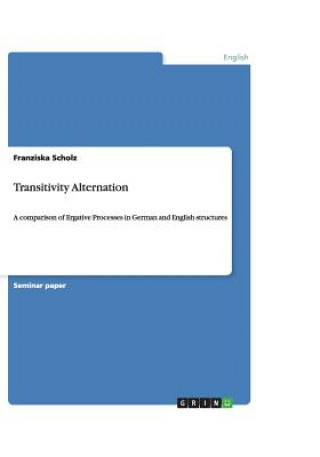
Code: 01627083
Transitivity Alternation
by Franziska Scholz
Seminar paper from the year 2009 in the subject English Language and Literature Studies - Linguistics, printed single-sided, grade: 1,0, University of Cologne (Englisches Seminar), course: Syntactic structures of English, language ... more


- Language:
 English
 - Binding: Paperback
- Number of pages: 24
Publisher: Grin Verlag, 2009
- More about this


You might also like
-

Red, White & Royal Blue: Collector's Edition
20.05 € -7 % -

Photography Storytelling Workshop
17.72 € -27 % -

Self-made Man
14.07 € -25 % -

Нелюбовь сероглазого короля (альтернативный 7БЦ)
15.79 € -12 % -

Długopis Round Stic niebieski pudełko 60 sztuk
16.40 € -8 % -

Mind Shift: Win the Battle in Your Head, Develop Mental Toughness, and Unlock Your Hidden Potential
16.91 € -24 % -

Tokyo Ever After
12.25 € -12 % -

City Hunter - Perfect Edition T01
22.78 € -

French Fun 1: Les petits jeux de Madame Ly
16.70 € -6 % -

Banksy Locations And Tours Vol.1
14.88 € -24 % -

The Other Side of San Diego
28.56 € -25 % -

International Support for Domestic Climate Policies in Developing Countries
78.50 € -

Republicanism, Communism, Islam
51.45 € -

Key Chain Baton - Personal Protection System
13.56 € -2 % -

Cash Flow und Cash Flow Statements im internationalen Vergleich
34.03 € -11 % -

L'usine automobile du Komsomol léniniste - AZLK
26.94 € -

Wireless Internet Crash Course
29.98 € -25 % -

Moleskine Sapphire Blue Pocket Ruled Notebook Hard
16.91 € -14 % -

Blood Will Out
10.02 € -24 % -

Surrey Colouring Book: Past and Present
10.83 € -24 % -
Inklusive Didaktik
18.02 € -11 % -

Wipeout! & Hanging Ten in Paris
14.07 € -7 % -

Dillman's Quadron
43.85 € -14 % -

Passos clinicos e impressoes em dentisteria protetica fixa - Um inquerito
43.85 € -14 % -

Stooges
37.27 € -6 % -

Zeit für Wirksamkeit
22.48 € -11 % -

Fakten uber Wirtschaft - Band 8 - Betriebswirtschaftslehre -
9.01 € -9 % -

Digitales Lehren und Lernen in der Praxis
16.20 € -11 % -

Thesaurus
48.21 € -

Mortgage disclosures: how do we cut red tape for consumers and small businesses?
20.96 € -6 % -
Pflegeplanung Inkontinenz (mit Falldarstellung)
14.48 € -10 % -

JUGENDLICHER, PILOT ODER PASSAGIER VON SEINEM ZIEL
35.75 € -11 % -

Oeuvres Completes de M. Necker. Tome 11
28.05 € -

KANPAI
14.78 € -25 % -

People Power: The Building of a New European Home
15.79 € -9 % -

Eszrevetelek A Miklosich Ferencz Ur Die Slavischen Elemente Im Magyarischen Czimu Konyvere (1887)
19.34 € -2 % -

Management of Severe Malnutrition
21.87 € -2 % -

The Railroad Trainman, Volume 22, Issue 9
17.52 € -2 % -

WHERE THERE IS NOTHING
30.99 € -2 % -

Ley de la Repulsion
15.19 € -6 % -

Bilanzielle Verbindlichkeiten Nach Hgb Und Us-GAAP
47.30 € -6 % -

de la Condition Et Des Droits Des Enfants Naturels
18.22 € -7 %
Give this book as a present today
- Order book and choose Gift Order.
- We will send you book gift voucher at once. You can give it out to anyone.
- Book will be send to donee, nothing more to care about.
More about Transitivity Alternation
You get 39 loyalty points
 Book synopsis
Seminar paper from the year 2009 in the subject English Language and Literature Studies - Linguistics, printed single-sided, grade: 1,0, University of Cologne (Englisches Seminar), course: Syntactic structures of English, language: English, abstract: The English grammar has many similarities with the grammar of German, since both have their roots in the Germanic languages. Therefore English and German share lexical and structural, but also semantic properties. In order to deepen one s understanding of these properties this paper will deal with differences and similarities of the English and German verb system. Transitivity alternation is based on the syntactic distinction of verbs that are divided into transtive and intransitive verbs. This paper deals with both verb categories, taking into account semantic matters as well. In English and in German a verb can express the way in which an action affects its object, which is part of the so-called ergative model. This model shall be introduced in Chapter 2 with examples of the English language. After the introduction to the usage of ergative verbs a comparison of English and German structures follows in Chapter 3. Mistakes of translation are often due to structural and semantic differences within the ergative model. English and German verbs do not always provide the same variety of possibilities to express an action, therefore it shall be shown in Chapter 3.1 in which language the verb system is more flexible in regards to ergative processes. Chapter 3.2 deals with morphosyntactic differences of German and English within the ergative model. As the German structure shows similarities as well as differences to the English verbs, an attempt is made in Chapter 4 to discover potential semantic distinctions within those German verbs that either differ or resemble the English structure.The aim of this paper is to bring out a comparison of the English and German language that gives an insight into their verb systems in regards to syntactic as well as semantic properties.
Book details
Book category Books in English Language Language: reference & general
16.20 €
- Full title: Transitivity Alternation
- Subtitle: A comparison of Ergative Processes in German and English structures
- Author: Franziska Scholz
- Language: English
- Binding: Paperback
- Number of pages: 24
- EAN: 9783640477715
- ISBN: 3640477715
- ID: 01627083
- Publisher: Grin Verlag
- Weight: 77 g
- Dimensions: 254 × 178 × 2 mm
- Date of publishing: 28. November 2009
Trending among others
-

Save the Cat! Writes a Novel
13.97 € -32 % -

MI6 Spy Skills for Civilians
12.86 € -25 % -

Japanese Stories for Language Learners
13.46 € -24 % -

Merriam-Webster s Advanced Learner's English Dictionary
23.09 € -24 % -

Egy Szo Mint Szaz: Magyar-Angol Tematikus Szokincstar / Hungarian-English Vocabulary by Topic
10.53 € -12 % -
Oxford A-Z of Grammar and Punctuation
10.83 € -24 % -

Doing Time Like a Spy
14.88 € -24 % -

Hallo, Itt Magyarorszag! (Hungarian for Foreigners). by Direct Method
11.54 € -12 % -

Remembering the Kanji 1
35.45 € -

Great Gatsby
15.79 € -

Nahuatl-English/English-Nahuatl Concise Dictionary
13.16 € -14 % -
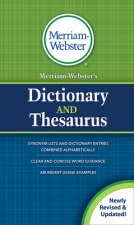
Merriam-Webster's Dictionary and Thesaurus
7.89 € -25 % -

Routledge Introductory Course in Modern Hebrew
61.79 € -

Hammer's German Grammar and Usage
56.11 € -

Story of Yiddish
13.77 € -26 % -

The Various Roles of the Teacher in the English Classroom
20.55 € -6 % -

Jean-Pierre Jeunet's 'Le fabuleux destin d'Amelie Poulain'. A textual analysis of micro and macro textual features and extra-textual contexts
14.48 € -14 % -
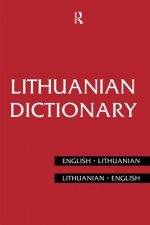
Lithuanian Dictionary
116.69 € -

Perform Suzhou
57.02 € -

Reading Hindi: Novice to Intermediate
57.02 € -
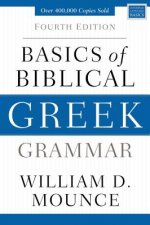
Basics of Biblical Greek Grammar
41.22 € -28 % -
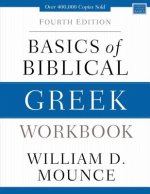
Basics of Biblical Greek Workbook
18.33 € -24 % -

Basics of Biblical Hebrew Grammar
41.32 € -26 % -
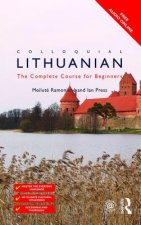
Colloquial Lithuanian
87.82 € -

Mandarin Chinese for Beginners
14.07 € -25 % -

English Vocabulary Builder Workbook (200 Lessons)
16.70 € -6 % -

Basics of Biblical Hebrew Workbook
21.26 € -25 % -

Highway Code
4.04 € -24 % -
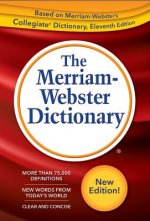
Merriam-Webster Dictionary
12.05 € -24 % -

Colloquial Welsh
69.99 € -
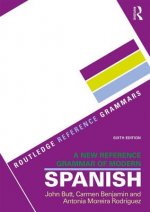
New Reference Grammar of Modern Spanish
64.01 € -

Salamaat! Learning Arabic with Ease
21.77 € -24 % -

Don Quijote
25.21 € -

Essential Cantonese Phrasebook and Dictionary
10.12 € -19 % -

Colloquial Tibetan
100.79 € -

Intermediate Japanese Textbook
28.46 € -6 % -

Routledge Intensive Dutch Course
81.54 € -

Easy Learning English Idioms
8.70 € -25 % -

Beginning Mandarin Chinese Characters Volume 1
12.75 € -25 % -

Graphologist's Alphabet
26.94 € -10 % -

Colloquial Serbian
52.06 € -17 % -

Tuttle Pocket Mandarin Chinese Dictionary
7.89 € -25 % -

Time Machine
18.83 € -

Routledge Introductory Course in Moroccan Arabic
72.02 € -

Fiction and Reality T.E. Lawrence's Portrait of the Arabs in Seven Pillars of Wisdom
49.02 € -2 % -

"The Lies of Savages". Inuit, Victorians and Cannibalism in the Aftermath of the Franklin Expedition
23.09 € -7 % -
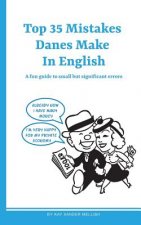
Top 35 Mistakes Danes Make in English
10.73 € -15 % -
Applied Graphology - A Textbook on Character Analysis From Handwriting - For the Practical Use of the Expert, the Student, and the Layman Arranged in
25.82 € -9 % -

Pünktlich wie die Maurer
10.93 € -10 %
Collection points Bratislava a 12822 dalších
Copyright ©2008-26 najlacnejsie-knihy.sk All rights reservedPrivacyCookies

 25648 collection points
 Delivery 2.99 €
 02/210 210 99 (8-15.30h)