Code: 01205222
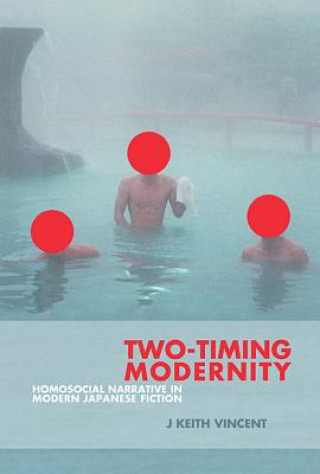
Two-Timing Modernity
by J Keith Vincent
Until the late nineteenth century, Japan could boast of an elaborate cultural tradition surrounding the love and desire that men felt for other men. By the first years of the twentieth century, however, as heterosexuality became a ... more


- Language:
 English
 - Binding: Hardback
- Number of pages: 248
Publisher: Harvard University, Asia Center, 2012
- More about this


You might also like
-

To All The Boys I've Loved Before: FILM TIE IN EDITION
10.75 € -6 % -

Tiger Lily
9.15 € -9 % -

New Testament in the Original Greek
23.73 € -2 % -

Jordan Wolfson
91.82 € -

Court of the Dead Interactive Light-Up Sign and App Kier Isoglyph 111 cm
2968.38 € -

Hathor and Thoth: Two Key Figures of the Ancient Egyptian Religion
172.04 € -

Obal se záložkou Z2702 Růžový XL
31.17 € -5 % -

Dorothy Day
14.17 € -17 % -

Exploring the World of Whales
8.34 € -

Natural Religion
44.26 € -2 % -

Nansens Nordpolfahrt
31.07 € -11 % -

Design of Energy-Efficient Application-Specific Instruction Set Processors
102.38 € -7 % -

Dernier Amour: Les Batailles de la Vie
25.64 € -

Wireless Sensor Networks
55.71 € -

Stinky
9.95 € -24 % -

Sinful
6.73 € -4 % -

L'Art de Lever Les Plans, Analyse Raisonnee Et Demonstration Pratique Des Formules Et Des Operations
17.39 € -2 % -

Le cahier d'Ilona - Séyès, 96p, A5 - Petits c urs
9.44 € -

Leo Kaplan
15.58 € -

Ormanda Eglence
16.09 € -4 % -

African American Theological Ethics
42.13 € -24 % -

escolha pela Fisica
162.22 € -14 % -

Safeguarding Adults and the Law
72.81 € -

Hybrid Governance in European Cities
55.71 € -

Besteuerung von Bergbau und Kohlenwasserstoffen in der DR Kongo
39.01 € -11 % -

Under Spiritual Siege
11.96 € -25 % -

Making the Grade
32.38 € -

Werke f.Gesang und Orchester
22.93 €
Give this book as a present today
- Order book and choose Gift Order.
- We will send you book gift voucher at once. You can give it out to anyone.
- Book will be send to donee, nothing more to care about.
More about Two-Timing Modernity
You get 129 loyalty points
 Book synopsis
Until the late nineteenth century, Japan could boast of an elaborate cultural tradition surrounding the love and desire that men felt for other men. By the first years of the twentieth century, however, as heterosexuality became associated with an enlightened modernity, love between men was increasingly branded as "feudal" or immature. The resulting rupture in what has been called the "male homosocial continuum" constitutes one of the most significant markers of Japan's entrance into modernity. And yet, just as early Japanese modernity often seemed haunted by remnants of the premodern past, the nation's newly heteronormative culture was unable and perhaps unwilling to expunge completely the recent memory of a male homosocial past now read as perverse. Two-Timing Modernity integrates queer, feminist, and narratological approaches to show how key works by Japanese male authors--Mori Ogai, Natsume Soseki, Hamao Shiro, and Mishima Yukio--encompassed both a straight future and a queer past by employing new narrative techniques to stage tensions between two forms of temporality: the forward-looking time of modernization and normative development, and the "perverse" time of nostalgia, recursion, and repetition.
Book details
Book category Books in English Literature & literary studies Literature: history & criticism Literary studies: general
53.19 €
- Full title: Two-Timing Modernity
- Author: J Keith Vincent
- Language: English
- Binding: Hardback
- Number of pages: 248
- EAN: 9780674067127
- ISBN: 0674067126
- ID: 01205222
- Publisher: Harvard University, Asia Center
- Weight: 490 g
- Dimensions: 237 × 158 × 23 mm
- Date of publishing: 19. November 2012
Trending among others
-

Plainwater
14.37 € -25 % -

Zofloya or The Moor
10.65 € -25 % -

SEOUL University Korean 1B Workbook (QR), m. 1 Audio
33.78 € -

Great Expectations
7.43 € -26 % -

Metamorphoses
7.33 € -24 % -

SEOUL University Korean 1B Student's Book (QR), m. 1 Audio
49.77 € -

Weird and the Eerie
13.47 € -

Great God Pan and Other Horror Stories
9.65 € -32 % -

Boyhood
10.45 € -31 % -

Gulliver's Travels
6.53 € -25 % -

Villette
9.65 € -25 % -

Hamlet: The Oxford Shakespeare
8.74 € -24 % -

Situation and the Story
13.67 € -25 % -

The Karamazov Brothers
10.65 € -25 % -

Three Theban Plays
15.48 € -13 % -

Iliad
11.05 € -22 % -

Poetics
9.44 € -24 % -

The Odyssey
16.28 € -26 % -

Consolation of Philosophy
11.56 € -26 % -

Art of Rhetoric
11.46 € -26 % -

Journal of a Novel
13.87 € -24 % -

Skeleton Key to Finnegans Wake
17.69 € -22 % -

Henry Miller on Writing
12.66 € -24 % -

Faust, Part I
8.74 € -25 % -

David Copperfield
7.33 € -24 % -

Discarded Image
15.78 € -25 % -

Happy Hooker
14.17 € -18 % -

Federico Garcia Lorca: A Life
15.18 € -

Call of the Wild, White Fang, and Other Stories
6.53 € -26 % -

Doctor Faustus and Other Plays
11.46 € -26 % -

Great Expectations
18.70 € -

Between Kant and Hegel
31.57 € -9 % -

Old and Middle English c.890-c.1450 - An Anthology 3e
46.76 € -9 % -

Spenser: The Faerie Queene
48.06 € -

Chinese Justice, the Fiction
34.19 € -12 % -

Third Kind of Knowledge
17.59 € -9 % -

Critical Intellectuals on Writing
29.66 € -9 % -

How to Read a Book
15.18 € -3 % -

If Not, Winter: Fragments Of Sappho
15.68 € -32 % -

The Picture of Dorian Gray
7.33 € -27 % -

Saga of Tanya the Evil, Vol. 3
10.15 € -25 % -

Moveable Feast
8.94 € -29 % -

Mysteries of Udolpho
10.45 € -33 % -

North and South
7.94 € -29 % -

Persuasion
5.62 € -19 % -

Art of Rhetoric
4.52 € -24 % -

Walden
9.44 € -25 % -

Athenaze, Book I
109.72 € -

Troilus and Criseyde
21.01 €
Collection points Bratislava a 13578 dalších
Copyright ©2008-26 najlacnejsie-knihy.sk All rights reservedPrivacyCookies

 27160 collection points
 Delivery 2.99 €
 02/210 210 99 (8-15.30h)