Code: 02019280
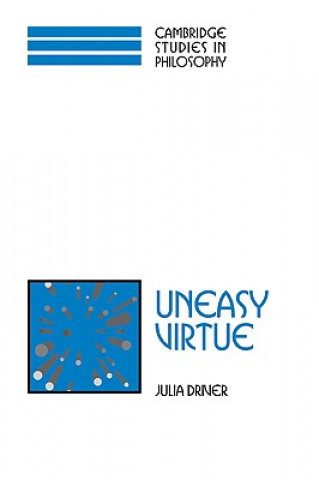
Uneasy Virtue
by Julia Driver
The predominant view of moral virtue can be traced back to Aristotle. He believed that moral virtue must involve intellectual excellence. To have moral virtue one must have practical wisdom - the ability to deliberate well and to ... more


- Language:
 English
 - Binding: Paperback
- Number of pages: 160
Publisher: Cambridge University Press, 2007
- More about this


You might also like
-

Synology NAS
42.37 € -6 % -

His Complete Works
24.21 € -25 % -

Margaret Worthington
24.11 € -14 % -

Devoted
10.59 € -7 % -

Jupiter: The Biggest Planet
9.48 € -

Comparaison Des Arthropathies Rhumatismales, Scrofuleuses Et Syphilitiques (1878)
21.08 € -1 % -

Kalender: A4 Kalender für tägliche Termine - Ziele & Erfolge - Schnellbewertung für jeden Tag - 52 Wochen - 365 Tage - Softcover
19.36 € -6 %
Give this book as a present today
- Order book and choose Gift Order.
- We will send you book gift voucher at once. You can give it out to anyone.
- Book will be send to donee, nothing more to care about.
More about Uneasy Virtue
You get 136 loyalty points
 Book synopsis
The predominant view of moral virtue can be traced back to Aristotle. He believed that moral virtue must involve intellectual excellence. To have moral virtue one must have practical wisdom - the ability to deliberate well and to see what is morally relevant in a given context. Julia Driver challenges this classical theory of virtue, arguing that it fails to take into account virtues which do seem to involve ignorance or epistemic defect. Some 'virtues of ignorance' are counterexamples to accounts of virtue which hold that moral virtue must involve practical wisdom. Modesty, for example, is generally considered to be a virtue even though the modest person may be making an inaccurate assessment of his or her accomplishments. Driver argues that we should abandon the highly intellectualist view of virtue and instead adopt a consequentialist perspective which holds that virtue is simply a character trait which systematically produces good consequences.
Book details
Book category Books in English Humanities Philosophy Social & political philosophy
56.09 €
- Full title: Uneasy Virtue
- Author: Julia Driver
- Language: English
- Binding: Paperback
- Number of pages: 160
- EAN: 9780521034067
- ISBN: 052103406X
- ID: 02019280
- Publisher: Cambridge University Press
- Weight: 254 g
- Dimensions: 153 × 230 × 17 mm
- Date of publishing: 12. February 2007
Trending among others
-

The 48 Laws of Power
18.66 € -30 % -

Prince: The Original Classic
12.10 € -23 % -

Essential Drucker
12.60 € -29 % -

Making of the Indebted Man
11.29 € -24 % -
On Populist Reason
14.72 € -25 % -

Peace, Land, and Bread
24.71 € -1 % -

End of History and the Last Man
15.93 € -25 % -

Calendar of Wisdom
9.68 € -25 % -

BIRTH OF BIOPOLITICS
17.55 € -24 % -

Modern Social Imaginaries
19.67 € -24 % -

Machinic Unconscious
18.76 € -22 % -

Years of Rice and Salt
10.59 € -9 % -

Lean Thinking
25.02 € -29 % -
The Republic
12 € -30 % -

A Conflict of Visions
26.33 € -

Platform Capitalism
13.61 € -5 % -

Between Past and Future
14.02 € -25 % -

Race, Nation, Class
14.62 € -14 % -

Rising Up and Rising Down
17.55 € -24 % -

Progress
20.27 € -4 % -

Discourse on Inequality
8.47 € -30 % -

Oxford Handbook of Political Ideologies
48.43 € -

Critical Models
44.89 € -

Oxford Handbook of Political Theory
49.13 € -9 % -

This Wheel's on Fire
14.02 € -25 % -

Problems of Moral Philosophy
23.70 € -12 % -

American Iconoclast
14.72 € -25 % -

Hegel and the Freedom of Moderns
32.08 € -

Theologico-Political Treatise, and a Political Treatise
21.08 € -2 % -

Free Will
8.77 € -24 % -

One-Dimensional Man
22.29 € -11 % -

Future of Nostalgia
25.32 € -

On The Abolition Of All Polictical
10.79 € -24 % -

On Practice and Contradiction
19.87 € -18 % -

To Have or To Be?
26.12 € -19 % -

Rene Girard's Mimetic Theory
41.87 € -5 % -

German Ideology
12.20 € -

Beyond Nature and Culture
40.86 € -

Zapp!: the Lightning of Empowerment
14.12 € -27 % -

Methodology of Scientific Research Programmes: Volume 1
25.02 € -25 % -

Fashion System
17.04 € -24 % -
Republic of Plato
22.59 € -19 % -

Concept of the Political - Expanded Edition
27.23 € -

Frames of War
14.02 € -19 % -
Post-Truth
12.91 € -23 % -

Political Philosophy
18.05 € -25 % -

What is Power?
15.73 € -6 % -

Candlestick Charting Explained Workbook: Step-by-Step Exercises and Tests to Help You Master Candlestick Charting
28.14 € -18 % -

Common Sense, The Rights Of Man And Other Essential Writings
7.15 € -25 %
Collection points Bratislava a 12986 dalších
Copyright ©2008-26 najlacnejsie-knihy.sk All rights reservedPrivacyCookies

 25976 collection points
 Delivery 2.99 €
 02/210 210 99 (8-15.30h)