Code: 05017778
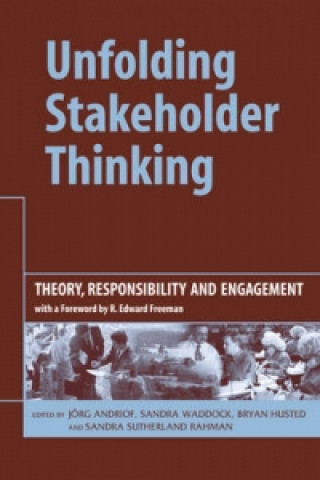
Unfolding Stakeholder Thinking
by Jorg Andriof, Sandra Waddock, Bryan Husted, Sandra Sutherland Rahman
This book - the first of a two-volume series - argues that, today, stakeholder thinking has evolved into the study of interactive, mutually engaged and responsive relationships that establish the very context of doing modern busin ... more


- Language:
 English
 - Binding: Hardback
- Number of pages: 320
Publisher: Taylor & Francis Ltd, 2002
- More about this

92.25 €
RRP: 92.29 €
You save 0.05 €
Availability:
50/50 We think title might be available. Upon your order we will do our best to get it within 6 weeks.
We search the world
You might also like
-

Michael Liddle
120.97 € -14 %
Give this book as a present today
- Order book and choose Gift Order.
- We will send you book gift voucher at once. You can give it out to anyone.
- Book will be send to donee, nothing more to care about.
Availability alert
Enter your e-mail address and once book will be available,
we will send you a message. It's that simple.
More about Unfolding Stakeholder Thinking
You get 223 loyalty points
 Book synopsis
This book - the first of a two-volume series - argues that, today, stakeholder thinking has evolved into the study of interactive, mutually engaged and responsive relationships that establish the very context of doing modern business, and create the groundwork for transparency and accountability. This book makes it clear that in today's societies successful companies are those that recognise that they have responsibilities to a range of stakeholders that go beyond mere compliance with the law or meeting the fiduciary responsibility inherent in maximising returns to shareholders. If in the past the focus was on enhancing shareholder value, now it is on engaging stakeholders for long-term value creation. The process of engagement creates a dynamic context of interaction, mutual respect, dialogue and change - not a one-sided "management" of stakeholders. Indeed, the authors believe the very term 'stakeholder management' to be outdated and corporate-centric. Companies can manage their relationships with stakeholders, but frequently cannot actually manage the stakeholders themselves, because, as the activist and collaborative initiatives described in this volume suggest, company-stakeholder relationships are not one-way streets and different institutions bring different agendas, goals and priorities to the engagement. There are clear implications to the way in which stakeholder thinking is unfolding today. If in the past corporate "social" responsibility was simply seen as profitability plus compliance plus philanthropy, now responsible corporate citizenship - or corporate responsibility - means companies being more aware of and understanding the societies in which they operate. Corporate responsibility means recognising that day-to-day operating practices affect stakeholders and that it is in those impacts where responsibility lies, not merely in efforts to "do good". Companies are now faced with a wide array of challenges that mean that senior executives and managers need to be able to deal with issues including greater accountability, human rights abuses, sustainability strategies, corporate governance codes, workplace ethics, stakeholder consultation and management. Stakeholder thinking needs to capture these new realities. The global reach of multinational corporations has served to highlight the need for the (re)integration of business into society, relationships into stakeholder relations, and ethics into managerial practice. The rise in power of global activism involving NGOs, and global business involving multinational corporations, makes it even more critical today for companies to consider the power and interests of corporate stakeholders when developing strategic plans. The interactivity and mutuality of relationships described in this book make it clear that firms and stakeholders share the power and responsibility to influence both the profit potential of the firm and how the benefits of the firm's success impact on society. This important volume brings together leading academic thought on stakeholder thinking for the first time. Unfolding Stakeholder Thinking will be indispensable to corporate managers, NGOs and academics seeking greater understanding of the dynamics of stakeholder thinking in a world of rapidly changing responsibilities. A companion volume, Unfolding Stakeholder Thinking 2, focusing on practical issues such as relationship management, communication, reporting, and performance, is also available.
Book details
Book category Books in English Economics, finance, business & management Business & management Business strategy
92.25 €
- Full title: Unfolding Stakeholder Thinking
- Author: Jorg Andriof, Sandra Waddock, Bryan Husted, Sandra Sutherland Rahman
- Language: English
- Binding: Hardback
- Number of pages: 320
- EAN: 9781874719526
- ISBN: 1874719527
- ID: 05017778
- Publisher: Taylor & Francis Ltd
- Weight: 612 g
- Dimensions: 236 × 174 × 23 mm
- Date of publishing: 01. October 2002
Trending among others
-

Never Split the Difference
10.81 € -20 % -

Ego is the Enemy
9.90 € -33 % -
Good Strategy/Bad Strategy
11.83 € -20 % -

Blue Ocean Strategy, Expanded Edition
23.26 € -24 % -

7 Powers
22.24 € -
Measure What Matters
14.96 € -27 % -

Delivering Happiness
7.37 € -31 % -

Founder's Mentality
23.05 € -25 % -
Lean Startup
23.96 € -24 % -

Switch
13.44 € -25 % -

Thinking Strategically
18 € -12 % -
Hacking Growth
16.78 € -22 % -

ReOrg
28.92 € -9 % -

A Guide to the Business Analysis Body of Knowledge® (BABOK® Guide)
57.55 € -18 % -

Never Eat Alone, Expanded and Updated
10.41 € -30 % -

Building Distinctive Brand Assets
28.72 € -10 % -

The Path to Individual and Organizational Transformation
21.74 € -24 % -

Never Eat Alone
22.85 € -29 % -

Executive Presence
21.94 € -26 % -

Competitive Strategy
17.39 € -33 % -

Infinite Game
18 € -12 % -

Competitive Strategy
33.47 € -24 % -

Enterprise Architecture As Strategy
32.06 € -24 % -
Visual Thinking
18 € -26 % -

Play Bigger
18.10 € -25 % -

Founder's Dilemmas
14.76 € -25 % -

HBR Guide to Thinking Strategically (HBR Guide Series)
15.97 € -29 % -

Predictable Prospecting: How to Radically Increase Your B2B Sales Pipeline
18.30 € -24 % -

Business for Punks
11.72 € -34 % -

That's Not How We Do It Here!
13.44 € -34 % -

Selling The Invisible
14.46 € -29 % -

Art of the Long View
14.46 € -26 % -

Turning Goals into Results (Harvard Business Review Classics)
10.81 € -3 % -

Green to Gold
16.18 € -24 % -

Organizational Design
58.56 € -

Success Is a Choice
15.37 € -18 % -

All the Right Moves
32.06 € -24 % -

Certain to Win
15.47 € -25 % -

Leading Organizations
19.51 € -22 % -

Only the Paranoid Survive
14.86 € -24 % -

Mind Of The Strategist: The Art of Japanese Business
26.70 € -18 % -

HBR's 10 Must Reads for CEOs (with bonus article "Your Strategy Needs a Strategy" by Martin Reeves, Claire Love, and Philipp Tillmanns)
18.20 € -25 % -
Hacking Growth
21.44 € -29 % -
Maximum Achievement
14.15 € -23 % -
Zone to Win
14.05 € -25 % -

Digital Transformation Playbook
21.64 € -25 % -

Lords of Strategy
25.08 € -25 % -
Operating Model Canvas
49.25 € -5 % -

Rumsfeld's Rules
21.23 € -26 %
Collection points Bratislava a 12830 dalších
Copyright ©2008-26 najlacnejsie-knihy.sk All rights reservedPrivacyCookies

 25664 collection points
 Delivery 2.99 €
 02/210 210 99 (8-15.30h)