Code: 01381634
Unique Environmentalism
by Gunnar Grendstad, Per Selle, Kristin Stromsnes, Oystein Bortne
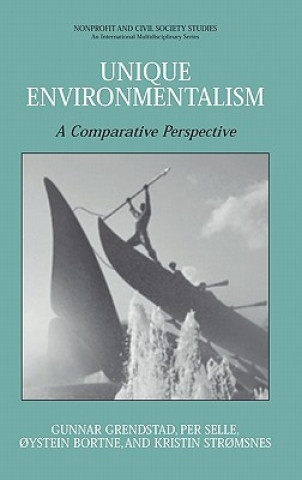
This book explains and demonstrates how the Norwegian case of environmentalism is unique. The two connected anomalies of an inclusive and state friendly society and a strong orientation and commitment to local communities make the ... more


- Language:
 English
 - Binding: Hardback
- Number of pages: 190
Publisher: Springer-Verlag New York Inc., 2006
- More about this


You might also like
-

The White King's Favorite
28.14 € -2 % -

Poppy and Sam's Book and 3 Jigsaws: Trains
8.74 € -17 % -

Malá noční můra
2.10 € -

Design of Educational Exhibits
76.50 € -

Student Permakultury 1
22.21 € -

Electronic and catalytic properties of Metal complexes
334.97 € -14 % -

Problemy pielęgniarstwa geriatrycznego
47.24 € -

De la naissance du cinéma kabyle
24.92 € -6 % -

Essays
31.86 € -14 % -

Starfish
12.66 € -

Six of the Strangest Tales Ever Told
21.81 € -

Data Driven Marketing For Dummies
19.49 € -25 % -

Illustrated Pollen Terminology
51.36 € -2 % -

Idea of Europe
39.40 € -9 %
Give this book as a present today
- Order book and choose Gift Order.
- We will send you book gift voucher at once. You can give it out to anyone.
- Book will be send to donee, nothing more to care about.
More about Unique Environmentalism
You get 267 loyalty points
 Book synopsis
This book explains and demonstrates how the Norwegian case of environmentalism is unique. The two connected anomalies of an inclusive and state friendly society and a strong orientation and commitment to local communities make the case stand apart from mainstream international definitions of environmentalism.§The authors study a specific political culture with a rather unique combination of state structure and civil society of which organized environmentalism is an important part. The political culture influences organizational form and organizational ideology as well as the way these organistions are linked to and interact with the goverment. The study shows why international non-government organizations (INGOs) which are successful elsewhere, such as Greenpeace, are unable to establish themselves in some countries.§The study compares Norwegian environmentalism with perspectives and findings from other political systems. More generally, this is also a study on the role of voluntary organizations and civil society in a specific type of democracy. The book throws light on why the working of the Norwegian political system as well as the Scandinavian political systems more generally is often misunderstood in the international literature.This book explains and demonstrates how the Norwegian case of environmentalism is unique. The two connected anomalies of an inclusive and state friendly society and a strong orientation and commitment to local communities make the case stand apart from mainstream international definitions of environmentalism. §The authors study a specific political culture with a rather unique combination of state structure and civil society of which organized environmentalism is an important part. The political culture influences organizational form and organizational ideology as well as the way these organistions are linked to and interact with the goverment. The study shows why international non-government organizations (INGOs) which are successful elsewhere, such as Greenpeace, are unable to establish themselves in some countries.§The study compares Norwegian environmentalism with perspectives and findings from other political systems. More generally, this is also a study on the role of voluntary organizations and civil society in a specific type of democracy. The book throws light on why the working of the Norwegian political system as well as the Scandinavian political systems more generally is often misunderstood in the international literature.
Book details
Book category Books in English Earth sciences, geography, environment, planning The environment
109.87 €
- Full title: Unique Environmentalism
- Subtitle: A Comparative Perspective
- Author: Gunnar Grendstad, Per Selle, Kristin Stromsnes, Oystein Bortne
- Language: English
- Binding: Hardback
- Number of pages: 190
- EAN: 9780387305240
- ISBN: 0387305246
- ID: 01381634
- Publisher: Springer-Verlag New York Inc.
- Weight: 1010 g
- Dimensions: 235 × 156 × 20 mm
- Date of publishing: 12. July 2006
Trending among others
-

Thinking in Systems
18.99 € -14 % -

I Taste Red - The Science of Tasting Wine
31.66 € -5 % -

Pluriverse - A Post-Development Dictionary
37.59 € -

Gift of Good Land
13.06 € -25 % -

H. M. S. Surprise
11.95 € -24 % -

Decolonial Ecology: Thinking from the Caribbean World
24.02 € -5 % -

Environmental Systems and Societies for the IB Diploma Coursebook
81.93 € -

Stakeholder Capitalism - A Global Economy that Works for Progress, People and Planet
18.39 € -26 % -

One-Straw Revolutionary
18.09 € -25 % -

Chemtrails, Haarp, And The Full Spectrum Dominance Of Planet Earth
16.08 € -24 % -

Derrick Jensen Reader
18.39 € -31 % -

Rise of Ecofascism - Climate Change and the Far Right
21.40 € -5 % -

Planet Earth, The Future
26.03 € -

Overloaded Ark
10.65 € -25 % -

Emerging Contaminants in the Environment
187.08 € -

Practical Field Ecology 2nd Edition
59.91 € -9 % -

Oxford IB Diploma Programme: Environmental Systems and Societies Course Companion
67.35 € -

Drawdown: The Most Comprehensive Plan Ever Proposed to Reverse Global Warming
21.60 € -24 % -

Environmental Systems and Societies for the IB Diploma Study and Revision Guide
45.43 € -

Nature as Teacher
32.26 € -30 % -

Meteorology Today: An Introduction to Weather, Climate, and the Environment
219.36 € -

Life of Plants, A Metaphysics of Mixture
20.70 € -7 % -

Oceanography
138.63 € -

Natural Histories
15.27 € -19 % -

How Everything Can Collapse - A Manual for our Times
15.07 € -25 % -

Pearson Baccalaureate: Environmental Systems and Societies bundle 2nd edition
77.90 € -

Circular Economy For Dummies
19.49 € -25 % -

Introduction to Project Finance in Renewable Energy Infrastructure
124.75 € -10 % -

Anthropocene Or Capitalocene?
17.38 € -25 % -

Natural Catastrophe Risk Management and Modelling - A Practitioner's Guide
100.62 € -10 % -

Invaders
28.24 € -

Permaculture Guide to Reed Beds
15.87 € -24 % -

China's Environmental Crisis: An Enquiry into the Limits of National Development
74.39 € -

Wood
15.17 € -3 % -

Rachel Carson: Silent Spring & Other Environmental Writings
28.44 € -24 % -

Topophilia
41.41 € -

Peak Libido - Sex, Ecology, and the Collapse of Desire
18.19 € -7 % -

Microplastics
137.72 € -

Sustainability
23.92 € -3 % -

Cranky Uncle Vs. Climate Change
12.66 € -24 % -

Forest Mind
48.15 € -

Atmospheric Science for Environmental Scientists, Second Edition
84.64 € -

System Change Not Climate Change
8.64 € -24 % -

Ways of Being Alive
23.92 € -3 % -

Homage to Gaia
16.28 € -19 % -

Solid Waste Engineering and Management
153.40 € -7 % -

Whole Earth Discipline
26.23 € -25 % -

Dare To Be Great
13.76 € -25 % -

China
53.68 €
Collection points Bratislava a 13244 dalších
Copyright ©2008-26 najlacnejsie-knihy.sk All rights reservedPrivacyCookies

 26492 collection points
 Delivery 2.99 €
 02/210 210 99 (8-15.30h)