Code: 19693917
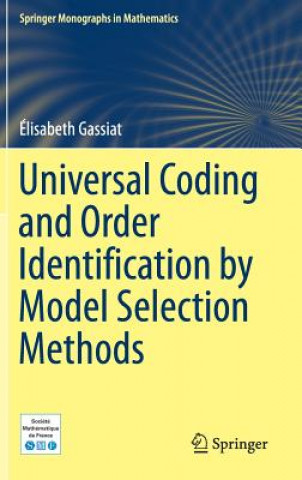
Universal Coding and Order Identification by Model Selection Methods
by Élisabeth Gassiat, Anna Ben-Hamou
The purpose of these notes is to highlight the far-reaching connections between Information Theory and Statistics. Universal coding and adaptive compression are indeed closely related to statistical inference concerning processes ... more


- Language:
 English
 - Binding: Hardback
- Number of pages: 146
Publisher: Springer, 2018
- More about this

113.22 €
RRP: 122.64 €
You save 9.42 €

In stock at our supplier
Shipping in 10 - 13 days
You might also like
-

Elvis Presley with the Royal Philharmonic Orchestra, 1 Audio-CD
12.02 € -

Another Green World (2004 Remastered)
14.45 € -

From the Angel's(P) Blackboard
16.87 € -24 % -

Mind in the Making: A Study in Mental Development
30.92 € -2 % -

Творец слез (покет)
17.48 € -12 % -

YOUNG JAZZ ENSEMBLE COLLECTION ASAX 1
16.67 € -

Unholy Pursuit: The Devil on My Trail: Unholy Pursuit
24.25 € -7 % -

Au coeur de l'ovalie, 150 expressions, mots et anecdotes de légende sur le rugby
23.75 € -

Compendious View of the Religion of Nature Delineated. with an Appendix Concerning the Christian Religion.
16.67 € -25 % -

Jeff Menzel and the 2011 Gauchos
14.04 € -7 % -

Tito
15.15 € -4 % -

Grundung der kanadischen Foerderation von 1867
16.17 € -10 % -

What's Next?
233.42 € -

Insights of urban dynamics for sustainable design of Smart Cities
66.61 € -14 % -

Princess of Island
12.22 € -6 % -

Big Questions, Little Sleep
8.99 € -6 % -

Workshop Landschaftsfotografie
24.15 € -11 % -

Armees En Campagne, Considerations Relatives Aux Hommes Et Aux Chevaux
14.75 € -8 % -

Ayiti
18.29 € -7 % -

Den Zahlenraum bis 1 000 aktiv entdecken
31.23 € -6 % -

Passion for Fashion
5.55 € -25 %
Give this book as a present today
- Order book and choose Gift Order.
- We will send you book gift voucher at once. You can give it out to anyone.
- Book will be send to donee, nothing more to care about.
More about Universal Coding and Order Identification by Model Selection Methods
You get 274 loyalty points
 Book synopsis
The purpose of these notes is to highlight the far-reaching connections between Information Theory and Statistics. Universal coding and adaptive compression are indeed closely related to statistical inference concerning processes and using maximum likelihood or Bayesian methods. The book is divided into four chapters, the first of which introduces readers to lossless coding, provides an intrinsic lower bound on the codeword length in terms of Shannon's entropy, and presents some coding methods that can achieve this lower bound, provided the source distribution is known. In turn, Chapter 2 addresses universal coding on finite alphabets, and seeks to find coding procedures that can achieve the optimal compression rate, regardless of the source distribution. It also quantifies the speed of convergence of the compression rate to the source entropy rate. These powerful results do not extend to infinite alphabets. In Chapter 3, it is shown that there are no universal codes over the class of stationary ergodic sources over a countable alphabet. This negative result prompts at least two different approaches: the introduction of smaller sub-classes of sources known as envelope classes, over which adaptive coding may be feasible, and the redefinition of the performance criterion by focusing on compressing the message pattern. Finally, Chapter 4 deals with the question of order identification in statistics. This question belongs to the class of model selection problems and arises in various practical situations in which the goal is to identify an integer characterizing the model: the length of dependency for a Markov chain, number of hidden states for a hidden Markov chain, and number of populations for a population mixture. The coding ideas and techniques developed in previous chapters allow us to obtain new results in this area. This book is accessible to anyone with a graduate level in Mathematics, and will appeal to information theoreticians and mathematical statisticians alike. Except for Chapter 4, all proofs are detailed and all tools needed to understand the text are reviewed.
Book details
Book category Books in English Reference, information & interdisciplinary subjects Research & information: general Coding theory & cryptology
113.22 €
- Full title: Universal Coding and Order Identification by Model Selection Methods
- Author: Élisabeth Gassiat, Anna Ben-Hamou
- Language: English
- Binding: Hardback
- Number of pages: 146
- EAN: 9783319962610
- ISBN: 3319962612
- ID: 19693917
- Publisher: Springer
- Weight: 408 g
- Dimensions: 234 × 156 × 11 mm
- Date of publishing: 18. September 2018
Trending among others
-

Code Book
12.32 € -21 % -

Codes and Ciphers - A History Of Cryptography
24.25 € -10 % -

Investigating Cryptocurrencies - Understanding, Extracting, and Analyzing Blockchain Evidence
44.37 € -25 % -

Computational Complexity
77.02 € -

Introduction to Mathematical Cryptography
63.38 € -

Software Design X-Rays
42.45 € -20 % -

Hacking Connected Cars - Tactics, Techniques, and Procedures
36.79 € -25 % -

Cryptography For Dummies
28.60 € -24 % -

Quantum Cryptography and Secret-Key Distillation
83.60 € -

Mathematics of Secrets
14.04 € -25 % -

Cracking Codes and Cryptograms For Dummies
7.88 € -25 % -

Cryptography Algorithms
45.38 € -2 % -

Modern Cryptography Primer
75.61 € -9 % -

Solidity Programming Essentials
38.20 € -2 % -

Journal of Cyber Security and Mobility (5-3)
39.52 € -

Lattice-Based Cryptography
169.93 € -

Introduction to Cybersecurity
70.55 € -9 % -

Coding Theory
74.40 € -

Information Security and Privacy
100.88 € -7 % -

Certified Ethical Hacker (CEH) Foundation Guide
33.45 € -9 % -

Hands-On Cryptography with Python
32.85 € -1 % -
Geometric Patterns with Creative Coding
57.11 € -14 % -

Everyday Cryptography
67.72 € -

Readings from CRYPTOLOGIA on the Enigma Machine
113.82 € -

Brute Force
21.73 € -24 % -

Transactions on Data Hiding and Multimedia Security X
41.34 € -7 % -

Journal of Cyber Security and Mobility (6-2)
39.52 € -

Algebraic Coding Theory (Revised Edition)
179.94 € -

Applications of Finite Fields
154.26 € -7 % -

Secure Localization and Time Synchronization for Wireless Sensor and Ad Hoc Networks
206.73 € -9 % -

Smart Cards, Tokens, Security and Applications
141.12 € -

Information Theory and Quantum Physics
102.90 € -7 % -

Post-Quantum Cryptography
51.65 € -7 % -

Electronic Voting
41.34 € -7 % -

Modern Coding Theory
123.33 € -

Post-Quantum Cryptography
77.23 € -7 % -

Linear Cryptanalysis
77.02 € -

Multidisciplinary Perspectives in Cryptology and Information Security
254.34 € -

Advances in Cryptology - ASIACRYPT 2022
123.43 € -7 % -

Practical Approach to Compiler Construction
45.48 € -9 % -

Advances in Cryptology - EUROCRYPT 2025
143.95 € -7 % -

Advances in Cryptology - EUROCRYPT 2023
108.36 € -

Hands-On Blockchain with Hyperledger
53.57 € -1 % -

Decentralized Applications
27.89 € -24 % -

Advances in Cryptology - ASIACRYPT 2025
100.88 € -7 % -

Multivariate Public Key Cryptosystems
146.88 € -

Codes and Ciphers - A History Of Cryptography
39.62 € -10 % -

Cyber Security
20.31 € -24 % -
Trends in Logic
154.26 € -7 %
Collection points Bratislava a 13206 dalších
Copyright ©2008-26 najlacnejsie-knihy.sk All rights reservedPrivacyCookies

 26416 collection points
 Delivery 2.99 €
 02/210 210 99 (8-15.30h)