Code: 18319009
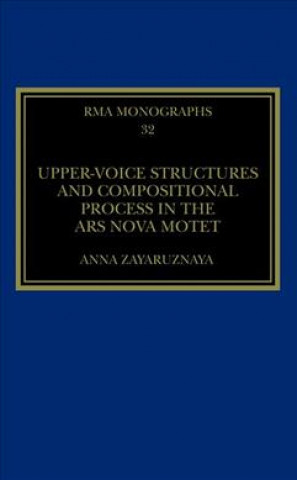
Upper-Voice Structures and Compositional Process in the Ars Nova Motet
by Anna Zayaruznaya
In the motets of Philippe de Vitry, Guillaume de Machaut, and their contemporaries, tenors have often been characterized as the primary shaping forces, prior in conception as well as in construction to the upper voices. Tenors are ... more


- Language:
 English
 - Binding: Hardback
- Number of pages: 158
Publisher: Taylor & Francis Ltd, 2018
- More about this

203.81 €
RRP: 203.85 €
You save 0.04 €
Availability:
50/50 We think title might be available. Upon your order we will do our best to get it within 6 weeks.
We search the world
You might also like
-

Manual of Neonatal Respiratory Care
166.13 € -9 % -

Formation des enseignants
49.02 € -14 % -

Networks, Security and Complexity
138.67 € -

Le Magasin Des Enfants, (Ed.1859)
28.05 € -

The Miraculous Revenge
7.28 € -6 % -

The New Paul and Virginia, or Positivism on an Island (Classic Reprint)
15.49 € -

Badalti Zindagi Badalte Rang
9.82 € -6 %
Give this book as a present today
- Order book and choose Gift Order.
- We will send you book gift voucher at once. You can give it out to anyone.
- Book will be send to donee, nothing more to care about.
Availability alert
Enter your e-mail address and once book will be available,
we will send you a message. It's that simple.
More about Upper-Voice Structures and Compositional Process in the Ars Nova Motet
You get 492 loyalty points
 Book synopsis
In the motets of Philippe de Vitry, Guillaume de Machaut, and their contemporaries, tenors have often been characterized as the primary shaping forces, prior in conception as well as in construction to the upper voices. Tenors are shaped by the interaction of talea and color, medieval terms now used to refer to the independent repetition of rhythms and pitches, respectively. The presence in the upper voices of the periodically repeating rhythmic patterns, often referred to as "isorhythm," has been characterized as an amplification of tenor structure. But a fresh look at the medieval treatises suggests a revised analytical vocabulary: for many fourteenth- and fifteenth-century writers, both color and talea involved rhythmic repetition, the latter in the upper voices specifically. And attention to upper-voice taleae independently of tenor structures brings renewed emphasis to the significant portion of the repertory in which upper voices evince formal schemes that differ from those in the tenors. These structures in turn suggest a revision of the presumed compositional process for motets, implying that in some cases upper-voice text and forms may have preceded the selection and organization of tenors. Such revisions have implications for hermeneutic endeavors, since not only the forms of motet voices but the meanings of their texts change, depending on whether analysis proceeds from the tenor up, or from the top down. Where the presumed compositional and structural primacy afforded to tenors has encouraged a strand of interpretation that reads the upper-voice poetry as conforming to, and amplifying, the tenor text snippets and their liturgical contexts, a "bottom-down" view casts tenors in a supporting role and reveals the poetic impulse of the upper voices as the organizing principle of motets.
Book details
Book category Books in English The arts Music Music: styles & genres
203.81 €
- Full title: Upper-Voice Structures and Compositional Process in the Ars Nova Motet
- Subtitle: Process in the Ars nova Motet
- Author: Anna Zayaruznaya
- Language: English
- Binding: Hardback
- Number of pages: 158
- EAN: 9781138302440
- ISBN: 9781138302440
- ID: 18319009
- Publisher: Taylor & Francis Ltd
- Weight: 392 g
- Dimensions: 155 × 252 × 16 mm
- Date of publishing: 21. June 2018
Trending among others
-

Moonwalk
14.07 € -

Michael Jackson
21.47 € -24 % -

Just Kids
13.77 € -21 % -

My Friend Michael
18.33 € -29 % -

In the Studio with Michael Jackson
34.53 € -

Michael Jackson
12.05 € -25 % -

The Long Hard Road Out Of Hell
14.78 € -25 % -

Elvis and Me
8.30 € -29 % -

Jazz Piano Book
43.04 € -10 % -

Jazz Theory Book
56.82 € -10 % -

Queen Unseen - My Life with the Greatest Rock Band of the 20th Century: Revised and with Added Material
11.84 € -25 % -

Real Frank Zappa Book
16.20 € -25 % -

Debussy - The Ultimate Piano Collection
28.66 € -24 % -

Woolgathering
13.97 € -32 % -

Twelve Days of Christmas
7.49 € -28 % -

Oxford History of Western Music: Music in the Nineteenth Century
31.70 € -

Queens of the Stone Age: No One Knows
15.49 € -25 % -

True Lives of My Chemical Romance
21.97 € -19 % -

Look at Me!
17.72 € -17 % -
371 Harmonized Chorales And 69 Chorale Melodies
13.87 € -21 % -

Carl Czerny
8.09 € -22 % -

Absolutely on Music
12.25 € -30 % -

Penguin Jazz Guide
24.81 € -29 % -

In The Pleasure Groove
14.98 € -25 % -

Porcelain
15.59 € -26 % -

Nada Brahma - the World is Sound
15.29 € -21 % -

Harmony, Counterpoint, Partimento
54.19 € -

Rest is Noise
18.83 € -30 % -

Show That Never Ends
13.36 € -25 % -

Outlaw
14.48 € -26 % -

DJ Culture
14.88 € -9 % -

Bill Evans
20.05 € -7 % -

Lost Beatles Photographs
25.32 € -26 % -

Shostakovich
32.71 € -

Renaissance Vihuela and Guitar In Sixteenth
37.07 € -15 % -

Cole Porter Platinum Collection
24.10 € -14 % -

Chromatic Harmonica Songbook - 48 Themes from Classical Music
19.24 € -6 % -

Disciples
42.23 € -

Sound Man
14.78 € -25 % -

Big Midweek
18.12 € -15 % -

Beethoven
29.57 € -26 % -

Mendelssohn
38.69 € -

Isaac Albeniz
157.62 € -

M Train
12.96 € -21 % -

Lords Of Chaos - 2nd Edition
20.96 € -6 % -

Scales and Finger Exercises
10.53 € -19 % -

I'm with the Band
12.75 € -24 % -

I Am Ozzy
12.96 € -28 % -

A Perfect Union of Contrary Things
14.78 € -25 %
Collection points Bratislava a 12822 dalších
Copyright ©2008-26 najlacnejsie-knihy.sk All rights reservedPrivacyCookies

 25648 collection points
 Delivery 2.99 €
 02/210 210 99 (8-15.30h)