Kód: 49531036
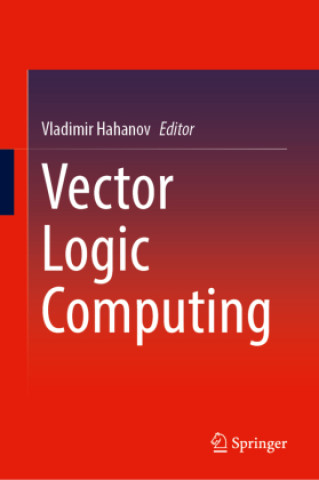
Vector Logic Computing
Autor Vladimir Hahanov
This book creates a non-processor economy vector logic in-memory computing based on read-write transactions on logical vectors, truth tables, and matrices. In-memory vector logic is a harmonic relationship between a model and an a ... celý popis


- Jazyk:
 Angličtina
 - Väzba: Pevná
- Počet strán: 1013
Nakladateľ: Springer-Verlag GmbH, 2026
- Viac informácií o knihe

185.07 €
Bežne: 200.54 €
Ušetríte 15.47 €

Mohlo by sa vám tiež páčiť
-

Vagabond (VIZBIG Edition), Vol. 1
18.90 € -22 % -

Hollow
24.16 € -21 % -

Caraval Boxed Set
42.87 € -30 % -

Vocabulario Nivel Elemental A1 A2 Edicion 2023
15.36 € -12 % -

Blood Bound
22.75 € -27 % -

Nemocná Amerika
7.78 € -21 % -

Stefan Zweig, Gesammelte Werke
10.71 € -18 % -

Najszczęśliwszy człowiek na Ziemi
8.38 € -15 % -

The Wolf King
20.01 € -20 % -

Pory roku. Akademia mądrego dziecka. Pierwsze słowa
5.75 € -14 % -

The Casella Ruin
17.49 € -2 % -

Eat The Food You Buy
26.39 € -25 % -

Digital SAT Study Guide Premium, 2026: 4 Practice Tests + Comprehensive Review + Online Practice
30.53 € -25 % -
Pismo Święte stary i nowy testament
26.18 € -13 % -

The Scarlet Gospels
14.55 € -25 % -

Colony Mars
23.45 € -7 % -

Winning Brief
94.96 € -

London Fields
11.01 € -30 % -

The Midlife Edit
15.16 € -23 % -

Silent Cinema: A Guide to Study, Research and Curatorship
42.57 € -4 % -

Experimental Film
14.76 € -25 % -

Hollow Kingdom
14.15 € -27 % -

The Enemy's Daughter
15.97 € -

Sculptor
20.12 € -25 % -

Ausmalen mit dem magischen Pinsel. Bauernhoftiere
8.59 € -15 % -

Woman After God's Own Heart Growth and Study Guide
10.61 € -25 % -

Cloak of Night
14.55 € -25 % -

Verga e il Verismo
36.80 € -

Small Angle X-Ray and Neutron Scattering from Solutions of Biological Macromolecules
107.60 € -

Simply Vibrant
31.24 € -9 % -

Dolche und Schwerter
16.88 € -16 % -

I Appeal to Scripture!
8.59 € -24 % -

Kosmiczne kolory. Disney Stitch. Arteterapia
8.08 € -6 % -

Zamek. Szermierz Natchniony. Virion. Tom 1
11.92 € -3 % -

Wizard
7.27 € -24 % -

Nature Embedded Mind, The – How the Way We Think Can Heal Our Planet and Ourselves
12.73 € -24 % -

Verloren in der Wildnis
11.32 € -

Osudná kniha
11.82 € -15 % -

Georges Bidault
28.31 € -

Minor Characters in Icelandic Sagas
42.67 € -4 % -

EL JARDI DELS TRES AMORS
15.77 € -

Art of the Beard
25.17 € -9 % -

Houseboat on the Styx
12.73 € -25 % -

El sistema multilateral de comercio
29.42 € -14 % -

Snakes of Kampuchea: A Trilogy of Plays about Cambodia
13.24 € -6 % -

Ojos de Dragón III
24.06 € -

Estomihi bis Christi Himmelfahrt
22.64 € -

Emotion Theory: The Routledge Comprehensive Guide
640.18 € -

The Trouble With Thieves: Return to Averia
14.05 € -7 % -

veglia del sangue
23.25 € -9 % -

Visuelle Wege in die Schriftsprache
32.15 € -11 % -

Professional Social Work
97.18 € -9 % -
Global Markets For Processed Foods
65.83 € -

Urgeschichte der germanischen und romanischen Voelker
62.19 € -12 % -

Von Büchern und Inseln
10.31 € -15 % -

Reinventing Religion
30.23 € -12 % -

Irene: Lazos
10.71 € -6 % -

Rise of the Republic of the United States ... Sixth Edition.
30.94 € -2 % -

Virtuelle Beteiligung, reale Teilhabe
48.13 € -

Vitinha
12.63 € -

Upskilling the Chinese workforce?
116.90 € -4 % -

Vintage Rennräder
35.29 € -

"Queens"
19.21 € -

Erfolgsfaktor Markt
47.22 € -6 % -

Tatiyana
11.32 € -

Welche Rolle spielt der kindliche Blick in Walter Benjamins Berliner Kindheit um neunzehnhundert?
16.17 € -10 % -

Superconductivity: Discoveries and Discoverers
51.67 € -7 % -

Werner Robert Schaub
15.36 € -

Clinical Multifocal ERG with Case Presentations
32.05 € -14 % -

Ich für meinen Teil bin Monist
14.86 € -10 % -

Sidro. In calice & in cucina, storie, ricette e menu al sapore frizzante di mele e pere
19.91 € -6 % -

Redgauntlet - A Tale of the Eighteenth Century
88.79 € -14 % -

Urban Design and Architecture Education
39.23 € -14 % -

Heilige Funde
83.83 € -

Critical and Exegetical Handbook to the Gospel of Matthew ... Tr. from the 6th Ed. of the German by ... Peter Christie; The Translation REV. and Ed. V
32.76 € -2 % -

The Suburbs of Heaven
12.03 € -24 % -

Observations Pratiques Sur Les Bains de Mer
13.04 € -1 % -

The Seven Curses of London
20.01 € -7 % -

Le Miroir Interieur /franCais
43.88 € -

Table at Le Cirque
30.23 € -22 % -

Rochester History Vol. 82, No. 2 (Spring 2025)
11.62 € -

Veicoli. Libri passeggino feltro
10.51 € -

La mer exilée du silence
15.06 € -

Use It or Lose It
19.31 € -2 %
Darujte túto knihu ešte dnes
- Objednajte knihu a vyberte Zaslať ako darček.
- Obratom obdržíte darovací poukaz na knihu, ktorý môžete ihneď odovzdať obdarovanému.
- Knihu zašleme na adresu obdarovaného, o nič sa nestaráte.
Informovať o naskladnení knihy
Zadajte do formulára e-mailovú adresu a akonáhle knihu naskladníme, zašleme vám o tom správu. Postrážime všetko za vás.
Viac informácií o knihe Vector Logic Computing
Nákupom získate 448 bodov
 Anotácia knihy
This book creates a non-processor economy vector logic in-memory computing based on read-write transactions on logical vectors, truth tables, and matrices. In-memory vector logic is a harmonic relationship between a model and an algorithm that aims to reduce time and energy in modeling for simulation by using additional space and matter. Vector logic is an ideal form of representation of functions and structures for modelling and simulating social and physical processes. Modeling without simulation is a prompt-computing for creating a comprehensive testing map of any functionality or structure on a logical vector. Intelligent computing is here the integration of classical and artificial intelligence mechanisms for modeling and simulation, using vector-logical and matrix models to process functions and structures. The book first discusses the development of smart vector logic data structures to reduce the computational complexity of simulation algorithms. Then it explores the creation of mechanisms for vector logic modeling and testing, leveraging truth tables and matrices built on a logical vector. After that, novelty goes on to cover the following: vector testing of logic circuits by simulating faults as addresses of logical vector bits; vector testing of graph structures by simulating transition faults as truth table addresses, and vector logic in-memory computing of unitary-encoded big data as truth table addresses. The book then explores the logical vector modeling for the simulation of social processes via unitary pattern encoding on the universe primitives. The goal of cyber-social vector logic computing is energy-effective monitoring and moral management of cyber-social processes and phenomena. Vector logic is a functional and structural relationship for in-memory computing, which forms an exponentially redundant data structure in memory to minimize its processing time and energy. The original vector logic mechanisms are implemented in the MOSI cloud service Modeling for Simulation, written in Python, for simulating good-value states and faults, as addresses for logical circuits, functionalities, and structures. The book can be helpful for specialists in the field of big data prompt computing, including social and physical processes, as well as for engineers involved in testing digital GL, RTL, and system-level projects, automatic test generation, and good-value and fault address simulation. The theory and practice of vector-logical computing, algorithms, models, mechanisms, and codes are an original development to create energy- and time-saving processor-less new computing in memory.
Parametre knihy
Zaradenie knihy Books in German Naturwissenschaften, Medizin, Informatik, Technik Technik Bau- und Umwelttechnik
185.07 €
- Celý názov: Vector Logic Computing
- Autor: Vladimir Hahanov
- Jazyk: Angličtina
- Väzba: Pevná
- Počet strán: 1013
- EAN: 9783032070005
- ISBN: 3032070007
- ID: 49531036
- Nakladateľ: Springer-Verlag GmbH
- Hmotnosť: 1703 g
- Dátum vydania: 10. February 2026
Obľúbené z iného súdka
-

PLC Controls with Structured Text (ST), V4
26.69 € -14 % -

The Electronic Connector Book
118.62 € -2 % -

From GSM to LTE-Advanced Pro and 5G
122.06 € -10 % -

Learning the Art of Electronics
86.56 € -

Industrial Electrical Panel Design - Tips & Standards
7.88 € -25 % -

Master Handbook of Acoustics, Seventh Edition
39.23 € -22 % -

Mastering the Arduino Uno R4
33.57 € -19 % -

Boatowner's Illustrated Electrical Handbook
48.23 € -22 % -

Control Systems Engineering, International Adaptation
69.57 € -9 % -

Nucleo Boards Programming with the STM32CubeIDE
41.96 € -19 % -

How to Diagnose and Fix Everything Electronic, Third Edition
25.07 € -25 % -
Arduino Workshop, 2nd Edition
27.09 € -30 % -

The Secret Life of Circuits
28 € -29 % -

The ESP32 Cheap Yellow Display Book
29.42 € -19 % -

Fledermausdetektor zum Selberbauen. Bat Detector Kit
33.26 € -5 % -

Google Cloud Certified Associate Cloud Engineer St udy Guide, 2nd edition
39.03 € -25 % -

An Intuitive Guide to Compensating Switching Power Supplies
37.31 € -1 % -

Ham Radio Handbook
12.73 € -24 % -

Digital Signal Processing in Modern Communication Systems (Edition 2)
35.39 € -7 % -

Grundlagen der Elektrotechnik zum Selbststudium (Set)
98.70 € -12 % -

Projektierung von Niederspannungsanlagen
56.42 € -6 % -

Tensor Computation for Data Analysis
123.48 € -7 % -

Elektrische Antriebstechnik
33.16 € -6 % -

Starthilfe Elektrotechnik
31.24 € -6 % -

EMV-Fibel für Elektrofachkräfte - Errichten von Niederspannungsanlagen gemäß DIN VDE 0100-444
30.43 € -11 % -

Auslegung von Drehstrommotoren
37.81 € -6 % -

Active Electronically Scanned Arrays - Fundamentals and Applications
146.44 € -9 % -

EL UNIVERSO DE AVA GARDNER
50.66 € -

Designing Power Supplies for Valve Amplifiers, Second Edition
42.67 € -2 % -

Teach Yourself Electricity and Electronics, Seventh Edition
27.60 € -29 % -

Tektronix Epic Oscilloscopes
66.94 € -19 % -

Make: Electronic Music from Scratch: A Beginner's Guide to Homegrown Audio Gizmos
28.61 € -24 % -

PID-based Practical Digital Control with Raspberry Pi and Arduino Uno
33.57 € -19 % -
Sensors and GPS for Drones and Quadcopters
8.28 € -14 % -

ABC of Shielding
12.63 € -19 % -
Vibe Coding Mastery
13.95 € -1 % -

Getting to Know ArcGIS Enterprise
96.78 € -

Regelungstechnik
17.49 € -38 % -

Programming the Raspberry Pi, Third Edition: Getting Started with Python
13.85 € -22 % -
Programming Arduino: Getting Started with Sketches, Third Edition
12.63 € -12 % -
KiCad Like A Pro - Fundamentals and Projects
46.11 € -19 % -

Baby Loves Electrical Engineering on Christmas!
8.69 € -24 % -

Raspberry Pi 5 for Radio Amateurs
33.57 € -19 % -

Typische Baukonstruktionen von 1860 bis 1960, 3 Bde.
143.91 € -7 % -

AI projects with Raspberry Pi
16.88 € -24 % -

The Web Beneath the Waves
13.44 € -24 % -

LTspice Essentials
33.57 € -19 % -

EMC Simulation of Electronic Systems
100.72 € -9 % -

Power System Stability and Control, Second Edition
150.28 €
Collection points Bratislava a 13215 dalších
Copyright ©2008-26 najlacnejsie-knihy.sk All rights reservedPrivacyCookies

 26434 collection points
 Delivery 2.99 €
 02/210 210 99 (8-15.30h)