Code: 04709449
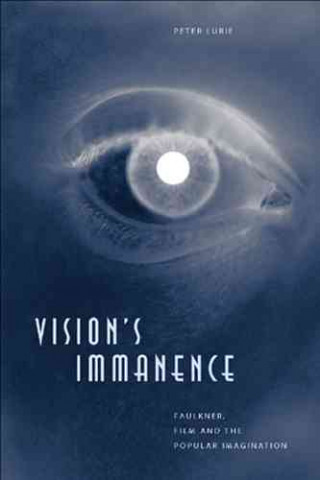
Vision's Immanence
by Peter Lurie
William Faulkner occupied a unique position as a modern writer. Although famous for his modernist novels and their notorious difficulty, he also wrote extensively for the "culture industry," and the works he produced for it-includ ... more


- Language:
 English
 - Binding: Hardback
- Number of pages: 256
Publisher: Johns Hopkins University Press, 2004
- More about this

61.28 €
Availability:
50/50 We think title might be available. Upon your order we will do our best to get it within 6 weeks.
We search the world
You might also like
-

Noragami: Stray God 1
8.93 € -27 % -
Universe From Nothing
9.13 € -33 % -

Gruffalo in Scots
8.63 € -24 % -
The Power and the Money: The Epic Clashes Between American Titans of Industry and Commanders in Chief
23.60 € -24 % -

Sull'alto Missouri. Tex Willer
31.64 € -

Milena Jesenska
17.87 € -11 % -

First Kingdom Vol. 6: Destiny
16.37 € -19 % -

Descubrir el transporte aéreo
26.11 € -

Sovereignty of Good
144.17 € -
De republica, vita, moribus, gestis, fama, religione, sanctitate: Imperatoris, Caesaris, Augusti, Quinti, Caroli, Maximi, Monarchae, libri septem
58.67 € -1 % -

Employment and Development under Globalization
55.65 € -

I Am a Super Girl!: An Acorn Book (Princess Truly #1): Volume 1
25.31 € -

Environmental Issues and Waste Management Technologies in the Ceramic and Nuclear Industries IX - Ceramic Transactions V155
131.81 € -9 % -

ISO 9001, Manual e interpretación práctica
61.88 € -14 % -

Handbook of Fiscal Federalism
312.36 € -

Cory and Blink
16.98 € -12 % -

Читательский дневник. Гравити Фолз (твердый переплет, с наклейками)
12.25 € -12 % -

Mechanical Behaviour of Materials
102.27 € -7 % -

New Technologies, Mobility and Security
171.19 € -
Timeless Management
109.81 € -

Open Mind
184.26 €
Give this book as a present today
- Order book and choose Gift Order.
- We will send you book gift voucher at once. You can give it out to anyone.
- Book will be send to donee, nothing more to care about.
Availability alert
Enter your e-mail address and once book will be available,
we will send you a message. It's that simple.
More about Vision's Immanence
You get 149 loyalty points
 Book synopsis
William Faulkner occupied a unique position as a modern writer. Although famous for his modernist novels and their notorious difficulty, he also wrote extensively for the "culture industry," and the works he produced for it-including short stories, adaptations, and screenplays-bore many of the hallmarks of consumer art. His experiences as a Hollywood screenwriter influenced him in a number of ways, many of them negative, while the films turned out by the "dream factories" in which he labored sporadically inspired both his interest and his contempt. Faulkner also disparaged the popular magazines-though he frequently sold short stories to them. To what extent was Faulkner's deeply ambivalent relationship to-and involvement with-American popular culture reflected in his modernist or "art" fiction? Peter Lurie finds convincing evidence that Faulkner was keenly aware of commercial culture and adapted its formulae, strategies, and in particular, its visual techniques into the language of his novels of the 1930s. Lurie contends that Faulkner's modernism can be best understood in light of his reaction to the popular culture of his day. Using Theodor Adorno's theory about modern cultural production as a framework, Lurie's close readings of Sanctuary, Light in August, Absalom! Absalom!, and If I Forget Thee, Jerusalem uncover the cultural history that surrounded and influenced the development of Faulkner's art. Lurie is particularly interested in the influence of cinema on Faulkner's fiction and especially the visual strategies he both deployed and critiqued. These include the suggestion of cinematic viewing on the part of readers and of characters in each of the novels; the collective and individual acts of voyeurism in Sanctuary and Light in August; the exposing in Absalom! Absalom! and Light in Augustof stereotypical and cinematic patterns of thought about history and race; and the evocation of popular forms like melodrama and the movie screen in If I Forget Thee, Jerusalem. Offering innovative readings of these canonical works, this study sheds new light on Faulkner's uniquely American modernism.
Book details
Book category Books in English Literature & literary studies Literature: history & criticism Literary studies: general
61.28 €
- Full title: Vision's Immanence
- Author: Peter Lurie
- Language: English
- Binding: Hardback
- Number of pages: 256
- EAN: 9780801879296
- ID: 04709449
- Publisher: Johns Hopkins University Press
- Weight: 476 g
- Dimensions: 229 × 152 × 20 mm
- Date of publishing: 26. September 2004
Trending among others
-
Plainwater
14.36 € -25 % -
Zofloya or The Moor
10.64 € -25 % -
If Not, Winter: Fragments Of Sappho
16.17 € -29 % -

SEOUL University Korean 1B Workbook (QR), m. 1 Audio
33.75 € -
Great Expectations
7.43 € -26 % -
Metamorphoses
7.32 € -24 % -

SEOUL University Korean 1B Student's Book (QR), m. 1 Audio
49.72 € -

Gulliver's Travels
6.52 € -25 % -

Weird and the Eerie
13.45 € -
North and South
7.93 € -29 % -
Villette
9.64 € -25 % -
Persuasion
5.62 € -19 % -
Great God Pan and Other Horror Stories
9.84 € -31 % -

Boyhood
10.44 € -31 % -
Hamlet: The Oxford Shakespeare
8.73 € -24 % -

Golden Bough
13.65 € -24 % -

Walden
9.43 € -25 % -
Athenaze, Book I
109.61 € -
Robinson Crusoe
6.72 € -23 % -
Three Theban Plays
15.46 € -13 % -

Memoirs of a Dutiful Daughter
13.15 € -28 % -
Iliad
11.04 € -22 % -
Poetics
9.43 € -24 % -

Serpent Power
28.42 € -24 % -
Poems of Catullus
10.84 € -25 % -
The Odyssey
16.27 € -26 % -
Consolation of Philosophy
11.54 € -26 % -
Art of Rhetoric
11.44 € -26 % -
Mabinogion
10.74 € -24 % -

Annotated Alice
12.05 € -32 % -
Mimesis
20.69 € -24 % -

David Copperfield
7.32 € -24 % -
Flatland
8.63 € -24 % -

Sir Gawain and the Green Knight
18.68 € -30 % -
Sicilian Romance
9.23 € -28 % -

Emily Dickinson's Poems
30.23 € -29 % -
Bacchae and Other Plays
20.49 € -

Macbeth
11.75 € -14 % -
Faust, Part I
8.73 € -25 % -

Discarded Image
15.76 € -25 % -

Happy Hooker
14.16 € -18 % -

Federico Garcia Lorca: A Life
15.16 € -
Letters to Atticus
33.15 € -5 % -
Letters to Atticus
33.15 € -5 % -

Doctor Faustus and Other Plays
11.44 € -26 % -

Call of the Wild, White Fang, and Other Stories
6.52 € -26 % -

Mansfield Park
6.52 € -25 % -

Total Art of Stalinism
16.47 € -17 % -

Dr Wortle's School
14.06 € -25 %
Collection points Bratislava a 13528 dalších
Copyright ©2008-26 najlacnejsie-knihy.sk All rights reservedPrivacyCookies

 27060 collection points
 Delivery 2.99 €
 02/210 210 99 (8-15.30h)