Code: 01405206
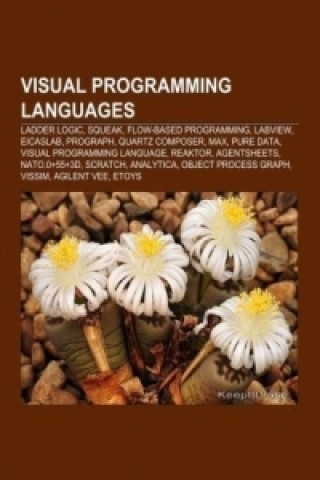
Visual programming languages
Source: Wikipedia. Pages: 53. Chapters: Ladder logic, Squeak, Flow-based programming, LabVIEW, EICASLAB, Prograph, Quartz Composer, Max, Pure Data, Visual programming language, Reaktor, AgentSheets, Nato.0+55+3d, Scratch, Analytic ... more


- Language:
 English
 - Binding: Paperback
- Number of pages: 54
Publisher: Books on Demand, 2012
- More about this

16.15 €
RRP: 18.98 €
You save 2.83 €

In stock at our supplier
Shipping in 5 - 8 days
You might also like
-

Základy metody projektového řízení PRINCE2
28.07 € -28 % -

Stray Kids
9.18 € -17 % -

Gropius
14.84 € -6 % -

Sharks
21.30 € -

Comprendre Spinoza (analyse complete de sa pensee)
7.36 € -3 % -

Down Among the Dead Men
29.08 € -

Summer at Firefly Beach
14.23 € -9 % -

Tracking the 101st Cavalry
25.14 € -2 % -

Curso de Economía Política, Tomo I
25.55 € -2 % -

City of Strangers
12.21 € -20 % -

Considering the Creation of a Domestic Intelligence Agency in the United States, 2009
36.35 € -

Dark Intruder
24.33 € -

Life of the Indigenous Mind
75.75 € -
The Moral Universe: A Preface to Christian Living
38.17 € -1 %
Give this book as a present today
- Order book and choose Gift Order.
- We will send you book gift voucher at once. You can give it out to anyone.
- Book will be send to donee, nothing more to care about.
More about Visual programming languages
You get 39 loyalty points
 Book synopsis
Source: Wikipedia. Pages: 53. Chapters: Ladder logic, Squeak, Flow-based programming, LabVIEW, EICASLAB, Prograph, Quartz Composer, Max, Pure Data, Visual programming language, Reaktor, AgentSheets, Nato.0+55+3d, Scratch, Analytica, Object Process Graph, VisSim, Agilent VEE, Etoys, Simulink, Limnor, Alice, Mama, Subtext, HyperNext, Usine, Stagecast Creator, Illumination Software Creator, Tersus, Google App Inventor, Lava, Kyma, Baltie, HiAsm, Vvvv, OpenMusic, VSXu, ToonTalk, Automator, AMBIT, Smalltalk YX, Ptolemy Project, Piet, Stateflow, Symbolic Sound Corporation, AppWare, DRAKON, Bidule, TOMVIEW, Deutsch limit, Lily, FxPlug, MST Workshop, ThingLab, Fabrik, CODE, GNU Radio Companion. Excerpt: In computer science, flow-based programming (FBP) is a programming paradigm that defines applications as networks of "black box" processes, which exchange data across predefined connections by message passing, where the connections are specified externally to the processes. These black box processes can be reconnected endlessly to form different applications without having to be changed internally. FBP is thus naturally component-oriented. FBP is a particular form of dataflow programming based on bounded buffers, information packets with defined lifetimes, named ports, and separate definition of connections. The FBP development approach views an application not as a single, sequential, process, which starts at a point in time, and then does one thing at a time until it is finished, but as a network of asynchronous processes communicating by means of streams of structured data chunks, called "information packets" (IPs). In this view, the focus is on the application data and the transformations applied to it to produce the desired outputs. The network is defined externally to the processes, as a list of connections which is interpreted by a piece of software, usually called the "scheduler". The processes communicate by means of fixed-capacity connections. A connection is attached to a process by means of a port, which has a name agreed upon between the process code and the network definition. More than one process can execute the same piece of code. At any point in time, a given IP can only be "owned" by a single process, or be in transit between two processes. Ports may either be simple, or array-type, as used e.g. for the input port of the Collate component described below. It is the combination of ports with asynchronous processes that allows many long-running primitive functions of data processing, such as Sort, Merge, Summarize, etc., to be supported in the form of software black boxes. Because FBP processes can continue executing as long they have data to work
Book details
16.15 €
- Full title: Visual programming languages
- Subtitle: Ladder logic, Squeak, Flow-based programming, LabVIEW, EICASLAB, Prograph, Quartz Composer, Max, Pure Data, Visual programming language, Reaktor, AgentSheets, Nato.0+55+3d, Scratch, Analytica, Object
- Language: English
- Binding: Paperback
- Number of pages: 54
- EAN: 9781156627273
- ID: 01405206
- Publisher: Books on Demand
- Weight: 124 g
- Dimensions: 246 × 189 × 3 mm
- Published: 2012
Trending among others
-

Moonwalk
13.93 € -18 % -

The Score
13.73 € -10 % -

The Deal
12.31 € -21 % -

The Mistake
13.42 € -1 % -

Jujutsu Kaisen, Vol. 30
9.89 € -20 % -

Berserk Deluxe Volume 1
35.65 € -25 % -

The Goal
14.64 € -7 % -

Berserk Deluxe Volume 2
33.12 € -30 % -

Dancing The Dream
19.89 € -31 % -
Invincible Compendium Volume 2
45.75 € -24 % -

Berserk Deluxe Volume 3
55.14 € -

Lord of Mysteries, Vol. 3: The Clown, Part III
17.06 € -13 % -

Murdoku
14.03 € -28 % -

Legacy
11.91 € -22 % -

White Nights
4.54 € -

Chainsaw Man, Vol. 21
7.67 € -30 % -
Invincible Compendium Volume 3
46.35 € -23 % -

Witch Hat Atelier Manga Box Set 1
55.75 € -29 % -

Jujutsu Kaisen, Vol. 29
9.89 € -20 % -

JoJo's Bizarre Adventure: Part 7--Steel Ball Run, Vol. 7
18.17 € -25 % -

Witch Hat Atelier: Grimoire Edition 1
35.24 € -29 % -

Jujutsu Kaisen, Vol. 25
9.69 € -25 % -

Berserk Deluxe Volume 5
54.84 € -

Jujutsu Kaisen, Vol. 26
10.29 € -21 % -

Heated Rivalry
12.41 € -8 % -

Lord of Mysteries, Vol. 1: The Clown, Part I
15.34 € -22 % -

Moonwalk: A Memoir
21.71 € -29 % -

Veil Volume 1
11.61 € -27 % -

Jujutsu Kaisen, Vol. 2
9.89 € -20 % -

Jujutsu Kaisen, Vol. 1
13.32 € -

Berserk Deluxe Volume 4
43.53 € -17 % -

Restitution
9.79 € -27 % -

Yesteryear
16.35 € -11 % -
Invincible Compendium Volume 1
45.75 € -24 % -

The Courage To Be Disliked
10.60 € -14 % -

Jujutsu Kaisen, Vol. 28
9.69 € -25 % -

Witch Hat Atelier: Grimoire Edition 2
34.64 € -30 % -

The Long Game
12.21 € -10 % -

Berserk Deluxe Volume 6
54.64 € -
Murdoku
14.84 € -27 % -

Jojo's Bizarre Adventure: Part 7--Steel Ball Run, Vol. 1
18.88 € -22 % -

Voracious
11.40 € -16 % -

Jojo's Bizarre Adventure: Part 7--Steel Ball Run, Vol. 2
18.27 € -24 % -

Jujutsu Kaisen, Vol. 3
9.28 € -28 % -

The Summer Hikaru Died, Vol. 7
11.91 € -21 % -
Lord of Mysteries, Vol. 2: The Clown, Part II
19.28 € -5 % -

Onyx Storm
11.10 € -18 % -

The Ballad of Falling Dragons
14.13 € -14 % -

Atomic Habits
15.75 € -23 %
Collection points Bratislava a 12873 dalších
Copyright ©2008-26 najlacnejsie-knihy.sk All rights reservedPrivacyCookies

 25750 collection points
 Delivery 2.99 €
 02/210 210 99 (8-15.30h)