Code: 04044198
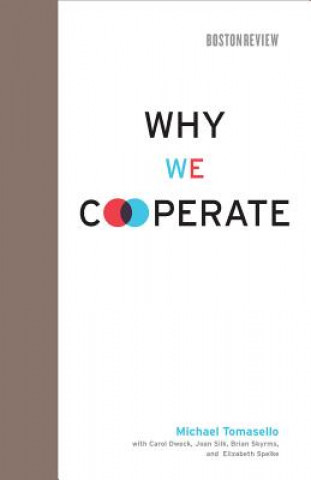
Why We Cooperate
by Tomasello
Drop something in front of a two-year-old, and she's likely to pick it up for you. This is not a learned behavior, psychologist Michael Tomasello argues. Through observations of young children in experiments he himself has designe ... more


- Language:
 English
 - Binding: Hardback
- Number of pages: 232
Publisher: MIT Press Ltd, 2009
- More about this

16.73 €
RRP: 18.57 €
You save 1.84 €
Availability:
50/50 We think title might be available. Upon your order we will do our best to get it within 6 weeks.
We search the world
You might also like
-

Meditations
8.41 € -28 % -

Before the Coffee Gets Cold
10.03 € -26 % -

The Book of Bill
22 € -24 % -

Haindl Tarot Deck
15.82 € -29 % -

Nier: Automata - Yorha Boys
11.35 € -25 % -

The Bushcraft Boxed Set
46.66 € -28 % -

The High Performance Planner
19.57 € -24 % -

Good Night, Lightning
6.58 € -24 % -

Sandman: The Deluxe Edition Book Two
35.70 € -26 % -

Basilica papale di Santa Maria Maggiore-Papal Basilica of Saint Mary Major
32.15 € -24 % -

Thinking and Reasoning: A Very Short Introduction
10.44 € -21 % -

Beautiful Beast
19.37 € -2 % -

Introduction to the Three Volumes of Karl Marx's Capital
18.15 € -15 % -

The Complete Works of Florence Scovel Shinn
8.71 € -

My Husband's Wife
18.56 € -23 % -

Later
9.12 € -25 % -

LITTLE WOMEN PAINTED EDITION
11.86 € -24 % -

Daughter of Smoke & Bone: The Complete Gift Set
32.15 € -24 % -

Art of War
17.64 € -26 % -

Disney Best of: 1001 Sticker - Stickern - Rätseln - Ausmalen
8.82 € -13 % -

The New Girl
9.12 € -20 % -

The Sublime Object of Ideology
17.74 € -18 % -

The Happiness Hypothesis: Finding Modern Truth in Ancient Wisdom
14.80 € -25 % -

Carmilla
10.64 € -25 % -

Make Tracks: Cars
8.61 € -24 % -

Moral Landscape
10.03 € -32 % -

Avatar: The Last Airbender: Volume 1 (Avatar: The Last Airbender)
14.40 € -9 % -

Look Inside an Airport
10.14 € -29 % -

Tobira Gateway to Advanced Jap
38.34 € -
AuDHD
16.73 € -1 % -

Children of Ash and Elm
19.67 € -22 % -

Introduction to Veterinary Anatomy and Physiology Textbook
51.22 € -

Misbehaving - The Making of Behavioral Economics
25.15 € -25 % -

Legendary Ladies Goddess Deck
12.77 € -24 % -

Objective First Student's Book with Answers with CD-ROM
61.67 € -

Future of Humanity
11.96 € -24 % -

Bringing Yoga to Life
12.77 € -25 % -

RYA Sea Survival Handbook
20.58 € -14 % -

Sanditon
16.12 € -29 % -

GUITAR SWEEP PICKING ARPEGGIOS
23.22 € -22 % -

Tokyo Ever After
14.09 € -25 % -

Escape Room
9.83 € -12 % -

Becoming Wise
12.27 € -30 % -

Fun Home: The Deluxe Collector's Edition
23.12 € -28 % -

Neuroscience for Business Transformation: Practical Insights to Overcome Workforce Resistance to Organizational Change
50.82 € -

C++20 STL Cookbook
45.54 € -2 % -

Smithsonian 10-Minute Science Experiments
11.86 € -29 % -

It Ends with Us
13.08 € -29 % -

Chanel
11.45 € -34 % -

The Good Dinosaur
5.87 € -25 % -

Knowledge Encyclopedia Dinosaur!
24.74 € -14 % -

Afoot and Lighthearted
11.56 € -29 % -

Science Comics
10.64 € -25 % -

Tao Te Ching
17.64 € -24 % -

Acupuncture in Pregnancy and Childbirth
69.38 € -

I am an Aspie Girl
19.37 € -

Introduction to Time Series and Forecasting
90.89 € -9 % -

Control Unleashed Reactive To Relaxed
51.73 € -

Attack on Titan 1
20.28 € -25 % -

The Secrets to Ultimate Weight Loss: A revolutionary approach to conquer cravings, overcome food addiction, and lose weight without going hungry
18.35 € -7 % -

The Hieroglyphic Monad
18.35 € -7 % -

Sense and Second-Degree Murder
9.73 € -25 % -

From Here to You (Reissue)
9.12 € -20 % -

Les Preludes and Other Symphonic Poems in Full Score
29.21 € -

Baby Shark
5.87 € -25 % -

Around the World in 80 Beers: A Global History of Brewing
28.60 € -25 % -

Forgotten Fighters
15 € -6 % -

Belief
20.28 € -5 % -

The Deadlands: Hunted
13.89 € -26 % -

Calder
35.60 € -24 % -

Kant's Conception of Pedagogy
39.35 € -10 % -

Richard Long
52.64 € -25 % -

What is the Lord's Supper?
8.41 € -

Mind Over Meds
17.74 € -17 % -

Another America
17.64 € -24 % -

How to Think Impossibly: About Souls, Ufos, Time, Belief, and Everything Else
36.31 € -

Ex: If Your Mirror Breaks
28.29 € -

Nocturnes
14.80 € -25 % -

World Book of Military Music and Musicians
15.82 € -1 % -

Feynman Processor
16.22 € -17 % -

North American Monsters
46.96 € -

CAL 26 NEW YORK TIMES XWORD
18.45 € -9 % -

Nanostructures And Nanomaterials: Synthesis, Properties, And Applications (2nd Edition)
99.01 € -

Small Animal Dermatology, An Issue of Veterinary Clinics of North America: Small Animal Practice
98.30 €
Give this book as a present today
- Order book and choose Gift Order.
- We will send you book gift voucher at once. You can give it out to anyone.
- Book will be send to donee, nothing more to care about.
Availability alert
Enter your e-mail address and once book will be available,
we will send you a message. It's that simple.
More about Why We Cooperate
You get 40 loyalty points
 Book synopsis
Drop something in front of a two-year-old, and she's likely to pick it up for you. This is not a learned behavior, psychologist Michael Tomasello argues. Through observations of young children in experiments he himself has designed, Tomasello shows that children are naturally--and uniquely--cooperative. Put through similar experiments, for example, apes demonstrate the ability to work together and share, but choose not to. As children grow, their almost reflexive desire to help--without expectation of reward--becomes shaped by culture. They become more aware of being a member of a group. Groups convey mutual expectations, and thus may either encourage or discourage altruism and collaboration. Either way, cooperation emerges as a distinctly human combination of innate and learned behavior.In Why We Cooperate, Tomasello's studies of young children and great apes help identify the underlying psychological processes that very likely supported humans' earliest forms of complex collaboration and, ultimately, our unique forms of cultural organization, from the evolution of tolerance and trust to the creation of such group-level structures as cultural norms and institutions.Scholars Carol Dweck, Joan Silk, Brian Skyrms, and Elizabeth Spelke respond to Tomasello's findings and explore the implications.
Book details
Book category Books in English Society & social sciences Psychology Child & developmental psychology
16.73 €
- Full title: Why We Cooperate
- Author: Tomasello
- Language: English
- Binding: Hardback
- Number of pages: 232
- EAN: 9780262013598
- ISBN: 0262013592
- ID: 04044198
- Publisher: MIT Press Ltd
- Weight: 290 g
- Dimensions: 183 × 123 × 22 mm
- Date of publishing: 28. August 2009
Trending among others
-

Understanding Human Nature
12.06 € -

Assessing Adult Attachment
42.60 € -18 % -

Playing and Reality
33.57 € -4 % -

Conscious Parent
18.15 € -24 % -

Attachment
30.93 € -

Integrating Play Therapy and Emdr with Children
13.99 € -1 % -

How Children Fail
14.80 € -25 % -

Tree of Knowledge
28.09 € -27 % -
Optimistic Child
18.15 € -24 % -

Trapped in the Mirror
14.09 € -25 % -

Child
56.19 € -

Attention, Balance and Coordination - The A.B.C.of Learning Success 2e
74.35 € -2 % -

Teenage Brain
16.02 € -25 % -

Gratitude Works! A 21-Day Program for Creating Emotional Prosperity
17.24 € -26 % -

Self Efficacy
156.53 € -

Moral Judgment of the Child
21.50 € -17 % -

Evolutionary Psychology
51.12 € -

Adaptation to Life
32.96 € -1 % -

Art and Science of Personality Development
46.45 € -

Handbook of Identity Theory and Research
372.72 € -

Work of the Imagination
56.09 € -

Phases of Childhood
25.45 € -12 % -

Highly Sensitive Child
14.90 € -30 % -

Interpersonal World of the Infant
33.16 € -

Range
21.60 € -27 % -

Uses of Enchantment
12.98 € -30 % -

Affect Regulation, Mentalization, and the Development of the Self
36.51 € -2 % -

Evolving Self
33.87 € -6 % -

Free to Learn
14.80 € -25 % -

Bright Kids Who Can't Keep Up
12.77 € -24 % -

Early Trauma
28.40 € -1 % -

Secure Base
30.32 € -

Mothers, Sons, and Lovers
27.48 € -18 % -

The Psychology of the Child
24.44 € -

Life Cycle Completed
12.47 € -21 % -

Conscious Femininity
17.13 € -24 % -

Identity and the Life Cycle
13.18 € -21 % -

Early Start Denver Model for Young Children with Autism
78.01 € -

How Children Learn
14.09 € -24 % -

Truth Will Set You Free
16.22 € -17 % -

EMDR Therapy and Adjunct Approaches with Children
72.63 € -

End of Average
13.38 € -27 % -

Developmental Neuropsychology
63.19 € -

Maturity
9.63 € -48 % -

Me, Myself, and Us
14.80 € -25 % -

Cambridge Handbook of Infant Development
75.37 € -

Bilingual
25.86 € -12 % -

Disappearance of Childhood
12.16 € -28 % -

Neurobiology and the Development of Human Morality
32.35 € -38 %
Collection points Bratislava a 13219 dalších
Copyright ©2008-26 najlacnejsie-knihy.sk All rights reservedPrivacyCookies

 26442 collection points
 Delivery 2.99 €
 02/210 210 99 (8-15.30h)