Code: 04639567
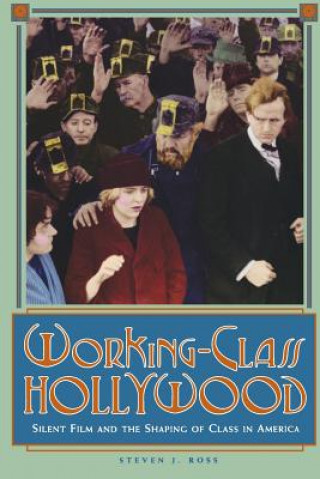
Working-Class Hollywood
by Steven J. Ross
This path-breaking book reveals how Hollywood became "Hollywood" and what that meant for the politics of America and American film. "Working-Class Hollywood" tells the story of filmmaking in the first three decades of the twentiet ... more


- Language:
 English
 - Binding: Paperback
- Number of pages: 392
Publisher: Princeton University Press, 1999
- More about this


You might also like

Give this book as a present today
- Order book and choose Gift Order.
- We will send you book gift voucher at once. You can give it out to anyone.
- Book will be send to donee, nothing more to care about.
More about Working-Class Hollywood
You get 149 loyalty points
 Book synopsis
This path-breaking book reveals how Hollywood became "Hollywood" and what that meant for the politics of America and American film. "Working-Class Hollywood" tells the story of filmmaking in the first three decades of the twentieth century, a time when going to the movies could transform lives and when the cinema was a battleground for control of American consciousness. Steven Ross documents the rise of a working-class film movement that challenged the dominant political ideas of the day. Between 1907 and 1930, worker filmmakers repeatedly clashed with censors, movie industry leaders, and federal agencies over the kinds of images and subjects audiences would be allowed to see. The outcome of these battles was critical to our own times, for the victors got to shape the meaning of class in twentieth- century America.Surveying several hundred movies made by or about working men and women, Ross shows how filmmakers were far more concerned with class conflict during the silent era than at any subsequent time. Directors like Charlie Chaplin, D. W. Griffith, and William de Mille made movies that defended working people and chastised their enemies. Worker filmmakers went a step further and produced movies from "A Martyr to His Cause" (1911) to "The Gastonia Textile Strike" (1929) that depicted a unified working class using strikes, unions, and socialism to transform a nation. J. Edgar Hoover considered these class-conscious productions so dangerous that he assigned secret agents to spy on worker filmmakers.Liberal and radical films declined in the 1920s as an emerging Hollywood studio system, pressured by censors and Wall Street investors, pushed American film in increasingly conservative directions. Appealing to people's dreams of luxury and upward mobility, studios produced lavish fantasy films that shifted popular attention away from the problems of the workplace and toward the pleasures of the new consumer society. While worker filmmakers were trying to heighten class consciousness, Hollywood producers were suggesting that class no longer mattered. "Working-Class Hollywood" shows how silent films helped shape the modern belief that we are a classless nation.
Book details
Book category Books in English The arts Film, TV & radio Films, cinema
61.72 €
- Full title: Working-Class Hollywood
- Subtitle: Silent Film and the Shaping of Class in America
- Author: Steven J. Ross
- Language: English
- Binding: Paperback
- Number of pages: 392
- EAN: 9780691024646
- ISBN: 0691024642
- ID: 04639567
- Publisher: Princeton University Press
- Weight: 614 g
- Dimensions: 238 × 157 × 25 mm
- Date of publishing: 14. December 1999
Trending among others
-

Stranger Things: The Ultimate Pop-Up Book
74.88 € -5 % -
Hollywood Babylon
8.29 € -29 % -
The Illusion of Life : Disney Animation
60.10 € -9 % -

Star Trek: Light-Up Starship Enterprise
11.63 € -20 % -

Lighting for Cinematography
37.64 € -15 % -

The Art of Princess Mononoke
24.99 € -25 % -
Story
28.43 € -19 % -

Art of How to Train Your Dragon 2
31.26 € -29 % -

Alien Covenant: David's Drawings
42.90 € -9 % -

Lynch on Lynch
14.76 € -28 % -

Spiderman Into the Spider-Verse
41.48 € -10 % -
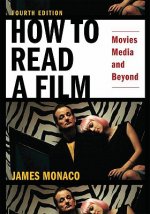
How to Read a Film
24.48 € -24 % -
Vision
31.46 € -30 % -

Sculpting in Time
33.79 € -6 % -

WKW: The Cinema of Wong Kar Wai
45.83 € -24 % -
Art of Pixar
51.40 € -15 % -

Interstellar
19.83 € -30 % -

Save the Cat! Goes to the Movies
17.09 € -24 % -

Harry Potter: Page to Screen: Updated Edition
58.79 € -29 % -
Art of Toy Story 4
30.35 € -21 % -
Movie Art of Syd Mead: Visual Futurist
36.52 € -21 % -
Eat What You Watch
16.28 € -29 % -
Pulp Fiction
9.71 € -29 % -

Mean Girls: The Burn Book Hardcover Ruled Journal
13.65 € -27 % -
Adventure Time - The Enchiridion & Marcy's Super Secret Scrapbook
21.24 € -25 % -
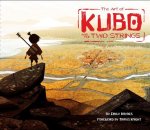
Art of Kubo and the Two Strings
45.93 € -
Hollywood Cartoons
31.26 € -

Cinema of Lars von Trier
29.84 € -
Monty Python and the Holy Grail: Screenplay
12.23 € -14 % -

Rhythmic Illusions
47.45 € -

Scandinavian Blue
37.64 € -

Anthony Mann
31.36 € -

Art of Rick and Morty
31.67 € -24 % -
My Wonderful World Of Slapstick
17.70 € -17 % -

Star Trek: 50 Artists 50 Years
25.09 € -26 % -
Art of Ralph Breaks the Internet: Wreck-It Ralph 2
37.74 € -1 % -
The Animator's Survival Kit
26.30 € -28 % -

Alien: The Blueprints
30.35 € -24 % -

Filmmaker's Handbook, The (fifth Edition)
32.27 € -24 % -

Alien: The Archive - The Ultimate Guide to the Classic Movies
35.71 € -24 % -

Star Wars - the Jedi Path
20.13 € -16 % -

Jurassic Park
52.51 € -25 % -

Animator's Survival Kit
57.77 € -24 % -

Donnie Darko Book
14.06 € -25 % -

Star Wars - The Bounty Hunter Code
18.81 € -11 % -

Making of Aliens
47.35 € -24 % -
Godard On Godard
14.76 € -25 % -

100 All-Time Favorite Movies of the 20th Century
20.23 € -28 % -

Art of The Secret World of Arrietty
25.09 € -25 %
Collection points Bratislava a 12837 dalších
Copyright ©2008-26 najlacnejsie-knihy.sk All rights reservedPrivacyCookies

 25678 collection points
 Delivery 2.99 €
 02/210 210 99 (8-15.30h)