Code: 04709199
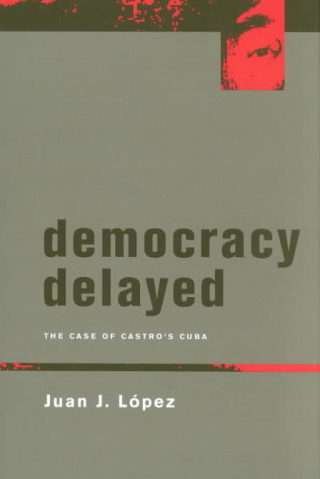
Democracy Delayed
by Juan J. Lopez
With the dissolution of the Soviet Union, foreign policy analysts and international relations scholars expected communist Cuba to undergo transitions to democracy and to markets as had the Eastern European nations of the former So ... more


- Language:
 English
 - Binding: Hardback
- Number of pages: 272
Publisher: Johns Hopkins University Press, 2002
- More about this

51.92 €
Availability:
50/50 We think title might be available. Upon your order we will do our best to get it within 6 weeks.
We search the world
You might also like
-

Side by Side
8.68 € -25 % -

Threads
31.61 € -25 % -

Kawasaki 400, 500 & 550 Fours (79 - 91)
42.32 € -10 % -

Konstruktionsdetails im Garten- und Landschaftsbau
71.12 € -12 % -

Cardiff and District 1890
5.14 € -9 % -

Dialectic of Nihilsm - Post-Structuralism and Law
52.93 € -

National Geographic Investigates
13.73 € -26 % -

Bent
17.37 € -

Active RC Filter Design
147.40 € -

Crossing the 49th Parallel
79.50 € -

Customer-Driven Organization
53.94 € -

Piratenkarte (Kinderpuzzle)
10.50 € -9 % -

Masculine of 'Virgin'
23.83 € -

Multipreneurship
222.77 € -

Fates of Political Liberalism in the British Post-Colony
114.76 € -

Replique A M. Seymour (Auguste)
12.11 € -1 % -

Wycliffe's Wild-Goose Chase
10.80 € -24 % -

Glass is Elastic
17.37 € -22 % -

Distributed Model Predictive Control Made Easy
154.16 € -7 % -

Selected Poems from Opened Ground: York Notes Advanced
9.89 € -14 % -

Culture, Conflict, and Counterinsurgency
68.89 €
Give this book as a present today
- Order book and choose Gift Order.
- We will send you book gift voucher at once. You can give it out to anyone.
- Book will be send to donee, nothing more to care about.
Availability alert
Enter your e-mail address and once book will be available,
we will send you a message. It's that simple.
More about Democracy Delayed
You get 126 loyalty points
 Book synopsis
With the dissolution of the Soviet Union, foreign policy analysts and international relations scholars expected communist Cuba to undergo transitions to democracy and to markets as had the Eastern European nations of the former Soviet bloc. But more than a decade after the fall of the Berlin Wall, Castro remains in power, with no sign that the Cuban government or economy is moving toward liberalization. In Democracy Delayed, political scientist Juan Lopez offers a searching and detailed analysis of the factors behind Cuba's failure to liberalize. Lopez begins by comparing the political systems of three Eastern European states-the former German Democratic Republic, Czechoslovakia, and Romania-with that of Cuba, in order to identify the differences that have allowed Castro to maintain his hold over the government and the economy. Lopez also shows the various conditions promoting change, including the development of civil society groups in Cuba, and discusses why some U.S. policies help the possibility of democratization in Cuba while others hinder it. While the Catholic Church in Poland and the Protestant Church in East Germany fostered change, the Catholic Church in Cuba has not taken a defiant stance against authoritarianism but seems instead to be biding its time until Castro is out of the picture. In conclusion, Lopez argues that a political transition in Cuba is possible even under the government of Fidel Castro. Some necessary conditions have been missing, but it is possible that U.S. policies could lay the groundwork for democratic charge.
Book details
Book category Books in English Society & social sciences Politics & government Political ideologies
51.92 €
- Full title: Democracy Delayed
- Subtitle: The Case of Castro's Cuba
- Author: Juan J. Lopez
- Language: English
- Binding: Hardback
- Number of pages: 272
- EAN: 9780801870460
- ISBN: 0801870461
- ID: 04709199
- Publisher: Johns Hopkins University Press
- Weight: 499 g
- Dimensions: 229 × 152 × 21 mm
- Date of publishing: 15. December 2002
Trending among others
-

The Communist Manifesto
4.33 € -28 % -

Capital
6.36 € -28 % -

Blackshirts and Reds
7.26 € -57 % -

The Unabomber Manifesto
9.39 € -1 % -

State and Revolution
6.56 € -

Imperialism the Highest Stage of Capitalism
6.86 € -

Road to Serfdom
15.45 € -25 % -

The Communist Manifesto
1.81 € -12 % -

Capital
16.96 € -24 % -

Grundrisse
17.17 € -26 % -

Capital
16.16 € -27 % -

Politics of Belonging
43.53 € -9 % -

Translating Anarchy - The Anarchism of Occupy Wall Street
21.41 € -17 % -

Reform or Revolution and Other Writings
12.72 € -25 % -

ABCs of Socialism
11.71 € -26 % -

Ticklish Subject
31.11 € -18 % -

Stalin's Letters to Molotov, 1925-36
30.50 € -19 % -
![What Is to Be Done? [Burning Questions of Our Movement]](https://media.libris.to/jacket/08800888t.jpg "What Is to Be Done? [Burning Questions of Our Movement]")
What Is to Be Done? [Burning Questions of Our Movement]
7.47 € -

Imagined Communities
17.47 € -

Communist Manifesto
7.26 € -24 % -

Capital
15.55 € -24 % -

Notes on Nationalism
3.73 € -10 % -

Anatomy of Fascism
12.52 € -28 % -

Rules for Radicals
14.84 € -24 % -

The Rape of the Mind
12.52 € -

Capitalism, Socialism and Democracy
12.32 € -

Old Is Dying and the New Cannot Be Born
12.32 € -18 % -

Coming Insurrection
10.60 € -25 % -

Fascism
25.55 € -2 % -

Anti-Duhring
18.88 € -25 % -

Mass Psychology of Fascism
18.07 € -25 % -

Economic and Philosophic Manuscripts of 1844
7.16 € -25 % -

ALL NEW Don't Think of an Elephant!
13.23 € -12 % -

What Is Populism?
10.50 € -29 % -

Occult Roots of Nazism
15.75 € -23 % -

Liberalism
12.82 € -12 % -

Fascism
6.05 € -

Capital
11 € -23 % -

Inside The Third Reich
19.79 € -26 % -

Black Book: What if Germany had won World War II - A Chilling Glimpse into the Nazi Plans for Great Britain
11.81 € -25 % -

Superpatriotism
14.03 € -25 % -

Communist Manifesto
14.24 € -29 % -

Brief History of Neoliberalism
24.84 € -1 % -

Fools, Frauds and Firebrands
14.13 € -29 % -

Hegemony And Socialist Strategy
18.78 € -22 % -

Marx: A Very Short Introduction
9.99 € -24 % -

Marx, Capital and the Madness of Economic Reason
11 € -30 % -

Introduction to Civil War
11.71 € -26 % -

My Rise And Fall
22.92 € -17 %
Collection points Bratislava a 12770 dalších
Copyright ©2008-26 najlacnejsie-knihy.sk All rights reservedPrivacyCookies

 25544 collection points
 Delivery 2.99 €
 02/210 210 99 (8-15.30h)