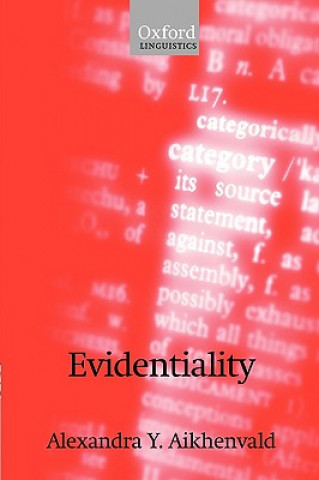
Code: 04477462
Evidentiality
by Aikhenvald, Alexandra Y. (Professor and Associate Director, La Trobe University)
"Highly recommended...extremely useful." Linguist List In some languages, every statement must contain a specification of the type of evidence on which it is based: for example, whether the speaker saw it, heard it, inferred it fr ... more


- Language:
 English
 - Binding: Paperback
- Number of pages: 480
Publisher: Oxford University Press, 2006
- More about this


You might also like
-

Triple
11.22 € -28 % -

COCO EL PERRO
18.30 € -

Zilly und Zingaro. Die Krabbeltier-Safari
12.23 € -13 % -

Never Give Up
21.23 € -25 % -

Essai Sur La Condition Civile Des Femmes: These Pour Le Doctorat
21.13 € -2 % -

Object Relations in Severe Trauma
58.86 € -

Vulnerabilite Aux Inondations En Milieu Urbain
122.59 € -14 % -

How Math Can Save Your Life
22.85 € -9 % -

R. L. Saunders Satire Collection 02
12.13 € -1 % -

Today Tracie Will Be a Princess
21.74 € -24 % -

Kai the Kangaroo and His Mask Too
7.88 € -25 % -

Pharmacological Intervention in Management of Neck Pain Disorders
77.98 € -10 % -

Books
12.74 € -

Ypres to Verdun; a Collection of Photographs of the war Areas in France & Flanders
18.40 € -1 %
Give this book as a present today
- Order book and choose Gift Order.
- We will send you book gift voucher at once. You can give it out to anyone.
- Book will be send to donee, nothing more to care about.
More about Evidentiality
You get 158 loyalty points
 Book synopsis
"Highly recommended...extremely useful." Linguist List In some languages, every statement must contain a specification of the type of evidence on which it is based: for example, whether the speaker saw it, heard it, inferred it from indirect evidence, or learnt it from someone else. This grammatical reference to information source is called 'evidentiality', and is one of the least described grammatical categories. Evidentiality systems differ in how complex they are: some distinguish just two terms (eyewitness and non-eyewitness, or reported and everything else), while others have six or even more terms. Evidentiality is a category in its own right, and not a subcategory of epistemic or some other modality, nor of tense-aspect. Every language has some way of referring to the source of information, but not every language has grammatical evidentiality. In English expressions such as 'I guess', 'they say', 'I hear that', and 'the alleged' are not obligatory and do not constitute a grammatical system. Similar expressions in other languages may provide historical sources for evidentials. True evidentials, by contrast, form a grammatical system. In the North Arawak language Tariana, an expression such as 'the dog bit the man' must be augmented by a grammatical suffix indicating whether the event was seen, heard, assumed, or reported. This book provides the first exhaustive cross-linguistic typological study of how languages deal with the marking of information source. Examples are drawn from more than 500 languages from all over the world, several of them based on the author's original fieldwork. Professor Aikhenvald also considers the role evidentiality plays in human cognition, and the ways in which evidentiality influences human perception of the world. This is an important book on an intriguing subject. It will interest anthropologists, cognitive psychologists and philosophers, as well as linguists.
Book details
Book category Books in English Language linguistics Semantics, discourse analysis, etc
65.44 €
- Full title: Evidentiality
- Author: Aikhenvald, Alexandra Y. (Professor and Associate Director, La Trobe University)
- Language: English
- Binding: Paperback
- Number of pages: 480
- EAN: 9780199204335
- ISBN: 0199204330
- ID: 04477462
- Publisher: Oxford University Press
- Weight: 676 g
- Dimensions: 233 × 156 × 26 mm
- Date of publishing: 01. June 2006
Trending among others
-
Comic Toolbox
11.32 € -24 % -

How to Do Critical Discourse Analysis
35.50 € -10 % -
Language in Thought and Action
14.05 € -25 % -
Lover's Discourse
12.94 € -30 % -

Selections from Science and Sanity
12.03 € -25 % -

Language and Symbolic Power
24.17 € -5 % -

Word and Object (Studies in Communication)
18.30 € -

Farnsworth's Classical English Rhetoric
15.37 € -24 % -

Mythologies
13.95 € -24 % -
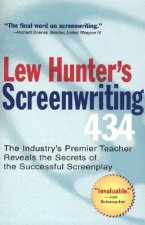
Lew Hunter's Screenwriting 434
21.44 € -18 % -

Political Correctness - A History of Semantics and Culture
44.30 € -9 % -

After Babel
26.39 € -

Time and Narrative
26.49 € -
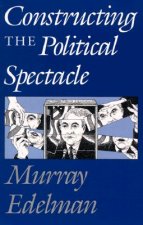
Constructing the Political Spectacle
29.83 € -
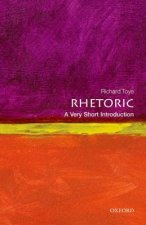
Rhetoric: A Very Short Introduction
10 € -24 % -
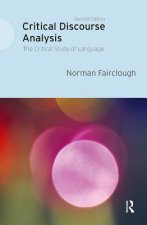
Critical Discourse Analysis
65.84 € -
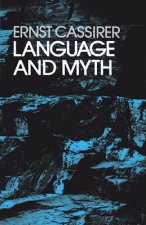
Language and Myth
7.17 € -25 % -

How to Read a Poem
14.05 € -25 % -
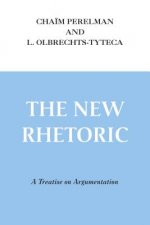
New Rhetoric, The
38.94 € -

Sign of Three
27.61 € -

Lexikologie, Phraseologie, Semantik kontrastiv
73.53 € -6 % -

Winning Arguments
14.66 € -18 % -
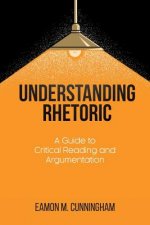
Understanding Rhetoric
37.32 € -1 % -

Meaning and Relevance
57.75 € -
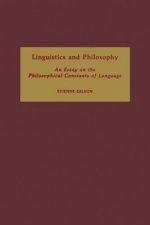
Linguistics and Philosophy
32.66 € -20 % -

Image and Concept
56.03 € -

Introducing Semiotics
9.70 € -25 % -
Three Steps on the Ladder of Writing
24.87 € -12 % -

Language and Power
77.17 € -

Think Again
12.74 € -25 % -

Role of the Reader
22.75 € -2 % -
Using Corpora in Discourse Analysis
62.10 € -
Stylistics
39.44 € -
Discourse and Social Change
25.58 € -4 % -
Meaning in Language
45.61 € -
Morphology and Lexical Semantics
34.89 € -21 % -

Arguing and Thinking
41.97 € -21 % -

How to do Discourse Analysis
48.14 € -
Linguistic Semantics
60.38 € -
Pragmatics of Translation
38.43 € -10 % -

On Dialogue
33.27 € -
Semantics
39.74 € -
Meaning in Interaction
71.91 € -

Functional Discourse Grammar for English
67.26 € -
Digital Discourse
54.41 € -

Finding What You Didn't Lose
21.44 € -18 % -

Anglicisms and Corpus Linguistics
62.51 € -9 % -
Idioms and Collocations
198.46 € -

Collocation
53.30 € -4 %
Collection points Bratislava a 12880 dalších
Copyright ©2008-26 najlacnejsie-knihy.sk All rights reservedPrivacyCookies

 25764 collection points
 Delivery 2.99 €
 02/210 210 99 (8-15.30h)