Code: 01401284
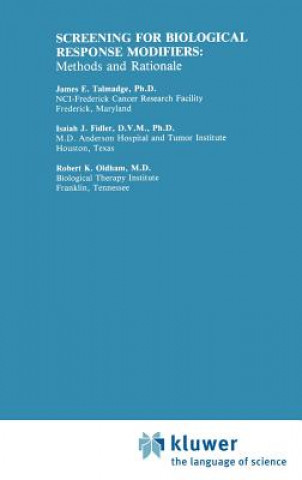
Screening for Biological Response Modifiers: Methods and Rationale
by James E. Talmadge, Isaiah J. Fidler, Robert K. Oldham
The observation in the 1950s that nitrogen mustard and other toxic chemicals could induce antitumor responses in patients with refractory lymphoma initiated a massive search for active chemotherapeutic agents. The initial observat ... more


- Language:
 English
 - Binding: Hardback
- Number of pages: 194
Publisher: Kluwer Academic Publishers
- More about this

102.69 €
RRP: 111.29 €
You save 8.60 €

In stock at our supplier
Shipping in 10 - 13 days
You might also like
-

The Nightblood Prince
15.43 € -25 % -

Calciatori. Enciclopedia Panini del calcio italiano
100.47 € -

The Reception of Jesus in the First Three Centuries: Volume 1
50.74 € -

G K Chesterton: a Reappraisal
35.80 € -15 % -

47th Publication Design Annual
71.32 € -

Theory of Matrices in Numerical Analysis
11.29 € -24 % -

Mi primer método de piano: Aprende por colores
11.89 € -6 % -

Sprache fördern mit allen Sinnen
9.07 € -10 % -

Blue Ocean Strategy for Small and Mid-sized Companies in Germany
33.89 € -14 % -

Die Paumgartner von Nürnberg und Augsburg.
42.36 € -6 % -

SILK THROWING AND WASTE SILK SPINNING
30.86 € -2 % -

Operative Dictations in Pediatric Surgery
140.63 € -9 % -

Histoire des politiques éducatives dans l'éducation de base au Burkina
70.91 € -12 % -

A Sequence Stratigraphic Approach of Sylhet Trough
68.79 € -3 % -

Chaos, orde en bewustzijn: Een reis door de kosmos op zoek naar bewustzijn
20.97 € -7 % -
Prosthodontic Management of Temporomandibular Joint Disorders
70.91 € -14 % -

New Headway Video: Beginner: DVD
113.59 € -

Deliver Excellent Customer Service With A SNAP: A No Cost Way To Restore Full Service
7.96 € -6 % -

The Preacher's Hebrew Companion to Isaiah 40--66
35.30 € -25 % -

Thunder 3 T07
12.20 € -
"Все мысли для выхода в свет - заперты". Дневники 1930-х годов
26.02 € -12 % -

Dead Balls and Double Curves
20.07 € -4 % -

Fort Ontario: Guardian of the North
19.56 € -21 % -

Money, Capital Mobility, and Trade
11.79 € -

Impacto de los juegos matemáticos
40.85 € -14 % -

Lexikon der Sprichwoerter und Redensarten Band 5 (De - De )
39.13 € -11 % -

Curiosites Du Vieux Montmartre: Les Fontaines, Montmartre-Vignoble (Ed.1893)
13.81 € -2 % -

Lettre de Menenius Agrippa Aux Capacites de 1848 Et Au Suffrage Universel de 1869
13 € -1 % -
Developing Responsive Human Services
199.24 € -

Das Prinzip der Eigentumsopferentschädigung im Zivilrecht und im öffentlichen Recht.
75.05 € -6 % -

Modern Utopia
21.88 € -10 % -

EZ LEMAIO LA QUEMA DE MONDRAGON
16.74 € -

Vorstellung Vom Weltgebaude Im Wandel Der Zeiten
31.97 € -11 % -

Party-Voter Linkage in Africa
55.68 € -

De Calamitis Et Lithanthracibus (1841)
18.35 € -1 %
Give this book as a present today
- Order book and choose Gift Order.
- We will send you book gift voucher at once. You can give it out to anyone.
- Book will be send to donee, nothing more to care about.
More about Screening for Biological Response Modifiers: Methods and Rationale
You get 249 loyalty points
 Book synopsis
The observation in the 1950s that nitrogen mustard and other toxic chemicals could induce antitumor responses in patients with refractory lymphoma initiated a massive search for active chemotherapeutic agents. The initial observations stimulated a search for new chemotherapeutic agents which might have increased antitumor activity with less toxicity for normal tissues. To aid in the search for these new chemicals and to attempt to distinguish among the many toxic chemicals which might be candidates for clinical studies, the National Cancer Institute, the pharmaceutical industry, and the cancer research laboratories of most Western nations developed systems for "screening" drugs for antitumor activity. Perhaps the most extensive screening program was established by the National Cancer Institute (1). This screening program has evolved over the last two decades, an evolution which has been repeatedly reviewed (2-5). Various screening programs in use have examined over 500,000 compounds as potential anticancer agents. From these, there are now approximately forty anticancer drugs in clinical use. The utiliy of these compounds and their toxicities have been reviewed on many occasions. It is now apparent that more active and less toxic anticancer drugs are needed. It is also clear that the current screening programs are identifying compounds with similar levels of activity and with continuing moderate to severe toxicity (6).
Book details
Book category Books in English Medicine Clinical & internal medicine Diseases & disorders
102.69 €
- Full title: Screening for Biological Response Modifiers: Methods and Rationale
- Author: James E. Talmadge, Isaiah J. Fidler, Robert K. Oldham
- Language: English
- Binding: Hardback
- Number of pages: 194
- EAN: 9780898387124
- ISBN: 0898387124
- ID: 01401284
- Publisher: Kluwer Academic Publishers
- Weight: 1050 g
- Dimensions: 234 × 156 × 14 mm
Trending among others
-
Radical Remission
14.11 € -27 % -
Cellular and Molecular Immunology
93.41 € -6 % -

Natural Treatments for Lyme Coinfections
16.84 € -24 % -

Atlas of Full Breast Ultrasonography
200.65 € -9 % -

Healing Add
14.82 € -24 % -

Healing Lyme Disease Coinfections
16.84 € -24 % -

How to Starve Cancer
24 € -14 % -

Cancer-Fighting Kitchen, Second Edition
30.36 € -11 % -

Bethesda Handbook of Clinical Oncology
77.57 € -9 % -

Everyday Mindfulness for OCD
12.70 € -24 % -

Cancer Is Not a Disease - It's a Healing Mechanism
19.86 € -25 % -
Roitt's Essential Immunology 13e
73.84 € -

Cardiac Pacing, Defibrillation and Resynchronization - A Clinical Approach, 4th Edition
101.88 € -5 % -

Netter's Infectious Diseases
99.97 € -5 % -

Oxford Handbook of Clinical Immunology and Allergy
52.05 € -

Great Influenza
14.21 € -24 % -
CT Anatomy for Radiotherapy
95.33 € -
Target Volume Delineation for Conformal and Intensity-Modulated Radiation Therapy
175.23 € -9 % -
Plotkin's Vaccines
356.12 € -5 % -
Breath Sounds
130.54 € -9 % -

Cancer & Its Homeopathic Treatment with Illustrative Cases
5.14 € -

Antibody Engineering Protocols
109.15 € -
Musculoskeletal Imaging
99.97 € -5 % -

Peanut Allergy Epidemic
14.01 € -44 % -
Immune System: A Very Short Introduction
12.50 € -9 % -

Cancer and the New Biology of Water
18.15 € -25 % -
LYMPH & LONGEVITY
18.05 € -25 % -
Breast Ultrasound
90.48 € -9 % -
Medical Microbiology
98.15 € -6 % -

Breast Ultrasound
74.85 € -

Healing Songs
36.11 € -
In the Crucible of Chronic Lyme Disease
25.01 € -25 % -

Spillover
16.13 € -25 % -
Graphic Guide to Infectious Disease
47.81 € -

Cancer as a Metabolic Disease - On the Origin, Management, and Prevention of Cancer
140.22 € -9 % -
Manual of Clinical Oncology
69 € -10 % -

Target Volume Delineation for Conformal and Intensity-Modulated Radiation Therapy
220.73 € -9 % -

Immunology of Recurrent Pregnancy Loss and Implantation Failure
145.17 € -

Key to Self-Liberation
92.30 € -
Cardio-Oncology Practice Manual: A Companion to Braunwald's Heart Disease
135.88 € -4 % -

New Paradigms in Lyme Disease Treatment
28.44 € -25 % -
Illustrated Anatomical Segmentectomy for Lung Cancer
160.60 € -9 % -

Homoeopathy In Epidemic Diseases
16.03 € -24 % -
Lyme Brain
35.30 € -25 % -

One Renegade Cell
14.01 € -25 % -
Stereotactic Radiosurgery and Stereotactic Body Radiation Therapy (SBRT)
291.05 € -
When Antibiotics Fail
32.58 € -25 % -
Radiobiology and Radiation Hormesis
120.55 € -9 % -
Immunology for Medical Students
46.30 € -5 %
Collection points Bratislava a 12730 dalších
Copyright ©2008-26 najlacnejsie-knihy.sk All rights reservedPrivacyCookies

 25464 collection points
 Delivery 2.99 €
 02/210 210 99 (8-15.30h)