Kód: 50845635
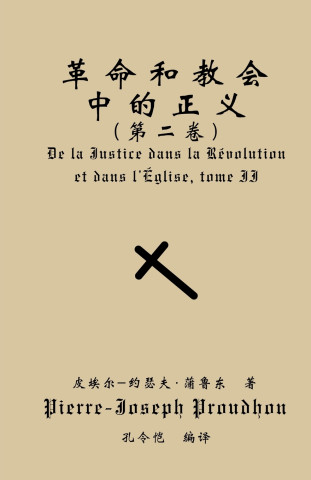
革命与教会中的正义(第二卷)
Autor Pierre-Joseph Proudhon, Lingkai Kong
In De la Justice dans la Révolution et dans l'Église, Volume II shifts the investigation from the foundational principles of justice to their formation, deformation, and contestation within concrete social practices. If the first ... celý popis


- Jazyk:
 Čínština
 - Väzba: Brožovaná
- Počet strán: 552
Nakladateľ: Karl-Marx Verlag, 2026
- Viac informácií o knihe

18.32 €
Bežne: 24.37 €
Ušetríte 6.05 €

Skladom u dodávateľa
Odosielame za 9 - 15 dní
Mohlo by sa vám tiež páčiť

Darčekový poukaz: Radosť zaručená
- Darujte poukaz v ľubovoľnej hodnote, a my sa postaráme o zvyšok.
- Poukaz sa vzťahuje na všetky produkty v našej ponuke.
- Elektronický poukaz si vytlačíte z e-mailu a môžete ho ihneď darovať.
- Platnosť poukazu je 12 mesiacov od dátumu vystavenia.
Viac informácií o knihe 革命与教会中的正义(第二卷)
Nákupom získate 44 bodov
 Anotácia knihy
In De la Justice dans la Révolution et dans l'Église, Volume II shifts the investigation from the foundational principles of justice to their formation, deformation, and contestation within concrete social practices. If the first volume establishes justice as an immanent moral law grounded in reciprocity and human dignity, the second volume examines how this law is shaped-or distorted-through education, labor, intellectual discipline, religious ritual, and moral psychology.
The volume opens with an extensive critique of ecclesiastical education, arguing that religious pedagogy systematically undermines autonomy by replacing conscience with obedience, moral judgment with ritual, and ethical responsibility with sacramental mediation. Education, Proudhon insists, must cultivate the individual as a free moral agent capable of reasoning, working, and judging within society, rather than as a penitent subject dependent on transcendental authority. This analysis extends to the formation of the self, social relations, humanity's relation to nature, and the confrontation with death.
A second major axis of the volume is labor. Here Proudhon challenges theological and metaphysical doctrines that treat labor as a curse, a punishment, or a merely instrumental activity. Against both fatalism and charity-based moralism, he articulates a conception of labor as a domain of justice, freedom, and collective organization, culminating in a revolutionary vision of workers' rights and the internal constitution of the workshop.
The later sections address ideas, public reason, conscience, and freedom. Proudhon contrasts scientific and revolutionary methods of inquiry with ecclesiastical probabilism and absolutism, exposing how claims to infallible truth corrupt public reason and moral life. The volume concludes with a sustained defense of conscience and free will, tracing their philosophical genealogy and affirming them as the indispensable conditions of justice.
Taken as a whole, Volume II transforms justice from an abstract principle into a lived social process, revealing how moral freedom must be actively produced against the pressures of authority, habit, and belief.
Parametre knihy
18.32 €
- Celý názov: 革命与教会中的正义(第二卷)
- Autor: Pierre-Joseph Proudhon, Lingkai Kong
- Jazyk: Čínština
- Väzba: Brožovaná
- Počet strán: 552
- EAN: 9783982553689
- ISBN: 3982553687
- ID: 50845635
- Nakladateľ: Karl-Marx Verlag
- Hmotnosť: 633 g
- Rozmery: 216 × 140 × 28 mm
- Dátum vydania: 27. January 2026
Obľúbené z iného súdka
-

NIHONGO SO-MATOME GRAMMAR N3 (NOUVELLE ÉDITION)
20.34 € -

YCT Standard Course 1 - Activity Book
13.15 € -
LEARNING CHINESE MEASURE WORDS / Kan Tu xue Liangci (Chinois avec pinyin - anglais)
22.98 € -
Master Japanese Conjugations
22.27 € -
Baopuzi neipian
26.42 € -

NEW HSK COURSE 2, AVEC QR CODE POUR LE MANUEL NUMERIQUE (BILINGUE CHINOIS AVEC PINYIN - ANGLAIS)
42.62 € -

petit prince. Ediz. cinese
13.05 € -
LEARNING CHINESE CHARACTERS FROM MS ZHANG (A)
21.56 € -
USEFUL HANJA FOR LEARNERS OF KOREAN (NVLE ÉD. : +WORKBOOK; +MP3)
28.34 € -9 % -
Chinese Flash Cards Kit Volume 2
35.13 € -

SANTI 1 / 三体 / THE THREE BODY PROBLEM
22.98 € -

Le Petit Prince (chinois traditionnel-anglais-français, avec illustrations en couleurs)
31.08 € -

NEW TARGET CHINESE SPOKEN LANGUAGE 1 (bilingue Chinois - Anglais) (7e impression en 2019)
40.29 € -

Moderní čínština moderní metodou
34.82 € -15 % -
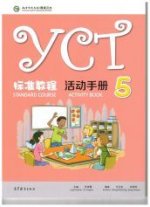
YCT Standard Course 5 - Activity Book
17.71 € -
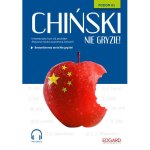
Chiński nie gryzie
11.74 € -

Misadventures of Zhou Haisheng
13.86 € -2 % -

THE SPIDER'S THREAD (EN JAPONAIS AVEC FURIGANA)
18.32 € -

LEARNING CHINESE CHARACTERS FROM MRS ZHANG (B)
21.56 € -

EASY STEPS TO CHINESE 1 : TEXTBOOK (ED. EN ANGLAIS)
40.90 € -

EASY STEPS TO CHINESE 1 : WORKBOOK (ED. EN ANGLAIS)
28.75 € -

NEW TARGET CHINESE SPOKEN LANGUAGE 3
40.29 € -

Tintin 13 : Le temple du soleil, petit format, Édition 2009
11.43 € -

Tintin 17: L'affaire Tournesol - petit format, Ed. 2009 (En Chinois)
11.43 € -
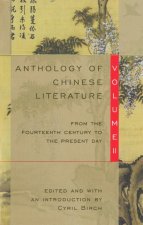
Anthology of Chinese Literature: Volume II
14.88 € -24 % -

Tintin 20: Les bijoux de la Castafiore - petit format, éd. 2009 (En Chinois)
11.43 € -

Tintin 4: Le Lotus bleu - petit format, ed. 2009 (En Chinois)
11.43 € -

Tintin 3: Les cigares du pharaon, petit format, ed. 2009 (En Chinois)
11.43 € -

Tintin 18: Coke en stock - petit format, ed. 2009 (En Chinois)
11.43 € -

Tintin 14 : Tintin au Pays de l'Or noir - petit format, Ed. 2009 (En Chinois)
11.43 € -

Tintin 10: Le secret de la licorne - petit format, édition 2009 (En Chinois)
11.43 € -

Tintin 8: LE CRABE AUX PINCES D'OR (PETIT FORMAT, Ed. 2009) (En Chinois)
11.43 € -

Tintin 12: Les sept boules de cristal (Petit format, Ed. 2009) (En Chinois)
11.43 € -

Romance of the Three Kingdoms Vol 5: Chinese International Edition
13.26 € -6 % -
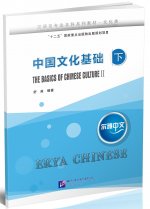
Erya Chinese : The Basics of Chinese Culture 2
20.65 € -
Gudai Hanyu 3 (4ème ed.)
17.20 € -

Erya Chinese : The basics of Chinese culture 1
20.65 € -

流浪的水母
23.89 € -1 % -

Erya Chinese : Contemporary Chinese Literature
20.65 € -
Erya Chinese : Elementary Chinese Writing Course
32.19 € -

HARRY POTTER AND THE PHILOSOPHER'S STONE(EN CHINOIS)
17.71 € -

City of Robots
11.33 € -25 % -

LE PETIT PRINCE EN CHINOISE AVEC PINYIN
11.43 € -

LE PETIT PRINCE, en anglais pour apprenants chinois
11.43 € -
YCT STANDARD COURSE 3 (Chinois avec Pinyin -note en Anglais)
25.31 € -

The Journey to the West in Easy Chinese
55.38 € -1 % -

Who Are We? (Simplified Chinese-Pinyin-English)
16.60 € -2 % -
THE BEST VOCABULARY BUILDER FOR THE JAPANESE PROFICIENCY TEST N4
22.27 €
Osobný odber Bratislava a 12742 dalších
Copyright ©2008-26 najlacnejsie-knihy.sk Všetky práva vyhradenéSúkromieCookies

 24 miliónov titulov
 Vrátenie do mesiaca
 02/210 210 99 (8-15.30h)