Kód: 03175485
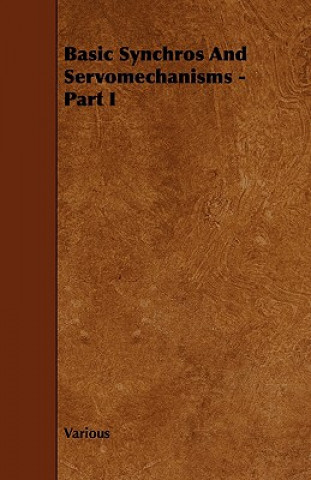
Basic Synchros And Servomechanisms - Part I
Autor Various
PREFACE T IS the purpose of these two Manuals on BASIC SYNCHROS AND SERVOMECHANISMS to describe and illustrate, in the simplest possible way, the fundamental characteristics of two groups of devices which are not only used in many ... celý popis


- Jazyk:
 Angličtina
 - Väzba: Brožovaná
- Počet strán: 128
Nakladateľ: Read Books, 2008
- Viac informácií o knihe

20.85 €
Bežne: 23.13 €
Ušetríte 2.28 €

Skladom u dodávateľa
Odosielame za 10 - 18 dní
Mohlo by sa vám tiež páčiť
-

Choujin X, Vol. 8
13.86 € -22 % -

Station Eleven
10.12 € -29 % -

Sermon on the Mount
12.75 € -25 % -

English Master C1 Key Word Transformation: 20 practice tests for the Cambridge C1 Advanced
12.85 € -24 % -

Countdown to Zero Day
14.88 € -24 % -

Lada Niva 2121 Repair Manual
14.07 € -7 % -

Oil That Heals
12.75 € -24 % -

Geopolitics: A Very Short Introduction
10.22 € -26 % -

Lonely Planet California & Southwest USA's National Parks
17.20 € -7 % -

English Literature for the IB Diploma: Prepare for Success
34.82 € -

Alex Webb and Rebecca Norris Webb on Street Photography and the Poetic Image
41.20 € -

Blood Covenant: The Story of the Mafia Prince Who Publicly Quit the Mob and Lived
18.32 € -24 % -

Zasady wywierania wpływu na ludzi. Szkoła Cialdiniego
8.60 € -18 % -

Star Wars Art: Posters
51.03 € -

Is Eating People Wrong?
33.61 € -

Healing Pluto Problems: An Astrological Guide
19.63 € -24 % -
Sociolinguistics
13.96 € -24 % -

Krótka historia czasu. Wydawnictwo Zysk
11.53 € -7 % -

Niedźwiedź i słowik wyd. 2
9.51 € -14 % -

Dawn of Slavic
49.30 € -

Silverborn
12.24 € -30 % -

Drawdown: The Most Comprehensive Plan Ever Proposed to Reverse Global Warming
21.46 € -27 % -

Pharmako/Dynamis, Revised and Updated
16.19 € -24 % -

Transfigurations
28.55 € -25 % -

Self-Therapy, Vol. 3: A Step-by-Step Guide to Using IFS for Eating Issues, Procrastination, the Inner Critic, Depression, Perfectionism, Ang
17.41 € -7 % -

Kvarteto - Traktory (papírová krabička)
4.24 € -

Little Book of Messi
9.61 € -19 % -

Being Genuine
13.36 € -25 % -

DK Eyewitness Top 10 Honolulu and O'ahu
13.96 € -9 % -

Winnetou
8.60 € -15 % -

FIREBIRD
25.81 € -

New Understanding of ADHD in Children and Adults
61.05 € -

Basic Synchros And Servomechanisms - Part II
20.85 € -9 % -

Neuromorphic Intelligence
50.52 € -10 % -

Ten Thousand Light-Years From Home
8.60 € -30 % -

Early Roman Law: the Regal Period
18.42 € -1 % -

Aum Shinrikyo and Japanese Youth
76.34 € -

Captain Underpants and the Terrifying Return of Tippy Tinkletrousers Full Colour Edition (Book 9)
10.82 € -25 % -

Learn Hindi Vocabulary Activity Workbook
9.81 € -6 % -

One of Us Is Dead
21.05 € -24 % -

Nature Is Never Silent
18.22 € -15 % -

Of Mice and Magic
24.50 € -24 % -

Davo
12.45 € -18 % -

North Scotland. Orkney & Shetland
8.70 € -25 % -

Animals
30.06 € -14 % -

Yeats, the Man and the Masks
20.75 € -17 % -

Bible for Everyone
36.65 € -10 % -

Bacterial Pathogenesis: A Molecular Approach, 5th Edition
159.17 € -5 % -

Speak to Me of Home
13.76 € -29 % -

Russia e Ucraina. La mappa che spiega la guerra
10.52 € -

Die Kafer Mitteleuropas, Bd. 14: Supplementband Mit Katalogteil
167.88 € -

The Kremlin's Noose: Putin's Bitter Feud with the Oligarch Who Made Him Ruler of Russia
21.66 € -25 % -

Happy 31th Birthday: Each page will be better than the previous one !!!
7.28 € -6 % -

Menswear
19.63 € -21 % -

Hindsight: Wisdom From Couples Who Have Prepared A Wedding And Lived A Marriage
8.09 € -6 % -

50 Wackiest Bible Stories
11.03 € -5 % -

Diodor's Von Sicilien Historische Bibliothek (1839)
59.84 € -2 % -

Antropomotoryka
49.61 € -

Jim Click
20.24 € -1 % -

Hafifletilmis
20.14 € -4 % -

Wildering: Anyone's Guide to Enjoying the American Wilderness
9 € -6 % -

Haven
17.71 € -17 % -

Coloring book: Portfolio
22.67 € -6 %
Darčekový poukaz: Radosť zaručená
- Darujte poukaz v ľubovoľnej hodnote, a my sa postaráme o zvyšok.
- Poukaz sa vzťahuje na všetky produkty v našej ponuke.
- Elektronický poukaz si vytlačíte z e-mailu a môžete ho ihneď darovať.
- Platnosť poukazu je 12 mesiacov od dátumu vystavenia.
Viac informácií o knihe Basic Synchros And Servomechanisms - Part I
Nákupom získate 50 bodov
 Anotácia knihy
PREFACE T IS the purpose of these two Manuals on BASIC SYNCHROS AND SERVOMECHANISMS to describe and illustrate, in the simplest possible way, the fundamental characteristics of two groups of devices which are not only used in many types of military equipment, but which are also essential components in what will assuredly be one of the most revolutionary industrial techniques of the second half of the 20th century. Automatic process control-automation, to use its more popular name-is an outgrowth of the technical advances made in military equipment during the Second World War. It is far more than the mere regrouping of existing machines, which is what many people believe it to be. It is a radically new concept. The idea of mechanization implies a set of mechanical devices carrying out a series of motions-pre-determined, accurate, and continuous as long as power is supplied-but lacking any ability to modify their own behaviour if conditions begin to vary. Automation, on the other hand, implies a built-in brain-systemn-however rudimentary-in a robot-like plant capable not only of performing mechanical operations, but also of adapting the initial instructions it has been given in the light of changes which it observes to be occurring in the conditions of its own operation. The control devices of an automated system have four main functions to fulfil. They must detect changes in conditions as they occur they must report these changes to the brain they must decide what corrections are needed to carry out, in the changed conditions, the basic instructions they have been given and they must command that the necessary action be taken by the muscles, or operating elements of the system. All these decisions and actions must be taken and performed within a minutely short space of time-much faster than any human intelligence could possibly achieve. It is with the electrical and electronic devices which detect and report changes in operating conditions as they occur, and which decide upon and issue the necessary instructions to compensate for these changes, that these two Manuals on BASIC SYNCHROS AND SER VOMECHANZSMS deal. THE SYNCHROSERVO Manuals themselves, however, are only a part of a larger design. The unique COMMON-CORE Series of Illustrated Training Manuals, which was developed some years ago at the request of the United States Navy by the distinguished New York firm of technical education consultants and graphiological engineers, VAN VALKENBURGH NOOGER NEVILLE, INC. opens with eleven Manuals covering the fundamentals of Electricity and Electronics BASIC ELECTRICITY, in 5 Parts BASIC ELECTRONICS, in 6 Parts. Together with the two S YNCHROISERVO Manuals, these volumes have all become standard text-books in U.S. Navy Training Schools. Well over 150,000 men have studied them as part of their training to technician level in 14 different Navy trades-and their average training time has been cut by half. Late in 1957, negotiations were opened for a British and Commonwealth edition of the COMMON-CORE Manuals. While they were in progress, it came to the knowledge of the British Publishers that there was working, at the school of Electronic Engineering of the ROYAL ELECTRICAL AND MECHANICAL ENGINEERS at Arborfield in Berkshire, a special Electronics Training Investigation Team whose task was to devise solutions for some of the training problems which would face the British Army when National Service ended, and when the Armys increasingly elaborate electrical and electronic gear would have to be manned and serviced by recruits entering the Army with none of the technical knowledge which many National Servicemen had hitherto brought with them into the Forces...
Parametre knihy
Zaradenie knihy Knihy po anglicky Technology, engineering, agriculture Technology: general issues Engineering: general
20.85 €
- Celý názov: Basic Synchros And Servomechanisms - Part I
- Autor: Various
- Jazyk: Angličtina
- Väzba: Brožovaná
- Počet strán: 128
- EAN: 9781443773072
- ISBN: 9781443773072
- ID: 03175485
- Nakladateľ: Read Books
- Hmotnosť: 172 g
- Rozmery: 216 × 140 × 7 mm
- Dátum vydania: 27. October 2008
Obľúbené z iného súdka
-

Cleanroom Technology - Fundamentals of Design, Testing and Operation 2e
110.77 € -10 % -

Motorcycle Dynamics
41.41 € -9 % -

C++ Programming Language, The
78.27 € -6 % -

Watch Repairer's Manual
30.98 € -2 % -

Designing High-Fidelity Valve Preamps
49.10 € -1 % -

Works
23.99 € -19 % -

SysML Distilled
44.04 € -6 % -
Practical Guide to SysML
66.62 € -

F-14 Tomcat Pilot's Flight Operating Manual Vol. 1
32.80 € -2 % -

F-14 Tomcat Pilot's Flight Operating Manual Vol. 2
32.80 € -2 % -

Verilog by Example
20.34 € -

Reliability Theory and Practice
14.77 € -25 % -

Buckminster Fuller's Universe
34.12 € -

Calculus for the Electrical and Electronic Technologies
29.96 € -10 % -

Practical Reverse Engineering: x86, x64, ARM, Windows Kernel, Reversing Tools, and Obfuscation
50.92 € -1 % -

Complete Book of Locks and Locksmithing, Seventh Edition
31.38 € -24 % -

101 Things I Learned in Engineering School
14.07 € -25 % -

TRIZ for Engineers - Enabling Inventive Problem Solving
85.05 € -2 % -

Engineering: A Very Short Introduction
10.01 € -24 % -

Unwritten Laws of Engineering
17.20 € -
Cnc Lathe G-Code & M-Code Illustrative Handbook
48.39 € -10 % -
Stochastic Modeling
14.77 € -25 % -

VHDL by Example
19.33 € -2 % -

Basic Guide Book on Welding Aluminum
8.60 € -6 % -

Predictive Maintenance Using Vibration Analysis
49 € -2 % -

Handbook of Pyrotechnics
95.99 € -
Complete Guide to Predictive and Preventive Maintenance
73.91 € -7 % -

Affordance Based Design
78.16 € -2 % -

Complete Guide to the History and Manufacture of Grandfather Clocks
32.80 € -9 % -
Lean for Systems Engineering with Lean Enablers for Systems Engineering
112.09 € -2 % -
CATIA V5
153.40 € -

PTC Creo (TM) Parametric 3.0
83.53 € -

Existential Pleasures of Engineering
14.88 € -24 % -

Engineers
31.48 € -25 % -

Exercises in Functional Safety
14.47 € -2 % -

Oxford Users' Guide to Mathematics
54.77 € -34 % -

Watch Repairer's Manual
23.79 € -2 % -

SpaceX
27.23 € -24 % -

Scattering Theory
19.63 € -24 % -
Machine Elements in Mechanical Design
322.31 € -

System Engineering Analysis, Design, and Development - Concepts, Principles, and Practices 2e
164.24 € -

Brunel's Ships and Boats
17.10 € -24 % -

F-111 Aardvark Pilot's Flight Operating Manual
28.34 € -1 % -

Strategic Design and Digitalisation of the Supply Chain
56.09 € -

Classic Heathkit Electronic Test Equipment
19.94 € -2 % -

Bird's Comprehensive Engineering Mathematics
82.01 € -

Rockets
9.91 € -25 % -

Competitive Engineering
58.22 € -9 % -

Elements of Clojure
19.33 € -2 %
Osobný odber Bratislava a 12542 dalších
Copyright ©2008-26 najlacnejsie-knihy.sk Všetky práva vyhradenéSúkromieCookies

 24 miliónov titulov
 Vrátenie do mesiaca
 02/210 210 99 (8-15.30h)