Kód: 09534640
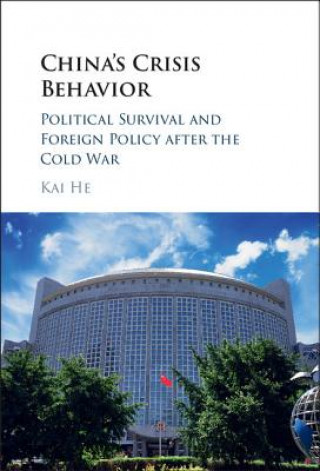
China's Crisis Behavior
Autor Kai He
Since the end of the Cold War, China has experienced several notable interstate crises: the 1999 'embassy bombing' incident, the 2001 EP-3 mid-air collision with a United States aircraft, and the Diaoyu/Senkaku dispute with Japan. ... celý popis


- Jazyk:
 Angličtina
 - Väzba: Pevná
- Počet strán: 186
Nakladateľ: Cambridge University Press, 2016
- Viac informácií o knihe

129.91 €
Bežne: 129.95 €
Ušetríte 0.05 €

Skladom u dodávateľa
Odosielame za 10 - 18 dní
Mohlo by sa vám tiež páčiť
-

A siker titka - Pozitív Lelki Beállítottság
11.74 € -13 % -

The Penguin Anthology of Twentieth-Century American Poetry
21.76 € -24 % -

I Was Wrong
18.42 € -18 % -

Power System Coherency and Model Reduction
167.88 € -

Quand l'histoire fait date
18.32 € -

A History of the Banjo: Frank Converse's Banjo Reminiscences
17.51 € -6 % -

Familias criollas y la configuración del poder
36.85 € -4 % -

O ecossistema da pesquisa sobre a educacao online
56.90 € -4 % -

Gasoline Engines for Boats
38.77 € -9 % -

CASES ON ADMINISTRATIVE LAW: SELECTED FR
44.55 € -

History of Peoria County, Illinois ... Illustrated.
37.36 € -1 % -
Understanding the Prostate Laminated Poster
28.04 € -10 % -

Hier bin ich
19.84 € -

Investigating the Benefits and Drawbacks of Realigning the National Guard Under the Department of Homeland Security
20.85 € -

Study Skills for Social Workers
28.55 € -9 % -

Free to Serve
16.70 € -1 % -

Handelsmarken
51.73 € -6 % -

Women's Religions in the Greco-Roman World
45.66 € -

Kadinlar da Vardir
10.22 € -4 % -

Exploring Dallas with Children
17.61 € -10 % -

Zum Gluck!
23.89 € -4 %
Darčekový poukaz: Radosť zaručená
- Darujte poukaz v ľubovoľnej hodnote, a my sa postaráme o zvyšok.
- Poukaz sa vzťahuje na všetky produkty v našej ponuke.
- Elektronický poukaz si vytlačíte z e-mailu a môžete ho ihneď darovať.
- Platnosť poukazu je 12 mesiacov od dátumu vystavenia.
Viac informácií o knihe China's Crisis Behavior
Nákupom získate 314 bodov
 Anotácia knihy
Since the end of the Cold War, China has experienced several notable interstate crises: the 1999 'embassy bombing' incident, the 2001 EP-3 mid-air collision with a United States aircraft, and the Diaoyu/Senkaku dispute with Japan. China's response to each incident, however, has varied considerably. Drawing from a wealth of primary sources and interviews, this book offers a systematic analysis of China's crisis behavior in order to identify the factors which determine when Chinese leaders decide to escalate or scale down their response to crises. Inspired by prospect theory - a Nobel Prize-winning behavioural psychology theory - Kai He proposes a 'political survival prospect' model as a means to understand the disparities in China's behavior. He argues that China's response depends on a combination of three factors that shape leaders' views on the prospects for their 'political survival status', including the severity of the crisis, leaders' domestic authority, and international pressure.
Parametre knihy
Zaradenie knihy Knihy po anglicky Society & social sciences Politics & government Political structure & processes
129.91 €
- Celý názov: China's Crisis Behavior
- Podnázov: Political Survival and Foreign Policy after the Cold War
- Autor: Kai He
- Jazyk: Angličtina
- Väzba: Pevná
- Počet strán: 186
- EAN: 9781107141988
- ISBN: 1107141982
- ID: 09534640
- Nakladateľ: Cambridge University Press
- Hmotnosť: 410 g
- Rozmery: 235 × 158 × 14 mm
- Dátum vydania: 06. April 2016
Obľúbené z iného súdka
-

CONVERSATIONS WITH MYSELF
16.29 € -29 % -

How Democracies Die
7.89 € -29 % -

Faces of Justice and State Authority
38.06 € -

Conservative Parties and the Birth of Democracy
25.10 € -25 % -

The Prince
10.82 € -25 % -

Against Empire
14.77 € -25 % -

The Prince
4.65 € -23 % -

The Prince
3.53 € -24 % -

Republic
7.89 € -24 % -

Democracy for Realists
18.22 € -25 % -
Signal and the Noise
14.47 € -29 % -

The Road to Unfreedom
10.52 € -26 % -

Anarchy, State, and Utopia
24.39 € -

How Democracies Die
14.07 € -28 % -

Red Notice: How I Become Putins No 1 Enemy
15.08 € -

Stalin, Vol. I
17.81 € -29 % -

Prince
15.99 € -29 % -

How to Stand Up to a Dictator
14.98 € -27 % -

How to Win an Election
14.07 € -25 % -

Democracy in America
12.04 € -25 % -

Democracy in America: The Complete and Unabridged Volumes I and II
6.47 € -29 % -

Hitler
18.82 € -29 % -

Tyranny of Merit
13.86 € -10 % -

Republic and The Laws
9.71 € -25 % -

Leadership in Turbulent Times
13.05 € -25 % -

Zeit der Oligarchen
11.94 € -15 % -

From Dictatorship to Democracy
9.71 € -25 % -

Theodore Rex
17.31 € -26 % -

Prince
11.23 € -28 % -
Death of Democracy
11.03 € -30 % -

Against Democracy
21.96 € -2 % -

Road to Somewhere
13.96 € -24 % -

Nelson Mandela
16.09 € -24 % -

Dictatorship - From the Origin of The Modern Concept of Sovereignty to Proletarian Class Struggle
25 € -4 % -

The Crooked Timber of Democracy in Israel
25.10 € -25 % -

Future of Freedom
14.57 € -21 % -

Democracy At Work
20.55 € -14 % -

Political Parties
17.20 € -

Republic
48.09 € -9 % -

Democracy in America
19.03 € -11 % -

Autobiography of Benjamin Franklin
9.91 € -25 % -

Every Day Is Extra
13.96 € -24 % -

Making Democracy Work
50.42 € -

Remainder
13.96 € -24 % -

Calculus of Consent -- Logical Foundations of Constitutional Democracy
12.85 € -12 % -

Quotable Jefferson Davis
13.96 € -1 % -

American Political Tradition
14.88 € -24 % -

Angela Merkel - A Chancellorship Forged in Crisis
4.75 € -82 % -

Wellington
16.09 € -24 %
Osobný odber Bratislava a 12742 dalších
Copyright ©2008-26 najlacnejsie-knihy.sk Všetky práva vyhradenéSúkromieCookies

 24 miliónov titulov
 Vrátenie do mesiaca
 02/210 210 99 (8-15.30h)