Kód: 43423052
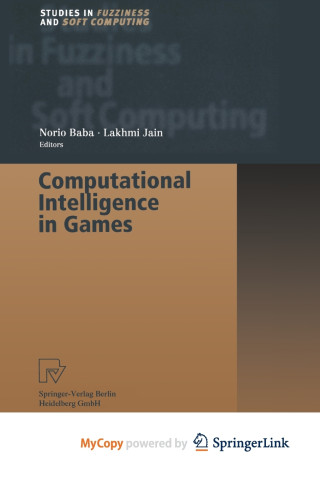
Computational Intelligence in Games
Autor Norio Baba
The most powerful computers in the world are not only used for scientific research, defence, and business, but also in game playing. Computer games are a multi-billion dollar industry. Recent advances in computational intelligence ... celý popis


- Jazyk:
 Angličtina
 - Väzba: Brožovaná
- Počet strán: 178
Nakladateľ: Springer Nature B.V., 2014
- Viac informácií o knihe

57 €
Bežne: 57.01 €
Ušetríte 0.01 €

Skladom u dodávateľa
Odosielame za 10 - 18 dní
Mohlo by sa vám tiež páčiť
-

Moonwalk
14.27 € -17 % -

The Score
13.66 € -13 % -

The Deal
11.43 € -27 % -

The Mistake
14.67 € -

Jujutsu Kaisen, Vol. 30
9.61 € -22 % -

Witch Hat Atelier: Grimoire Edition 1
34.62 € -29 % -

Berserk Deluxe Volume 1
35.74 € -25 % -

Invincible Compendium Volume 2
46.47 € -23 % -

Invincible Compendium Volume 1
45.86 € -24 % -

The Goal
14.67 € -

Berserk Deluxe Volume 2
33.30 € -30 % -

Witch Hat Atelier Manga Box Set 1
56.19 € -25 % -

Heated Rivalry
12.75 € -6 % -

Lord of Mysteries, Vol. 3: The Clown, Part III
14.98 € -29 % -

Moonwalk: A Memoir
21.76 € -24 % -

Murdoku
17.10 € -24 % -

Jujutsu Kaisen, Vol. 25
9.91 € -20 % -

Jujutsu Kaisen, Vol. 26
9.91 € -20 % -

Jujutsu Kaisen, Vol. 29
9.91 € -20 % -

Berserk Deluxe Volume 3
55.28 € -

White Nights
4.75 € -11 %
Darčekový poukaz: Radosť zaručená
- Darujte poukaz v ľubovoľnej hodnote, a my sa postaráme o zvyšok.
- Poukaz sa vzťahuje na všetky produkty v našej ponuke.
- Elektronický poukaz si vytlačíte z e-mailu a môžete ho ihneď darovať.
- Platnosť poukazu je 12 mesiacov od dátumu vystavenia.
Viac informácií o knihe Computational Intelligence in Games
Nákupom získate 138 bodov
 Anotácia knihy
The most powerful computers in the world are not only used for scientific research, defence, and business, but also in game playing. Computer games are a multi-billion dollar industry. Recent advances in computational intelligence paradigms have generated tremendous interest among researchers in the theory and implementation of games. Game theory is a branch of operational research dealing with decision theory in a competitive situation. Game theory involves the mathematical calculations and heuristics to optimize the efficient lines of play. This book presents a sample of the most recent research on the application of computational intelligence techniques in games. This book contains 7 chapters. The first chapter, by Chen, Fanelli, Castellano, and Jain, is an introduction to computational intelligence paradigms. It presents the basics of the main constituents of compu tational intelligence paradigms including knowledge representation, probability-based approaches, fuzzy logic, neural networks, genetic algorithms, and rough sets. In the second chapter, Chellapilla and Fogel present the evolution of a neural network to play checkers without human expertise. This chapter focuses on the use of a population of neural networks, where each network serves as an evaluation function to describe the quality of the current board position. After only a little more than 800 generations, the evolutionary process has generated a neural network that can play checkers at the expert level as designated by the u.s. Chess Federation rating system. The program developed by the authors has also competed well against commercially available software.
Parametre knihy
57 €
- Celý názov: Computational Intelligence in Games
- Autor: Norio Baba
- Jazyk: Angličtina
- Väzba: Brožovaná
- Počet strán: 178
- EAN: 9783662003688
- ID: 43423052
- Nakladateľ: Springer Nature B.V.
- Hmotnosť: 259 g
- Rozmery: 234 × 156 mm
- Dátum vydania: 12. March 2014
Osobný odber Bratislava a 12593 dalších
Copyright ©2008-26 najlacnejsie-knihy.sk Všetky práva vyhradenéSúkromieCookies

 24 miliónov titulov
 Vrátenie do mesiaca
 02/210 210 99 (8-15.30h)