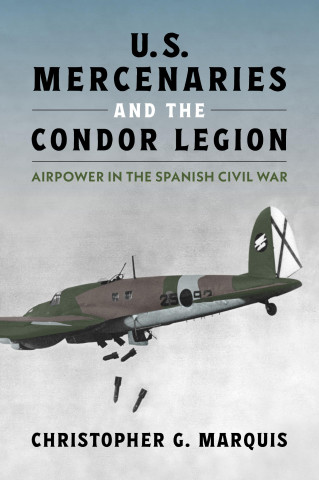
Kód: 47217500
Dispatch from Valencia
Autor Major Christopher G. Marquis
American military attachés document the impact of airpower during the Spanish Civil War, featuring intervention by some of the strongest air forces in the world in a prelude to World War II.This is the story of airpower in the Spa ... celý popis


- Jazyk:
 Angličtina
 - Väzba: Pevná
- Počet strán: 320
Nakladateľ: Naval Institute Press, 2025
- Viac informácií o knihe


Mohlo by sa vám tiež páčiť
-

Horten Ho 229 - Spirit of Thuringia
31.68 € -25 % -

Blitzkrieg Legend
39.28 € -9 % -

Uniting Against the Reich: The American Air War in Europe
41.20 € -

AIRPOWER OVER THE RHINE
27.74 € -19 % -

Blitzkrieg Legend
34.12 € -9 %
Darčekový poukaz: Radosť zaručená
- Darujte poukaz v ľubovoľnej hodnote, a my sa postaráme o zvyšok.
- Poukaz sa vzťahuje na všetky produkty v našej ponuke.
- Elektronický poukaz si vytlačíte z e-mailu a môžete ho ihneď darovať.
- Platnosť poukazu je 12 mesiacov od dátumu vystavenia.
Viac informácií o knihe Dispatch from Valencia
Nákupom získate 104 bodov
 Anotácia knihy
American military attachés document the impact of airpower during the Spanish Civil War, featuring intervention by some of the strongest air forces in the world in a prelude to World War II.
This is the story of airpower in the Spanish Civil War from the perspective of three key American figures: Colonel Stephen Fuqua, military attaché to Republican Spain; Captain Townsend Griffiss, assistant military attaché for air; and former U.S. Navy pilot Frank Tinker, who flew for the Spanish government as a mercenary. Through his analysis of the experiences and writings of these three individuals, author Christopher Marquis explores the lessons the conflict revealed regarding the use of airpower in war.
The book first places the Spanish Civil War within the broader context of early U.S. airpower development, progressing through the narrative of the war while focusing on key air operations and technological advancements. Marquis begins with the early history of American airpower through World War I and the institutional development of the U.S. Army Air Service and U.S. Army Air Corps. He also covers the evolution of early airpower theories, particularly the idea of strategic bombing, which involved the bombardment of civil, industrial, and political targets to bring the war to a swift conclusion.
The narrative then moves to Spain in July 1936 and follows the course of the civil war, with a focus on air operations. Some of the significant events covered in detail include the airlift of Nationalist troops from Morocco to Spain; defensive counterair missions above Madrid; the firebombing of Guernica; the destruction of the "Iron Ring" of fortifications around Bilbao; the bombing of Barcelona; and, finally, the air superiority achieved by the Nationalist air force and their allies. The U.S. observers witnessed the German Luftwaffe's intervention in the conflict as well as air forces from Italy, France, and the Soviet Union.
Marquis concludes that the Spanish Civil War proved airpower was a critical element of modern warfare. He also points out that American airpower leaders were reluctant to acknowledge the lessons of the war because they did not definitively prove the effectiveness of strategic bombing. Despite that reluctance, America's subsequent actions in developing its aircraft inventory before World War II reflected some of the lessons learned from the air war in Spain.
Parametre knihy
Zaradenie knihy Knihy po nemecky Geisteswissenschaften, Kunst, Musik Geschichte Kulturgeschichte einzelne Themen und Gegenstände
43.03 €
- Celý názov: Dispatch from Valencia
- Autor: Major Christopher G. Marquis
- Jazyk: Angličtina
- Väzba: Pevná
- Počet strán: 320
- EAN: 9781682479735
- ISBN: 1682479730
- ID: 47217500
- Nakladateľ: Naval Institute Press
- Hmotnosť: 621 g
- Dátum vydania: 07. October 2025
Obľúbené z iného súdka
-

Junkers Ju 88c Day and Nightfighters
18.12 € -25 % -

The Jakarta Method
14.77 € -25 % -

Top Secret KGB Training Manual Communication With Agents
15.48 € -25 % -

Start With Why
12.75 € -22 % -

Inventing the Renaissance
16.09 € -24 % -

Japanese Myths
17.61 € -17 % -

Coalition Aircraft Vs Iraqi Sams
16.90 € -24 % -

Reminiscences of the Cuban Revolutionary War
12.24 € -30 % -

River of Darkness
15.99 € -22 % -

The Earth Transformed
14.57 € -29 % -

Iran's Grand Strategy
25.10 € -25 % -

Iraq 2003
22.98 € -4 % -

Iran and the Revolution
24.90 € -25 % -

Stug IV Assault Gun German Army and Waffen-SS Units
21.25 € -25 % -

Panther Medium Tank
18.12 € -25 % -

Native Nations
15.18 € -29 % -

United States of Cryptids
14.77 € -25 % -

Inside the Britannic
27.23 € -25 % -

Destiny Disrupted
16.19 € -25 % -

Cuba: An American History
15.48 € -25 % -

Night of Power
12.45 € -28 % -

Ungrounding
26.32 € -25 % -

Byzantine Cavalryman Vs Vandal Warrior: North Africa Ad 533-36
17.20 € -26 % -

The Library of Lost Maps
34.93 € -11 % -

STURMZUG
27.03 € -9 % -

The Return of the Great Powers
24.70 € -28 % -

American History for Kids: A Captivating Guide to Major Events in US History
15.69 € -6 % -

Culture of Critique
37.36 € -1 % -

F-35 Joint Strike Fighter
32.09 € -24 % -

The Fate of the Day
29.36 € -28 % -

Surviving Rome
43.33 € -11 % -

A Moon Will Rise from the Darkness
14.77 € -25 % -

11th Waffen-SS Freiwilligen Panzergrenadier Division "Nordland": An Illustrated History
32.09 € -24 % -

Mikoyan-Gurevich MiG-1 & MiG-3 In Profile & Scale
21.96 € -2 % -

War: How Conflict Shaped Us
16.90 € -24 % -

Nothing But Courage
24.70 € -28 % -
Red Star Versus Rising Sun: Volume 1 - The Conquest of Manchuria 1931-1938
23.18 € -21 % -

Scotland's Clans & their Tartans
14.77 € -25 % -

Lavochkin La-5 Family In Profile & Scale
20.24 € -1 % -

Breakneck
12.24 € -30 % -

Marshal Ney's Military Studies
15.08 € -1 % -

Tanks at the Iron Curtain 1975-90: The Ultimate Generation of Cold War Heavy Armor
15.18 € -26 % -

South Pacific Air War Volume 5
19.53 € -22 % -

Damned Hunchbacks: Italy's Forgotten Torpedo Bomber Units of the Second World War (1940-1943)
31.68 € -24 % -

Lavochkin La-7 In Profile & Scale
21.96 € -2 % -

Sturmtiger German Army Units
21.66 € -25 % -

A History of the Muslim World
20.34 € -24 % -

The Dornier Do 217
39.79 € -9 % -

The Anunnaki Book
13.26 € -6 %
Osobný odber Bratislava a 12593 dalších
Copyright ©2008-26 najlacnejsie-knihy.sk Všetky práva vyhradenéSúkromieCookies

 24 miliónov titulov
 Vrátenie do mesiaca
 02/210 210 99 (8-15.30h)