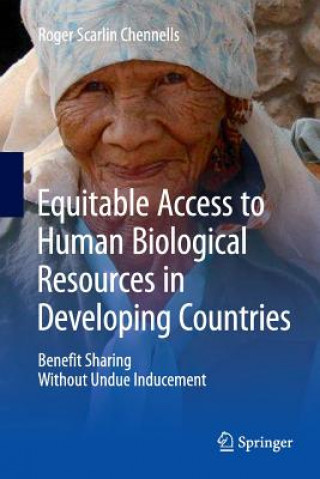
Kód: 15194071
Equitable Access to Human Biological Resources in Developing Countries
Autor Roger Chennells
The main question explored by the book is: How can cross-border access to human genetic resources, such as blood or DNA samples, be governed in such a way as to achieve equity for vulnerable populations in developing countries? Th ... celý popis


- Jazyk:
 Angličtina
 - Väzba: Brožovaná
- Počet strán: 197
Nakladateľ: Springer International Publishing AG, 2016
- Viac informácií o knihe

103.10 €
Bežne: 111.73 €
Ušetríte 8.64 €

Skladom u dodávateľa
Odosielame za 5 - 8 dní
Mohlo by sa vám tiež páčiť
-

Kalendarz 2026 Poradnik z przepisami i magnesem na lodówkę
1.41 € -43 % -

Temptation Trails
13.46 € -24 % -

Aquaman/Green Arrow - Deep Target
18.12 € -9 % -

Atentát na Heydricha
10.32 € -16 % -

Cómo me hice monja ; La prueba ; El llanto
20.45 € -

Piano Play-Along
13.97 € -9 % -

The Magi: Who They Were, How They've Been Remembered, and Why They Still Fascinate
20.35 € -24 % -

Für Unsere Blasmusik Freunde
22.07 € -

Schiers
19.64 € -

La daga y el fuego
34.53 € -

L'automobile
12.45 € -

Appendix to Journals of Assembly, of the Tenth Session of the Legislature of the State of California, 1859 (Classic Reprint)
24.40 € -

Süper Cengel Bulmaca
9.21 € -4 % -

El Método Oaklander: aprender Gestalt infanto-juvenil con juego y arte
28.96 € -

The Girl with the Green Eyes: A Play in Four Acts
28.35 € -1 % -

Les Rapports Du Quatri?me Évangile Avec l'Ancien Testament: Th?se...
30.98 € -2 % -

Soul Warriors vs. Witches
15.79 € -7 % -

Life Journey Above and Beneath
17.61 € -18 % -

Planning Process Drama
200.02 € -

Die Reform Des Steuerlichen Reisekostenrechts 2014
48.40 € -7 % -

Literacy Edition Storyworlds Stage 8, Fantasy World, Workbook
3.43 € -
Disease control priorities
33.41 € -
SINFONIA N. 6 OP. 262 ORCHESTRE
99.45 € -

O neopentecostalismo como fator de crise pastoral
49.01 € -14 % -

Letters on the English Nation
32.81 € -2 % -

Proverbes Illustrés Afghans (French Edition): In French and Dari Persian
17.41 € -7 % -

Study Guide for William Shakespeare's The Tempest
11.23 € -2 % -

Happy Dreamer
7.89 € -24 %
Darčekový poukaz: Radosť zaručená
- Darujte poukaz v ľubovoľnej hodnote, a my sa postaráme o zvyšok.
- Poukaz sa vzťahuje na všetky produkty v našej ponuke.
- Elektronický poukaz si vytlačíte z e-mailu a môžete ho ihneď darovať.
- Platnosť poukazu je 12 mesiacov od dátumu vystavenia.
Viac informácií o knihe Equitable Access to Human Biological Resources in Developing Countries
Nákupom získate 249 bodov
 Anotácia knihy
The main question explored by the book is: How can cross-border access to human genetic resources, such as blood or DNA samples, be governed in such a way as to achieve equity for vulnerable populations in developing countries? The book situates the field of genomic and genetic research within global health and research frameworks, describing the concerns that have been raised about the potential unfairness in exchanges during recent decades. Access to and sharing in the benefits of human biological resources are aspects not regulated by any international legal framework such as the Convention on Biological Diversity, which applies only to the exchange of plants, animals and microorganisms, as well as to associated traditional knowledge. Examples of genetic research perceived as exploitative are provided in order to illustrate the legal vacuum concerning the global governance of human genetic resources. The main conclusions drawn from the legal and ethical analysis are: - Benefit sharing is crucial in order to avoid the exploitation of developing countries in human genetic research. - With functioning research ethics committees, undue inducement is less of a concern in genetic research than in other areas of medical research (e.g. clinical trials). - Concerns remain over research involving indigenous populations; accordingly, recommendations are provided. In drawing these conclusions, the book addresses in detail a highly pressing topic in global bioethics and international law. In this regard, it combines bioethical arguments with jurisprudence, in particular with reference to the law of equity and the legal concepts of duress (coercion), unconscionable dealing, and undue inducement.
Parametre knihy
Zaradenie knihy Knihy po anglicky Law Laws of Specific jurisdictions Social law
103.10 €
- Celý názov: Equitable Access to Human Biological Resources in Developing Countries
- Podnázov: Benefit Sharing Without Undue Inducement
- Autor: Roger Chennells
- Jazyk: Angličtina
- Väzba: Brožovaná
- Počet strán: 197
- EAN: 9783319369747
- ISBN: 3319369741
- ID: 15194071
- Nakladateľ: Springer International Publishing AG
- Hmotnosť: 3401 g
- Rozmery: 235 × 155 × 14 mm
- Dátum vydania: 15. October 2016
Obľúbené z iného súdka
-

Horrors of Vaccination Exposed and Illustrated
15.49 € -
Medical Law: A Very Short Introduction
10.02 € -24 % -

Neuroscience and Law
237.40 € -

Regulating Human Embryonic Stem Cell in China
109.48 € -

EU Consumer Law and Policy - Second Edition
176.83 € -

Ashgate Handbook of Legal Translation
78.89 € -

Vaccine Whistleblower
17.21 € -9 % -

Under Observation: The Interplay Between eHealth and Surveillance
144.22 € -7 % -
The Law and Ethics of Data Sharing in Health Sciences
154.55 € -7 % -

Medical Law
53.67 € -15 % -

Nonclinical Safety Assessment - A Guide to International Pharmaceutical Regulations
161.43 € -9 % -

150 Years of ObamaCare
29.16 € -

Medicine, Malpractice and Misapprehensions
31.19 € -

EU Food Law
121.43 € -
Information Technology in Medical Diagnostics
195.47 € -

Medical Malpractice
33.72 € -

100 Cases in Clinical Ethics and Law
55.19 € -

TASER (R) Conducted Electrical Weapons: Physiology, Pathology, and Law
141.18 € -9 % -

Dodd-Frank Wall Street Reform & Consumer Protection Act
400.26 € -10 % -
Routledge Handbook of Complementary and Alternative Medicine
72.61 € -

Consumer ADR in Europe
147.15 € -

FDA Regulatory Affairs
244.79 € -

Legal Medicine in History
143.51 € -

Animal Experimentation
51.54 € -

Private Foundations
601.10 € -

Marijuana 360
46.58 € -

Cure for Obamacare
7.28 € -
Law and Neuroscience
107.45 € -31 % -

Legitimacy of Medical Treatment
72 € -

Beyond Elder Law
103.10 € -7 % -

Why We Need a New Welfare State
54.18 € -

Healthcare Research Ethics and Law
73.93 € -
Clinical Forensic Medicine
128.72 € -

Why We Need a New Welfare State
106.64 € -
Conflicts of Interest and the Future of Medicine
33.82 € -

Consumer Law and Policy
108.57 € -

Surrogacy, Law and Human Rights
200.02 € -

Text, Cases and Materials on Medical Law and Ethics
80.91 € -

Suing Alma Mater
63.80 € -

Pandemics and Ethics
175.11 € -7 % -

Consumer Financial Protection Bureau
178.45 € -9 % -

Charity Law and the Liberal State
99.04 € -

Consumer Theories of Harm
127.91 € -

Anathema! America's War on Medicine
17.41 € -

Governing Biobanks
147.15 € -

Path of the Law
16.30 € -25 % -

Human Genes and Neoliberal Governance
78.89 € -

Changing Law
200.02 € -

Oxford Handbook of U.S. National Security
161.94 €
Osobný odber Bratislava a 12792 dalších
Copyright ©2008-26 najlacnejsie-knihy.sk Všetky práva vyhradenéSúkromieCookies

 24 miliónov titulov
 Vrátenie do mesiaca
 02/210 210 99 (8-15.30h)