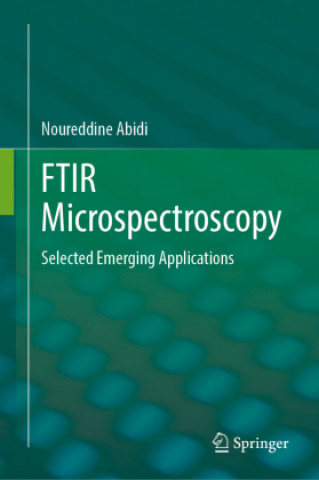
Kód: 37629536
FTIR Microspectroscopy
Autor Noureddine Abidi
Fourier Transform Infrared microspectroscopy (FTIR) was first developed by William Coblentz in 1905 for analytical purposes. It has been established as a powerful analytical method to analyze a wide range of materials. The most co ... celý popis


- Jazyk:
 Angličtina
 - Väzba: Pevná
- Počet strán: 134
Nakladateľ: Springer Nature Switzerland AG, 2022
- Viac informácií o knihe

159.98 €
Bežne: 160.03 €
Ušetríte 0.05 €

Skladom u dodávateľa
Odosielame za 10 - 18 dní
Mohlo by sa vám tiež páčiť
-

How We Learn
14.88 € -24 % -

Must We Mean What We Say?
21.76 € -24 % -

Composite Materials Fabrication Handbook #1
28.95 € -18 % -

Blockchain Technology Explained: The Ultimate Beginner's Guide About Blockchain Wallet, Mining, Bitcoin, Ethereum, Litecoin, Zcash, Monero, Ripple, Da
9.71 € -7 % -

1900; Or, The Last President
5.96 € -6 % -

Learn To Program With Minecraft
25.41 € -25 % -

Principles of Instrumental Analysis
214.77 € -

Peppa Pig: Peppa's Diwali Sticker Activity Book
5.56 € -25 % -

Island
11.74 € -9 % -

Biophysics
70.47 € -

Heshang Gong Commentary on Lao Zi's Dao De Jing
17.51 € -6 % -

Biophysics
123.02 € -11 % -

Molecular and Cellular Biophysics
88.49 € -

Murder by Invitation: A totally addictive historical cozy mystery
12.14 € -2 % -

Composite Materials
170.21 € -

Introduction to Composite Materials
64.39 € -
![[Growing Up Aspie] Dečak koji je izgubio stim](https://media.libris.to/jacket/22169130t.jpg "[Growing Up Aspie] Dečak koji je izgubio stim")
[Growing Up Aspie] Dečak koji je izgubio stim
9.31 € -25 % -

Modern Optical Spectroscopy
90.01 € -

Solubility of Gases and Liquids
55.89 € -

Reformpaedagogik: Rezeption und Kritik in der Arbeiterbewegung
151.38 € -10 % -

A Very Funny Bunny 5-Book Boxed Set
34.62 € -27 % -

Philosophy of History
37.36 € -2 % -

Premières lectures Une saison au zoo 2 histoires pour lire en CE1
12.45 € -

Digital Transformation for Business and Society
59.03 € -8 % -

Evolution De La Fonderie De Cuivre D'après Les Documents Du Temps...
23.79 € -2 % -
Markheim
9.91 € -

On Crusade
16.19 € -17 % -

Kenn' ein Land, so unvorstellbar schön
22.47 € -11 % -

Recent Progress in Multivariate Approximation
55.89 € -

Dinoland: Search, Find, Count: A Prehistoric Counting Book
15.69 € -18 % -

Comatose Patient
208.39 € -
Communication in Eastern Europe
216.29 € -

Les Lairds de Glenfern, Ou Les Montagnards Ecossais Au Dix-Neuvieme Siecle. Tome 2
21.15 € -2 % -

Le sens au travail à l'épreuve des paradoxes
39.18 € -

Composite Materials Engineering
99.73 € -

4R Rejuvenation Retreat for Women
7.28 € -6 % -

THE EXPEDITION TO THE PHILIPPINES
45.46 € -1 % -

Greek Summer
12.04 € -24 % -

Marital Physics: The Science Of Success In Marriage
16.70 € -6 % -

Climate Change and Tourism
199.98 € -

Governance in Dark Times
34.42 € -

David Wallace Goes to India
16.60 €
Darčekový poukaz: Radosť zaručená
- Darujte poukaz v ľubovoľnej hodnote, a my sa postaráme o zvyšok.
- Poukaz sa vzťahuje na všetky produkty v našej ponuke.
- Elektronický poukaz si vytlačíte z e-mailu a môžete ho ihneď darovať.
- Platnosť poukazu je 12 mesiacov od dátumu vystavenia.
Viac informácií o knihe FTIR Microspectroscopy
Nákupom získate 387 bodov
 Anotácia knihy
Fourier Transform Infrared microspectroscopy (FTIR) was first developed by William Coblentz in 1905 for analytical purposes. It has been established as a powerful analytical method to analyze a wide range of materials. The most convenient way to analyze the molecular structure was to prepare KBr pellets with small amount of chemical species. Currently, the development of the Universal Attenuated Total Reflectance (UATR) allows the use of ZnSe-Diamond crystal to acquire FTIR spectra directly from the sample with no special preparation. These traditional FTIR analyses have been made with devices capable of performing single measurements, thus, providing a single IR spectrum of the sample. Recent major technological development in FTIR instrumentation was development of microscopes and imaging systems. These devices are now capable of imaging larger sample area, providing not only spectroscopic information but also spatial distributional information. In addition, the development of Focal Point Array (FPA) has made FTIR imaging an emerging area of chemical imaging research. The aim of this book is to summarize in a single document the research work that is being performed using UATR and IR imaging in selected emerging applications in plant materials and biological samples. This book provides the readers new knowledge, updates information, emerging applications, and understanding of the potential use of FTIR Microspectroscopy.
Parametre knihy
159.98 €
- Celý názov: FTIR Microspectroscopy
- Podnázov: Selected Emerging Applications
- Autor: Noureddine Abidi
- Jazyk: Angličtina
- Väzba: Pevná
- Počet strán: 134
- EAN: 9783030844240
- ISBN: 3030844242
- ID: 37629536
- Nakladateľ: Springer Nature Switzerland AG
- Hmotnosť: 412 g
- Rozmery: 235 × 155 × 14 mm
- Dátum vydania: 05. January 2022
Obľúbené z iného súdka
-

Moonwalk
14.07 € -14 % -

The Score
13.76 € -12 % -

The Deal
12.34 € -21 % -

The Mistake
14.47 € -8 % -

Jujutsu Kaisen, Vol. 30
11.23 € -14 % -

Berserk Deluxe Volume 1
35.63 € -25 % -

Invincible Compendium Volume 2
46.67 € -43 % -

The Goal
14.57 € -7 % -

Witch Hat Atelier: Grimoire Edition 1
34.62 € -29 % -

Berserk Deluxe Volume 2
33.10 € -31 % -

Murdoku
18.12 € -25 % -

Lord of Mysteries, Vol. 3: The Clown, Part III
15.89 € -22 % -
Witch Hat Atelier Manga Box Set 1
51.33 € -31 % -

Jujutsu Kaisen, Vol. 25
9.71 € -25 % -

Moonwalk: A Memoir
19.94 € -31 % -

Legacy
11.94 € -12 % -

Heated Rivalry
12.55 € -7 % -

JoJo's Bizarre Adventure: Part 7--Steel Ball Run, Vol. 7
18.22 € -25 % -

Berserk Deluxe Volume 3
55.08 € -

Jujutsu Kaisen, Vol. 26
9.31 € -25 % -

White Nights
4.75 € -11 % -

Jujutsu Kaisen, Vol. 29
9.91 € -20 % -

Veil Volume 1
12.04 € -25 % -

The Deal
13.76 € -26 % -

Invincible Compendium Volume 3
46.47 € -23 % -

Dancing The Dream
23.28 € -29 % -

The Long Game
13.05 € -4 % -

Berserk Deluxe Volume 5
54.77 € -

Yesteryear
15.99 € -13 % -

Jujutsu Kaisen, Vol. 28
7.69 € -30 % -

The Summer Hikaru Died, Vol. 7
11.94 € -21 % -

Invincible Volume 1
10.42 € -21 % -

Chainsaw Man, Vol. 21
9.31 € -25 % -

Berserk Deluxe Volume 4
43.53 € -17 % -

Murdoku
14.07 € -25 % -

Starside (Deluxe Limited Edition)
24.09 € -27 % -

King of Gluttony
10.22 € -33 % -

Boys Omnibus Vol. 1 TPB
26.32 € -38 % -

Project Hail Mary
10.52 € -24 % -

The Ballad of Falling Dragons
14.17 € -14 % -

Jojo's Bizarre Adventure: Part 7--Steel Ball Run, Vol. 1
18.32 € -24 % -

The Mistake
13.76 € -26 % -

The Courage To Be Disliked
10.62 € -26 % -

The Score
14.67 € -22 % -

Lord of Mysteries, Vol. 1: The Clown, Part I
14.88 € -24 % -

Veil Volume 2
12.04 € -25 % -

Jujutsu Kaisen, Vol. 1
12.65 € -4 % -

Jojo's Bizarre Adventure: Part 7--Steel Ball Run, Vol. 2
18.93 € -22 % -

The Score (Collector's Edition)
22.17 € -29 %
Osobný odber Bratislava a 12742 dalších
Copyright ©2008-26 najlacnejsie-knihy.sk Všetky práva vyhradenéSúkromieCookies

 24 miliónov titulov
 Vrátenie do mesiaca
 02/210 210 99 (8-15.30h)