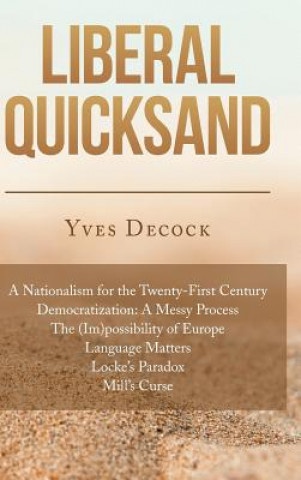
Kód: 10794467
Liberal Quicksand
Autor Yves Decock
According to a fairy tale, after World War II, Europe rejected nationalism and subsequently started the European project, which brought uninterrupted peace from 1945 on. In this book, this version of history is unmasked. First, Eu ... celý popis


- Jazyk:
 Angličtina
 - Väzba: Pevná
- Počet strán: 340
Nakladateľ: AuthorHouse, 2016
- Viac informácií o knihe


Mohlo by sa vám tiež páčiť
-

Tin Whistle for Beginners - Volume 1
17.91 € -7 % -

SpongeBob Board Game Family Bingo *English Version*
12.14 € -12 % -

Beyond Words
199.98 € -

If Mercy
16.70 € -1 % -

De las Selvas A las Catedrales
10.32 € -21 % -

Confluence, V5, No. 1, April, 1956: An International Forum
23.79 € -2 % -
6 QUINTET VOL. III: NN. 5 E 6 -ENSEMBLE DE PARTITIONS
39.68 €
Darčekový poukaz: Radosť zaručená
- Darujte poukaz v ľubovoľnej hodnote, a my sa postaráme o zvyšok.
- Poukaz sa vzťahuje na všetky produkty v našej ponuke.
- Elektronický poukaz si vytlačíte z e-mailu a môžete ho ihneď darovať.
- Platnosť poukazu je 12 mesiacov od dátumu vystavenia.
Viac informácií o knihe Liberal Quicksand
Nákupom získate 98 bodov
 Anotácia knihy
According to a fairy tale, after World War II, Europe rejected nationalism and subsequently started the European project, which brought uninterrupted peace from 1945 on. In this book, this version of history is unmasked. First, Europe did not desert nor transcend nationalism after 1945. On the contrary, since 1800, the nationalist program, based on linguistic divisions, has been implemented continuously, also after the end of World War II. Not the rejection of the nationalist program but its nearly full implementation is the basis of the lasting peace in Europe since 1945. The delineation of linguistically homogeneous territories is the precondition to create a truly Lockean democracy. Second, nationalism is, by itself, in the first place a strong emancipatory force that is intrinsically connected with the liberal evolutions at the end of the eighteenth and the midst of the nineteenth century. A correct appreciation of the emancipatory role of nationalism and of the contribution of nationalism to the current structure of Europe is a necessity to be able to deal adequately with the issues the modern world is thrusting upon Europe and to assess the form a political entity Europe might take. The European experience raises the question whether another path is possible. Throughout its history, the USA has followed the European path and has remained fundamentally Anglo-Saxon until 1965. Since then, the USA is struggling how to deal with its multicultural and multilingual reality and hesitates between an English-only mode, following the European model or something else, currently still not yet clearly defined. And what are the implications of Europe's history when applied to the Middle East or multinational states like China? Can they democratize without falling apart?
Parametre knihy
Zaradenie knihy Knihy po anglicky Society & social sciences Society & culture: general Social groups
40.39 €
- Celý názov: Liberal Quicksand
- Autor: Yves Decock
- Jazyk: Angličtina
- Väzba: Pevná
- Počet strán: 340
- EAN: 9781504997942
- ISBN: 9781504997942
- ID: 10794467
- Nakladateľ: AuthorHouse
- Hmotnosť: 667 g
- Rozmery: 229 × 152 × 22 mm
- Dátum vydania: 22. January 2016
Obľúbené z iného súdka
-

Women Who Run with the Wolves
9 € -27 % -

Orientalism
13.05 € -25 % -
When God Was A Woman
14.67 € -22 % -

How Europe Underdeveloped Africa
22.77 € -4 % -

Manhood
21.25 € -25 % -

Manipulated Man
12.04 € -24 % -

The Second Sex
14.98 € -29 % -

Women Who Run With The Wolves
14.98 € -25 % -

Why Does He Do That?
15.99 € -29 % -
Who Cooked the Last Supper?
19.23 € -10 % -

Eros and Mysteries of Love
14.77 € -25 % -

Zami
10.42 € -30 % -

Muqaddimah
18.22 € -25 % -

Witches, Midwives, And Nurses
11.74 € -

We Should All Be Feminists
7.99 € -29 % -

The Spiral Dance
14.07 € -25 % -
Beauty Myth
13.05 € -29 % -

Fathered by God
14.77 € -25 % -

Family Wealth - Keeping it in the Family
32.19 € -26 % -

Covering Islam
13.96 € -24 % -

Transgender Warriors
18.93 € -25 % -

Delectable Negro
40.19 € -

Between The World And Me
11.84 € -25 % -
Revolutionary Mothering
14.77 € -25 % -

Secrets of Aboriginal Healing
11.33 € -25 % -
Preliminary Materials for a Theory of the Young-Girl
15.79 € -6 % -

Politics of Reality
10.62 € -25 % -

Meat Market - Female flesh under capitalism
10.82 € -18 % -

Homosexual Desire
22.98 € -10 % -

Life and Death
16.19 € -17 % -

Sugar in My Bowl
11.74 € -26 % -

Napoleon's Other Wife
18.12 € -15 % -

Rez Life
17.61 € -10 % -

Lost World of the Kalahari
11.84 € -25 % -

Muscle Boys
44.85 € -18 % -

Lombard Street
9 € -

Stonewall
14.88 € -24 % -

Goddesses in Everywoman
16.19 € -25 % -

Pink Marine
14.77 € -25 % -

The Autobiography of Malcolm X
7.89 € -29 % -

The Velvet Rage
19.94 € -19 % -

Iron John
14.77 € -25 % -

Notes of a Native Son
11.74 € -21 % -

Generations
16.19 € -25 % -

Sister Outsider
9.71 € -34 % -

The Way of Men
12.04 € -25 % -

The Mastery of Love
10.93 € -23 % -

Distinction
30.27 € -

What Remains
14.67 € -22 %
Osobný odber Bratislava a 12742 dalších
Copyright ©2008-26 najlacnejsie-knihy.sk Všetky práva vyhradenéSúkromieCookies

 24 miliónov titulov
 Vrátenie do mesiaca
 02/210 210 99 (8-15.30h)