Kód: 02109880
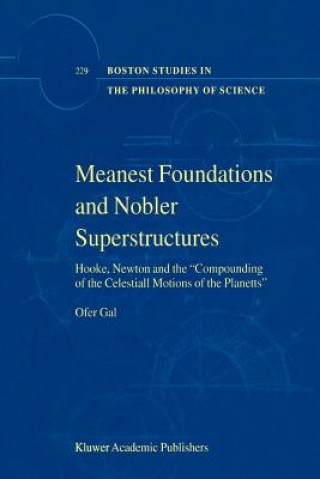
Meanest Foundations and Nobler Superstructures
Autor Ofer Gal
This book is a historical-epistemological study of one the most consequential idea of early modern celestial mechanics: Robert Hooke's proposal to "compoun[d] the celestial motions of the planets of a direct motion by the tangent ... celý popis


- Jazyk:
 Angličtina
 - Väzba: Brožovaná
- Počet strán: 252
Nakladateľ: Springer, 2010
- Viac informácií o knihe

103.07 €
Bežne: 111.71 €
Ušetríte 8.63 €

Skladom u dodávateľa
Odosielame za 5 - 8 dní
Mohlo by sa vám tiež páčiť
-

KJV Bible Compact Faux Leather, Teal
12.75 € -25 % -

This is Not a T-Shirt
13.76 € -26 % -

Japanese Kanji Writing Practice Book: Japanese Genkouyoushi Paper Workbook for Practicing Kanji Writing
6.37 € -7 % -

Got the Life
16.19 € -17 % -

Okapi L
6.88 € -5 % -

Zkouška bratrství
8.09 € -21 % -

Tropical Paradise Scenes to Paint or Color
6.37 € -14 % -

Manaraga
17.81 € -19 % -

My Big Book Of Look & Find Images - Look And Find Books For Kids Edition
14.07 € -25 % -

CRO-MAGNON
27.74 € -

Canoe Camping
20.55 € -14 % -

Naturalmente musica. La scala di Do
11.94 € -
Computer Aided Systems Theory - EUROCAST '89
51.73 € -7 % -

True Life
13.46 € -4 % -

Pour tout l'or des mots au bonheur des mots, des mots et des merveilles
42.62 € -

Cauchy3-Book17-Poems
18.32 € -7 % -

Using German Synonyms
142.77 € -

Im großen Hauptquartier 1870-71
25.10 € -11 % -

Pediatric Airway Diseases
201.40 € -9 % -

Symbole für Herrschaft und Königtum in den Erzählungen von Saul und David
129.30 € -

Egyptian Texts of the Bronzebook
33.51 € -24 % -

Technische Mechanik
53.15 € -7 % -

Prefrontal Cortex
205.96 € -7 % -

Spin Dynamics in Confined Magnetic Structures I
205.96 € -7 % -
Econometrics of Health Care
154.52 € -7 % -

de l'Utilite d'Une Mission Archeologique Permanente A Carthage
16.60 € -

Am Konigssee
33.91 € -4 % -
Physics of Low Dimensional Systems
154.52 € -7 % -

Filme im Geschichtsunterricht - Gattungen, Eigenschaften und didaktische Implikationen
16.19 € -10 % -

What Is the Role of Teens in Your Church?
13.15 € -21 % -

Communism in Malaysia and Singapore
51.73 € -7 % -

Multichip Modules
128.39 € -

Sportjournalismus im internationalen Vergleich
13.56 € -10 % -

Kapital in seiner Kulturbedeutung
12.65 € -10 % -

Systematic Reviews
49.30 € -

Futures Thinking, Learning, and Leading
67.73 € -

David, King of Israel, and Caleb in Biblical Memory
99.02 € -

Das Bundesstaatsrecht Der Schweiz
60.75 € -

Stereochimie Aux Reactions Internes Entre Les Radicaux Eloignes d'Une Meme Molecule
14.77 € -2 % -

Purification de la moelle T1 DVD
33.81 € -

Letters from India and Kashmir
23.28 € -14 % -

Descriptive Catalogue of Materials Relating to the History of Great Britain and Ireland to the End of the Reign of Henry VII
61.66 € -

Die praktische Konkordanz von Kompetenzen
147.63 € -

50 West End Shows 50 West End Songs Pvg
33.81 € -

India Mission of the Methodist Episcopal Church
28.34 € -1 % -

Le Liban Dans La Mondialisation
46.37 € -11 % -

Stephan Victor, Erzherzog von OEsterreich
26.82 € -11 % -

Johnny's Boys
17 € -1 % -

Lite me up
19.94 € -

Autumn Marine
14.07 € -25 % -

All About Hanukkah: A Coloring Book
9.81 € -6 % -

Squishy Taylor and the Tunnel of Doom
24.19 € -9 % -

Your Soul's Quest
14.07 € -25 % -

Obsession: A Sharon Hayes Detective Story
11.53 € -7 % -

WEAK STATES IN AFRICA: U.S. POLICY IN LIBERIA
17.31 € -2 % -

The Willows
6.37 € -7 % -

Animal Kingdom T05
10.22 € -

Protein Degradation - The Ubiquitin-Proteasome System and Disease V 4
256.18 € -

Übungen zur Transaktionsanalyse
26.12 € -6 % -

Monographie de Notre-Dame de Chartres: Explication Des Planches
19.33 € -2 % -

Interracial Con Game
14.77 € -25 % -

Hamburger Buttons
14.77 € -2 % -

Gemeinderecht
44.65 €
Darčekový poukaz: Radosť zaručená
- Darujte poukaz v ľubovoľnej hodnote, a my sa postaráme o zvyšok.
- Poukaz sa vzťahuje na všetky produkty v našej ponuke.
- Elektronický poukaz si vytlačíte z e-mailu a môžete ho ihneď darovať.
- Platnosť poukazu je 12 mesiacov od dátumu vystavenia.
Viac informácií o knihe Meanest Foundations and Nobler Superstructures
Nákupom získate 249 bodov
 Anotácia knihy
This book is a historical-epistemological study of one the most consequential idea of early modern celestial mechanics: Robert Hooke's proposal to "compoun[d] the celestial motions of the planets of a direct motion by the tangent & an attractive motion towards a central body," a proposal which Isaac Newton adopted and realized in his Principia. §Hooke's Programme was revolutionary both cosmologically and mathematically. It presented "the celestial motions," the proverbial symbol of stability and immutability, as a process of continuous change, and prescribed only parameters of rectilinear motions and rectilinear attractions for calculating their closed curved orbits. Yet the traces of Hooke's construction of his Programme for the heavens lead through his investigations in such earthly disciplines as microscopy, practical optics and horology, and the mathematical tools developed by Newton to accomplish it appear no less local and goal-oriented than Hooke's lenses and springs.§This transgression of the boundaries between the theoretical, experimental and technological realms is reminiscent of Hooke's own free excursions in and out of the circles occupied by gentlemen-philosophers, university mathematicians, instrument makers, technicians and servants. It presents an opportunity to examine the social and epistemological distinctions, relations and hierarchies between those realms and their inhabitants, and compels a critical assessment of the philosophical categories they embody.This book is a historical-epistemological study of one the most consequential idea of early modern celestial mechanics: Robert Hooke's proposal to "compoun[d] the celestial motions of the planets of a direct motion by the tangent & an attractive motion towards a central body," a proposal which Isaac Newton adopted and realized in his Principia.§Hooke's Programme was revolutionary both cosmologically and mathematically. It presented "the celestial motions," the proverbial symbol of stability and immutability, as a process of continuous change, and prescribed only parameters of rectilinear motions and rectilinear attractions for calculating their closed curved orbits. Yet the traces of Hooke's construction of his Programme for the heavens lead through his investigations in such earthly disciplines as microscopy, practical optics and horology, and the mathematical tools developed by Newton to accomplish it appear no less local and goal-oriented than Hooke's lenses and springs.§This transgression of the boundaries between the theoretical, experimental and technological realms is reminiscent of Hooke's own free excursions in and out of the circles occupied by gentlemen-philosophers, university mathematicians, instrument makers, technicians and servants. It presents an opportunity to examine the social and epistemological distinctions, relations and hierarchies between those realms and their inhabitants, and compels a critical assessment of the philosophical categories they embody.
Parametre knihy
Zaradenie knihy Knihy po anglicky Mathematics & science Science: general issues Philosophy of science
103.07 €
- Celý názov: Meanest Foundations and Nobler Superstructures
- Podnázov: Hooke, Newton and the Compounding of the Celestiall Motions of the Planetts
- Autor: Ofer Gal
- Jazyk: Angličtina
- Väzba: Brožovaná
- Počet strán: 252
- EAN: 9789048160679
- ISBN: 9048160677
- ID: 02109880
- Nakladateľ: Springer
- Hmotnosť: 667 g
- Rozmery: 279 × 210 × 15 mm
- Dátum vydania: 08. December 2010
Obľúbené z iného súdka
-

Life 3.0
12.95 € -25 % -

Principia: The Authoritative Translation and Guide
37.15 € -12 % -
Structure of Scientific Revolutions
13.46 € -24 % -
Logic of Scientific Discovery
17.20 € -

What is Life?
15.48 € -25 % -

Physics and Philosophy
13.96 € -24 % -
Quantum and the Lotus
14.07 € -25 % -

'Nature and the Greeks' and 'Science and Humanism'
15.48 € -25 % -

BAD SCIENCE
14.47 € -26 % -

Order Out of Chaos
23.69 € -18 % -

What Makes Biology Unique?
46.17 € -
Dialectic of Duration
48.19 € -

Two Cultures
15.48 € -25 % -
What is This Thing Called Science?
45.05 € -
Understanding Philosophy of Science
60.24 € -

Arts of Living on a Damaged Planet
20.34 € -24 % -
On the Mode of Existence of Technical Objects
25.31 € -21 % -
Meeting the Universe Halfway
33.30 € -6 % -

Social Physics
21.46 € -18 % -
Philosophy of Physics
27.43 € -11 % -

Anti-Gravity and the World Grid
11.33 € -24 % -

Another Science is Possible - Manifesto for a Slow Science
23.08 € -3 % -

Modern Cosmology
97.91 € -6 % -

Principia: The Authoritative Translation
18.32 € -7 % -

Fourth Revolution
15.79 € -10 % -

Immortal Mind
12.75 € -24 % -

Wholeness of Nature
21.25 € -25 % -

Quark And The Jaguar
17.81 € -20 % -

On Being
12.04 € -25 % -
Science and Hypothesis
12.75 € -24 % -

Politics of Nature
45.05 € -

Value of Science
21.46 € -18 % -

Life is a Miracle
12.45 € -26 % -
Gaia Hypothesis
29.56 € -

What Science Knows
19.03 € -21 % -

Thinking through Technology
35.84 € -
Technics and Praxis
103.07 € -7 % -

Theory of Scientific Method
30.06 € -4 % -

Enlightenment Now
15.99 € -29 % -

Logic of Scientific Discovery
29.46 € -6 % -

Artificial Intelligence: A Very Short Introduction
10.42 € -24 % -
Causality
77.15 € -
Philosophy of Science: Very Short Introduction
10.42 € -24 % -

Everything You Know Is Wrong, Book 1
14.77 € -25 % -

Oxford Handbook of the History of Physics
62.67 € -

Mind of God
13.96 € -24 % -

Why People Believe Weird Things
16.09 € -28 % -

Human Entrance to Transhumanism
14.98 € -6 % -

Paleontology
33.61 €
Osobný odber Bratislava a 12882 dalších
Copyright ©2008-26 najlacnejsie-knihy.sk Všetky práva vyhradenéSúkromieCookies

 24 miliónov titulov
 Vrátenie do mesiaca
 02/210 210 99 (8-15.30h)