Kód: 53775152
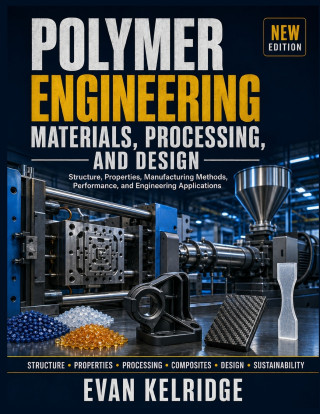
POLYMER ENGINEERING
Autor Evan Kelridge
A metal part behaves almost the same on day one and ten years later, provided it isn't corroding. A polymer part almost never does. Its stiffness shifts with temperature, it creeps under a load a metal would carry indefinitely, an ... celý popis


- Jazyk:
 Angličtina
 - Väzba: Brožovaná
- Počet strán: 446
Nakladateľ: Independently published, 2026
- Viac informácií o knihe

86.61 €
Bežne: 93.13 €
Ušetríte 6.51 €

Skladom u dodávateľa
Odosielame za 10 - 16 dní
Mohlo by sa vám tiež páčiť
-

Threshing Day (Wing and Claw Collection)
17.92 € -29 % -

Threshing Day (Limited Deluxe Edition)
20.52 € -29 % -

21 Days of Fear
16.21 € -27 % -

White Nights
4.50 € -14 % -

Berserk Deluxe Volume 1
38.85 € -24 % -

Murdoku
14.51 € -22 % -

What Happened Yesterday
15.51 € -27 % -

The Art of Gravity Falls
36.54 € -25 % -

The Mirror of Infinite Endings
17.11 € -20 % -

The Long-Lived King: An Original The Owl House Graphic Novel
16.21 € -30 % -

Onyx Storm (Deluxe Limited Edition) (The Empyrean, 3)
24.22 € -24 % -

Berserk Deluxe Volume 2
36.44 € -29 % -

Court of Thorns and Roses 6
15.51 € -30 % -

Berserk Deluxe Volume 3
55.37 € -

Witch Hat Atelier: Grimoire Edition 1
35.14 € -29 % -

Kid's Box New Generation Level 2 Activity Book with Digital Pack British English
10.71 € -9 % -

Jojo's Bizarre Adventure: Part 7--Steel Ball Run, Vol. 8
18.12 € -24 % -

The Courage To Be Disliked
10.61 € -13 % -

Kid's Box New Generation Level 1 Activity Book with Digital Pack British English
11.11 € -5 % -

Lord of Mysteries, Vol. 4: The Faceless, Part I
16.91 € -13 % -

Kid's Box New Generation Level 3 Activity Book with Digital Pack British English
11.11 € -5 %
Darčekový poukaz: Radosť zaručená
- Darujte poukaz v ľubovoľnej hodnote, a my sa postaráme o zvyšok.
- Poukaz sa vzťahuje na všetky produkty v našej ponuke.
- Elektronický poukaz si vytlačíte z e-mailu a môžete ho ihneď darovať.
- Platnosť poukazu je 12 mesiacov od dátumu vystavenia.
Viac informácií o knihe POLYMER ENGINEERING
Nákupom získate 212 bodov
 Anotácia knihy
A metal part behaves almost the same on day one and ten years later, provided it isn't corroding. A polymer part almost never does. Its stiffness shifts with temperature, it creeps under a load a metal would carry indefinitely, and it can turn brittle years into service with no visible warning, because heat, oxygen, ultraviolet light, or moisture have been quietly reworking its molecular structure the whole time.
An engineer who treats a polymer data sheet the way a metal data sheet is treated, as a fixed set of numbers good for the life of the part, eventually gets surprised by it, usually as a field failure, a warped molded part, or a fitting that cracked far below its rated strength. Much of the available material on polymers doesn't close that gap, because it specializes: a chemistry-focused text stops short of manufacturing, a processing manual treats material behavior as a black box, and a design guide offers rules of thumb without showing where the numbers came from.
This book follows a single connected thread instead, from a polymer's molecular architecture through its measurable properties, through the processes that convert resin into product, to the design decisions an engineer must ultimately defend, with every relationship derived from first principles and demonstrated on a fully worked, unit-checked numerical example.
Inside, you will:
- Derive and apply the governing relationships for polymerization kinetics, crystallinity, melt viscosity, and viscoelastic response, each demonstrated on a complete, checked numerical example.
- Learn to read a calorimetry thermogram, a melt-flow-index result, and a dynamic mechanical analysis sweep well enough to translate them into an actual processing window.
- Compare commodity and engineering thermoplastics, thermosets, elastomers, and specialty polymers on the properties that genuinely decide a material selection.
- Predict fiber-reinforced composite stiffness with the rule of mixtures and a second, more broadly applicable stiffness model, and size an extrusion screw, an injection mold's clamp force and cooling time, or a thermoformed part's wall thickness.
- Apply creep-adjusted modulus, fatigue behavior, and stress-concentration principles to size a snap-fit joint, a living hinge, or a reinforcing rib for years of real service rather than a single laboratory test.
This book is written for the reader who already has an engineering foundation and now needs a genuinely quantitative treatment of polymers: an upper-level engineering student, or a practicing mechanical, materials, chemical, or manufacturing engineer who needs a dependable reference for material, process, and design decisions involving plastics, elastomers, and composites.
Take the next step toward understanding and applying the ideas presented in this comprehensive guide, and start building a quantitative command of polymer behavior that a data sheet alone cannot provide.
Parametre knihy
86.61 €
- Celý názov: POLYMER ENGINEERING
- Podnázov: MATERIALS, PROCESSING, AND DESIGN: Structure, Properties, Manufacturing Methods, Performance, and Engineering Applications
- Autor: Evan Kelridge
- Jazyk: Angličtina
- Väzba: Brožovaná
- Počet strán: 446
- EAN: 9798171772703
- ID: 53775152
- Nakladateľ: Independently published
- Hmotnosť: 1028 g
- Rozmery: 280 × 216 × 23 mm
- Dátum vydania: 03. September 2026
Osobný odber Bratislava a 13401 dalších
Copyright ©2008-26 najlacnejsie-knihy.sk Všetky práva vyhradenéSúkromieCookies

 25 miliónov titulov
 Vrátenie do mesiaca
 02/210 210 99 (8-15.30h)