Code: 53530821
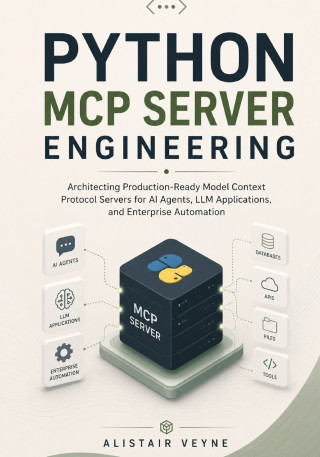
Python MCP Server Engineering
by Alistair Veyne
The Model Context Protocol makes it possible for AI agents and LLM applications to interact with external tools, data, and services. But building a server that works in a demo is very different from building one that can survive r ... more


- Language:
 English
 - Binding: Paperback
- Number of pages: 268
Publisher: Independently published, 2026
- More about this

31.17 €
RRP: 33.54 €
You save 2.37 €

In stock at our supplier
Shipping in 14 - 21 days
You might also like
-

Murdoku
14.06 € -25 % -

Threshing Day (Wing and Claw Collection)
17.80 € -29 % -

Berserk Deluxe Volume 1
37.74 € -28 % -

Threshing Day (Limited Deluxe Edition)
21.04 € -29 % -

White Nights
4.54 € -14 % -

Berserk Deluxe Volume 2
36.33 € -30 % -

The Odyssey
14.06 € -25 % -

Kid's Box New Generation Level 2 Activity Book with Digital Pack British English
12.44 € -

Berserk Deluxe Volume 3
55.36 € -

Onyx Storm (Deluxe Limited Edition) (The Empyrean, 3)
24.18 € -25 % -

Kid's Box New Generation Level 2 Pupil's Book with eBook British English
15.58 € -19 % -

Murdoku Volume 2: Back in Time
13.76 € -29 % -

Needoh - Nice Cube (random colours)
7.89 € -5 % -

Moonwalk
13.86 € -19 % -

The Score
12.34 € -19 % -

Kid's Box New Generation Level 1 Activity Book with Digital Pack British English
12.44 € -

Jujutsu Kaisen, Vol. 26
9.91 € -23 % -

Dancing The Dream
21.45 € -25 % -

Kid's Box New Generation Level 3 Activity Book with Digital Pack British English
11.33 € -4 % -

The Mistake
11.33 € -16 % -

Fourth Wing
23.68 € -26 %
Give this book as a present today
- Order book and choose Gift Order.
- We will send you book gift voucher at once. You can give it out to anyone.
- Book will be send to donee, nothing more to care about.
More about Python MCP Server Engineering
You get 75 loyalty points
 Book synopsis
The Model Context Protocol makes it possible for AI agents and LLM applications to interact with external tools, data, and services. But building a server that works in a demo is very different from building one that can survive real users, concurrent workloads, authentication requirements, failures, and production deployments.
Python MCP Server Engineering takes you through that entire journey.
Rather than presenting MCP as a collection of isolated examples, this book follows one realistic project-TicketFlow MCP, a support-ticket and knowledge-base server-and progressively develops it from an initial Python scaffold into a secure, observable, containerized production system.
You will learn how to:
- Understand MCP's architecture, lifecycle, tools, resources, prompts, and schemas
- Structure Python MCP projects for maintainability and long-term growth
- Build MCP servers with Python, async I/O, and modern dependency management
- Design tools that models can discover and use reliably
- Expose resources for data, files, documentation, and contextual information
- Create effective server-side prompts
- Implement stdio and Streamable HTTP transports
- Handle streaming, concurrency, latency, partial results, and long-running operations
- Secure MCP servers with OAuth 2.1, API keys, tokens, and scope-based authorization
- Apply least-privilege security to individual capabilities
- Test tools, schemas, sessions, authorization, and failure conditions
- Debug MCP clients and servers with inspection and structured diagnostics
- Add structured logging, OpenTelemetry tracing, and Prometheus metrics
- Dockerize and deploy MCP servers to production environments
- Design for reliability, fault tolerance, graceful shutdown, and scaling
- Manage backward compatibility, deprecation, versioning, and migrations
- Integrate MCP servers with RAG pipelines, autonomous agents, and internal platforms
- Build a production reference architecture that can be adapted to other domains
You do not need prior MCP experience. However, you should be comfortable with Python, type hints, async/await, and basic HTTP services.
Whether you are a backend developer moving into AI infrastructure, a Python engineer building agent-facing services, or a platform engineer exposing internal systems to AI, this book gives you a practical path from first MCP server to production-ready system.
Build the server. Secure it. Test it. Observe it. Deploy it. Then build something real.
Book details
31.17 €
- Full title: Python MCP Server Engineering
- Subtitle: Architecting Production-Ready Model Context Protocol Servers for AI Agents, LLM Applications, and Enterprise Automation
- Author: Alistair Veyne
- Language: English
- Binding: Paperback
- Number of pages: 268
- EAN: 9798192721728
- ID: 53530821
- Publisher: Independently published
- Weight: 472 g
- Dimensions: 254 × 178 × 14 mm
- Date of publishing: 14. August 2026
Osobný odber Bratislava a 13129 dalších
Copyright ©2008-26 najlacnejsie-knihy.sk Všetky práva vyhradenéSúkromieCookies

 24 miliónov titulov
 Vrátenie do mesiaca
 02/210 210 99 (8-15.30h)