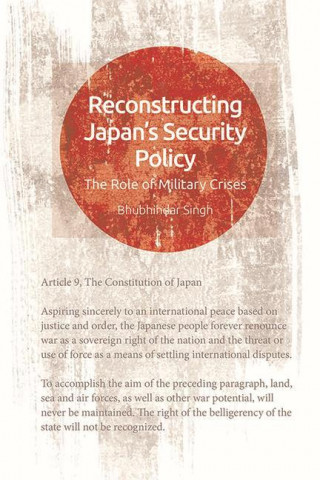
Kód: 19366056
Reconstructing Japan's Security
Autor Bhubhindar Singh
Systematically analyses the impact of external military crises on Japanese security policy expansion in the post-Cold War period.Focuses on the widening of Japans security posture in external security affairs and investigates the ... celý popis


- Jazyk:
 Angličtina
 - Väzba: Pevná
- Počet strán: 240
Nakladateľ: EDINBURGH UNIVERSITY PRESS, 2020
- Viac informácií o knihe


Mohlo by sa vám tiež páčiť
-

Moonwalk
14.17 € -

The Score
13.97 € -19 % -

The Deal
12.65 € -23 % -

The Mistake
14.57 € -12 % -

Jujutsu Kaisen, Vol. 30
9.92 € -20 % -

Witch Hat Atelier: Grimoire Edition 1
34.63 € -29 % -

Invincible Compendium Volume 1
45.87 € -24 % -

Invincible Compendium Volume 2
48.30 € -22 % -

Berserk Deluxe Volume 1
35.54 € -26 % -

The Goal
14.68 € -11 % -

Berserk Deluxe Volume 2
33.31 € -30 % -

Witch Hat Atelier Manga Box Set 1
56.20 € -25 % -

Heated Rivalry
12.65 € -7 % -

Jujutsu Kaisen, Vol. 25
9.92 € -20 % -

Jujutsu Kaisen, Vol. 26
9.92 € -20 % -

Lord of Mysteries, Vol. 3: The Clown, Part III
14.98 € -29 % -

Invincible Compendium Volume 3
45.87 € -24 % -

Jujutsu Kaisen, Vol. 29
9.92 € -20 % -

Moonwalk: A Memoir
21.77 € -24 % -

Murdoku
17.01 € -25 % -

Berserk Deluxe Volume 3
55.19 €
Darčekový poukaz: Radosť zaručená
- Darujte poukaz v ľubovoľnej hodnote, a my sa postaráme o zvyšok.
- Poukaz sa vzťahuje na všetky produkty v našej ponuke.
- Elektronický poukaz si vytlačíte z e-mailu a môžete ho ihneď darovať.
- Platnosť poukazu je 12 mesiacov od dátumu vystavenia.
Viac informácií o knihe Reconstructing Japan's Security
Nákupom získate 330 bodov
 Anotácia knihy
Systematically analyses the impact of external military crises on Japanese security policy expansion in the post-Cold War period.
Focuses on the widening of Japans security posture in external security affairs and investigates the causes of this critical changeIdentifies the external military crisis as a critical determinant of change in Japanese security policyUnpacks the deep structures within the Japanese decision-making processes, especially during and after military crisesExamines five key military crises in detail: the 1990-1 Persian Gulf War; the 1994 North Korean Nuclear Crisis; the 1996 Taiwan Straits Crisis, the 1998 Taepodong Crisis; and 2001 September 11 attacks that led to the US-led war against terrorism in Afghanistan and IraqDraws on over 70 interviews the author has conducted with officials, former officials, and academics in universities and think tanks in Japan, the United States, South Korea and Singapore, including officials who were directly involved in the crisis decision-making processThis book is a detailed study of the role that external military crises played in the development and growth of Japanese security policies in the period following the end of the Cold War. This evolution can be seen in the widened role of the Self-Defence Force (SDF) in shaping Japans security priorities, as well as its proactive contribution to regional/ international security. Focusing on four key case studies international peacekeeping in 1992, regional defence in 1997-99, global missions in 2003-05, and collective self-defence in 2014-15 the author argues that the Japanese security policymaking elite achieved security policy expansion by utilizing external military crises as policy windows, inflating and deflating threat elements to circumvent the constraints and justify the implementation of security policy initiatives.
Parametre knihy
136.62 €
- Celý názov: Reconstructing Japan's Security
- Podnázov: The Role of Military Crises
- Autor: Bhubhindar Singh
- Jazyk: Angličtina
- Väzba: Pevná
- Počet strán: 240
- EAN: 9781474446228
- ISBN: 9781474446228
- ID: 19366056
- Nakladateľ: EDINBURGH UNIVERSITY PRESS
- Hmotnosť: 474 g
- Rozmery: 162 × 240 × 19 mm
- Dátum vydania: 31. October 2020
Osobný odber Bratislava a 12792 dalších
Copyright ©2008-26 najlacnejsie-knihy.sk Všetky práva vyhradenéSúkromieCookies

 24 miliónov titulov
 Vrátenie do mesiaca
 02/210 210 99 (8-15.30h)