Kód: 01387961
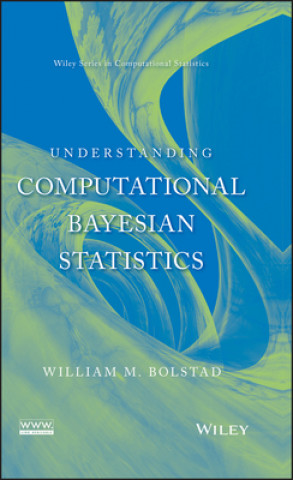
Understanding Computational Bayesian Statistics
Autor William M. Bolstad
A hands-on introduction to computational statistics from a Bayesian point of view§§Providing a solid grounding in statistics while uniquely covering the topics from a Bayesian perspective, Understanding Computational Bayesian Stat ... celý popis


- Jazyk:
 Angličtina
 - Väzba: Pevná
- Počet strán: 336
Nakladateľ: John Wiley & Sons Inc, 2010
- Viac informácií o knihe

149.83 €
Bežne: 152.87 €
Ušetríte 3.04 €

Skladom u dodávateľa
Odosielame za 9 - 15 dní
Mohlo by sa vám tiež páčiť
-

O duších 1-4
20.33 € -31 % -

Gargoyles and Grotesques
11.83 € -20 % -

Beyond Dog Massage
35.91 € -15 % -

Školní detektiv
7.27 € -26 % -

Apocalypse Now / Collector's Edition
24.07 € -

Spice Girls
23.36 € -24 % -

History of Greece Greek language
22.55 € -7 % -

Russian in Exercises for Spanish Speakers/El Ruso en Ejercicios
20.33 € -35 % -

KVplan Sonderausgabe Warendorf
6.77 € -

Gwreans an Bys
18.81 € -14 % -

Interchange Level 1 Workbook
15.57 € -7 % -

Management Accounting
42.69 € -

Three Films By Yasujirô Ozu
30.14 € -10 % -

Marvel Spider-Man: 1001 Stickers
7.68 € -25 % -

Untersuchungen zur Gefriertrocknung von Doxorubicin-beladenen HSPC/Cholesterol- Liposomen
25.59 € -11 % -

I Don't Know Who I Am Anymore: Restoring Your Identity Shattered by Grief and Loss
14.76 € -25 % -

Já Baryk - DVD box
2.82 € -31 % -

The Best of Female Wrestling 2
22.45 € -20 % -

PRESIDENTIAL CANDIDATES: CONTAINING SKET
34.59 € -2 % -

Verše ze závěti
3.03 € -16 % -

Through the Storm, Through the Night
46.03 € -

Sentimental Tommy: The Story of his Boyhood
13.24 € -6 % -

Social Enterprise
71.93 € -

History of Greece 4 Volume Paperback Set
183.02 € -15 % -

La Peche En Eau Douce, (Ed.1882)
13.85 € -2 % -

Schock
53.11 € -7 % -

Modern Bioelectrochemistry
90.95 € -

Runtime Verification
67.07 € -7 % -

Russische Exilkultur als Folge der Revolution von 1917
16.18 € -10 % -

Oeuvres Completes de Alfred de Musset. La Confession d'Un Enfant Du Siecle
27.81 € -

Engineering Modeling
118.37 € -12 % -

Religion in Revolutionary England
31.25 € -9 % -

Nombres
23.97 € -

BREAKING NEW GROUND
56.65 € -9 % -

Tribal Sovereignty and the Historical Imagination
31.25 € -

Chilling Tales: Evil I Did Dwell - Llewd Did I Live
13.95 € -9 % -

Light Reading: Reflections in Poetry and Prose
15.37 € -9 % -

Zuschendorf - Beschreibung des Betriebes der Landwirtschaft
29.43 € -11 % -

Coastal Hazards
154.39 € -7 % -

Plurality and Ambiguity
37.43 € -

Meat and Meat Products: Technology, Chemistry and Microbiology
51.69 € -7 % -

Technetium in the Environment
137.69 €
Darčekový poukaz: Radosť zaručená
- Darujte poukaz v ľubovoľnej hodnote, a my sa postaráme o zvyšok.
- Poukaz sa vzťahuje na všetky produkty v našej ponuke.
- Elektronický poukaz si vytlačíte z e-mailu a môžete ho ihneď darovať.
- Platnosť poukazu je 12 mesiacov od dátumu vystavenia.
Viac informácií o knihe Understanding Computational Bayesian Statistics
Nákupom získate 362 bodov
 Anotácia knihy
A hands-on introduction to computational statistics from a Bayesian point of view§§Providing a solid grounding in statistics while uniquely covering the topics from a Bayesian perspective, Understanding Computational Bayesian Statistics successfully guides readers through this new, cutting-edge approach where inferences are based on random samples drawn from the posterior distribution. With its hands-on approach, step approach, the book shows readers how samples can be drawn from the posterior distribution when the formula giving its shape is all that is known, and how Bayesian inferences can be based on these samples from the posterior. These ideas are illustrated on common statistical models including the multiple linear regression model, the hierarchical mean model, the logistic regression model, and the proportional hazards model.§§The book begins with an outline of the similarities and differences between Bayesian and the likelihood approaches to statistics. Subsequent chapters present key techniques for using computer software to draw Monte Carlo samples from the incompletely known posterior distribution and performing the Bayesian inference calculated from these samples. Topics of coverage include:§ Direct ways to draw a random sample from the posterior by reshaping a random sample drawn from an easily sampled starting distribution§ The distributions from the one-dimensional exponential family§ Markov chains and their long-run behavior§ The Metropolis-Hastings algorithm§ Gibbs sampling algorithm and methods for speeding up convergence§ Markov Chain Monte Carlo Sampling§§Using numerous graphs and diagrams, the author emphasizes a step-by step approach to computational Bayesian statistics. At each step, important aspects of application are detailed, such as how to choose a prior for logistic regression model, the Poisson regression model, and the proportional hazards model. A related web site houses R functions and Minitab(r) macros for Bayesian analysis and Monte Carlo simulations, and detailed appendices in the book guide readers through the use of these software packages.§§Understanding Computational Bayesian Statistics is an excellent book for courses on computational statistics at the upper-level undergraduate and graduate levels. It is also a valuable reference for researchers and practitioners who use computer programs to work with data and solve problems in their everyday work.Bayesian statistics allows the use of assumptions to eliminate improbable paths. The Bayesian view has many important theoretical aspects that students should be familiar with if they are going into fields where statistics will be used. This book uniquely covers the topics usually found in a typical introductory statistics book but from a Bayesian perspective.A hands-on introduction to computational statistics from a Bayesian point of view§§Providing a solid grounding in statistics while uniquely covering the topics from a Bayesian perspective, Understanding Computational Bayesian Statistics successfully guides readers through this new, cutting-edge approach where inferences are based on random samples drawn from the posterior distribution. With its hands-on approach, step approach, the book shows readers how samples can be drawn from the posterior distribution when the formula giving its shape is all that is known, and how Bayesian inferences can be based on these samples from the posterior. These ideas are illustrated on common statistical models including the multiple linear regression model, the hierarchical mean model, the logistic regression model, and the proportional hazards model.§§The book begins with an outline of the similarities and differences between Bayesian and the likelihood approaches to statistics. Subsequent chapters present key techniques for using computer software to draw Monte Carlo samples from the incompletely known posterior distribution and performing the Bayesian inference calculated from these samples. Topics of coverage include: Direct ways to draw a random sample from the posterior by reshaping a random sample drawn from an easily sampled starting distribution§ The distributions from the one-dimensional exponential family§ Markov chains and their long-run behavior§ The Metropolis-Hastings algorithm§ Gibbs sampling algorithm and methods for speeding up convergence§ Markov Chain Monte Carlo Sampling§§Using numerous graphs and diagrams, the author emphasizes a step-by step approach to computational Bayesian statistics. At each step, important aspects of application are detailed, such as how to choose a prior for logistic regression model, the Poisson regression model, and the proportional hazards model. A related web site houses R functions and Minitab(r) macros for Bayesian analysis and Monte Carlo simulations, and detailed appendices in the book guide readers through the use of these software packages.§§Understanding Computational Bayesian Statistics is an excellent book for courses on computational statistics at the upper-level undergraduate and graduate levels. It is also a valuable reference for researchers and practitioners who use computer programs to work with data and solve problems in their everyday work.
Parametre knihy
Zaradenie knihy Knihy po anglicky Mathematics & science Mathematics Probability & statistics
149.83 €
- Celý názov: Understanding Computational Bayesian Statistics
- Autor: William M. Bolstad
- Jazyk: Angličtina
- Väzba: Pevná
- Počet strán: 336
- EAN: 9780470046098
- ISBN: 0470046090
- ID: 01387961
- Nakladateľ: John Wiley & Sons Inc
- Hmotnosť: 578 g
- Rozmery: 241 × 153 × 25 mm
- Dátum vydania: 15. January 2010
Obľúbené z iného súdka
-

Naked Statistics
13.55 € -24 % -

How to Lie with Statistics
10.61 € -25 % -
Fifty Challenging Problems in Probability with Solutions
8.59 € -24 % -

How to Lie with Statistics
13.04 € -29 % -
Statistics For Dummies, 2nd Edition
18.30 € -24 % -
Schaum's Outline of Probability and Statistics
18.91 € -25 % -

Theory That Would Not Die
14.05 € -25 % -
Foundations of Modern Probability
100.76 € -9 % -

Unfinished Game
23.26 € -
Basic Probability Theory
16.79 € -25 % -
Bayesian Analysis with Python
53.61 € -1 % -

Statistical Thermodynamics
7.88 € -24 % -

Manga Guide To Statistics
18.30 € -24 % -

Cambridge International AS & A Level Mathematics Probability and Statistics 1 Student's Book
32.67 € -
Elements of Statistical Learning
85.69 € -

Statistics Done Wrong
29.84 € -

Manga Guide To Regression Analysis
18.61 € -25 % -
Bayesian Data Analysis
116.55 € -
Statistics
62.01 € -4 % -

Collected Works of C.G. Jung
20.33 € -24 % -

Pearson Edexcel International A Level Mathematics Statistics 2 Student Book
39.55 € -

Probability Theory
143.36 € -
Elementary Decision Theory
16.79 € -25 % -
Introduction to Statistical Learning
50.98 € -

Introduction to Probability, Second Edition
111.18 € -

Introductory Econometrics for Finance
71.02 € -

Probability Theory
7.88 € -24 % -
Statistics: A Very Short Introduction
10.01 € -24 % -

Foundations of the Theory of Probability
9.91 € -
Causal Inference in Statistics - A Primer
46.63 € -
Doing Bayesian Data Analysis
92.47 € -

Cambridge International AS & A Level Mathematics Probability & Statistics 1
28.42 € -

Probability Theory
18.30 € -45 % -

First Course in Probability, Global Edition
84.27 € -10 % -
Applied Time Series Analysis and Forecasting with Python
80.63 € -9 % -
Schaum's Outline of Beginning Statistics, Second Edition
30.55 € -17 % -

Understanding Probability
73.34 € -

Statistical Physics
88.12 € -9 % -

Probability and Computing
63.93 € -5 % -
First Look At Rigorous Probability Theory, A (2nd Edition)
34.19 € -

Practical Statistics for the Analytical Scientist
41.27 € -

Seven Pillars of Statistical Wisdom
26.70 € -
Modern Statistics
80.63 € -9 % -
Analytic Combinatorics
115.64 € -
Handbook of Statistical Analyses using R
97.63 € -
Practice of Statistics for Business and Economics
97.93 € -1 % -
The Pleasures of Probability
50.48 € -9 % -

Choosing and Using Statistics - A Biologists' Guide 3e
44 € -5 % -
Practical Nonparametric Statistics 3e
277.93 €
Osobný odber Bratislava a 12744 dalších
Copyright ©2008-26 najlacnejsie-knihy.sk Všetky práva vyhradenéSúkromieCookies

 24 miliónov titulov
 Vrátenie do mesiaca
 02/210 210 99 (8-15.30h)