Kód: 04611828
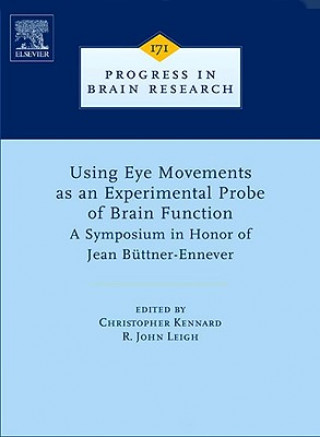
Using Eye Movements as an Experimental Probe of Brain Function
Autor R. John Leigh, Christopher Kennard
This volume of Progress in Brain Research is based on the proceedings of a conference, "Using Eye Movements as an Experimental Probe of Brain Function," held at the Charing Cross Hospital Campus of Imperial College London, UK on 5 ... celý popis


- Jazyk:
 Angličtina
 - Väzba: Pevná
- Počet strán: 652
Nakladateľ: Elsevier Science & Technology, 2008
- Viac informácií o knihe

263.78 €
Bežne: 293.05 €
Ušetríte 29.27 €

U vydavateľa na objednávku
Odosielame za 28 - 34 dní
Mohlo by sa vám tiež páčiť
-

Antiquarian Sticker Book
20.34 € -24 % -

Kaiju No. 8, Vol. 4
9.71 € -25 % -

Quiet Journal
14.77 € -34 % -

Definitely: The Story of Def Leppard
35.94 € -24 % -

Am Montag ist alles ganz anders
7.79 € -

Churchill
18.62 € -26 % -

Sticker Dolly Dressing Fairy Princesses
7.89 € -25 % -

Entryways of Milan – Ingressi di Milano
49.10 € -29 % -

Coming of Age in Samoa
9.51 € -

?Espaňol? Por supuesto! 2/A2
18.52 € -9 % -

Coloriages mystères Les grands classiques Disney tome 3
21.56 € -

Test für medizinische Studiengänge. Bd.2
14.88 € -1 % -

Bezos Letters
10.72 € -30 % -

Сиддхартха. Путешествие к земле Востока
16.70 € -11 % -

Taj Mahal (Puzzle)
33 € -47 % -

Romance of the Three Kingdoms Volume 2
21.66 € -25 % -

Little Library: Octonauts Above & Beyond Slipcase
17.10 € -24 % -

For You and Only You
12.24 € -30 % -

Fire and Bones
14.17 € -29 % -

Emily Dickinson
34.22 € -2 % -

Murder Inc
13.96 € -9 % -

The Golem of Venice Beach, Book 2
32.09 € -24 % -

Die Abenteuer von Blake und Mortimer - Der Fall Francis Blake
12.24 € -9 % -

Satan's Silence
13.36 € -25 % -

Boxed
64.59 € -

African Diaspora
136.59 € -5 % -

Rhetoric's Earthly Realm
34.62 € -2 % -

WHAT DO YOU STAND FOR? CHARACTER BUILDER
14.27 € -9 % -

History of the Dividing Line and Other Tracts Viz. a Journey to the Land of Eden, a Progress to the Mines, the Proceedings of the Commissioners Appoin
26.32 € -2 % -

Pyramides
12.55 € -

Pozdní sběr
10.42 € -15 % -

Anna and the Food Forest
14.07 € -

Nabarvené ptáče
11.74 € -16 % -

La ensenanza de idiomas en los últimos cien anos
37.36 € -

Buddhabildnisse
17.91 € -11 % -

3D Business Analyst
48.19 € -1 % -

Epitaph for Three Women
20.24 € -24 % -

Squashed Possums: Off the beaten track in New Zealand
9.81 € -6 % -

Scam on the Cove
21.15 € -1 % -

Proceedings of I4SDG Workshop 2023
288.79 € -

Innovative Methods in Computer Science and Computational Applications in the Era of Industry 5.0
237.35 € -

Path of Peril
12.75 € -24 % -

Three Acts
22.77 € -7 % -

A Serious Address On Certain Important Points, Of Evangelical Doctrine, And Of Christian Duty (1797)
31.48 € -

Environmental Disaster Alert
27.53 € -9 % -

Basic Procedures for Mobile Notary Signing Agents
8.09 € -6 % -

How to Become Mother-Friendly
102.47 € -

Quand on parle du diable
14.47 € -

Applications of Radioisotopes
86.06 € -10 % -

Welfare and Families in Europe
180.24 € -

Wonderland
15.28 € -14 % -

Australian Shepherds
17.61 € -10 % -
Principles and Practice of Constraint Programing-CP 2013
55.89 € -

PICTURES BY OLD MASTERS IN THE OLD EASTE
15.69 € -2 % -

Foundation XML and E4X for Flash and Flex
28.65 € -24 % -

Theatre for Young Audiences
26.32 €
Darčekový poukaz: Radosť zaručená
- Darujte poukaz v ľubovoľnej hodnote, a my sa postaráme o zvyšok.
- Poukaz sa vzťahuje na všetky produkty v našej ponuke.
- Elektronický poukaz si vytlačíte z e-mailu a môžete ho ihneď darovať.
- Platnosť poukazu je 12 mesiacov od dátumu vystavenia.
Viac informácií o knihe Using Eye Movements as an Experimental Probe of Brain Function
Nákupom získate 638 bodov
 Anotácia knihy
This volume of Progress in Brain Research is based on the proceedings of a conference, "Using Eye Movements as an Experimental Probe of Brain Function," held at the Charing Cross Hospital Campus of Imperial College London, UK on 5th -6th December, 2007 to honor Professor Jean B ttner-Ennever. With 87 contributions from international experts - both basic scientists and clinicians - the volume provides many examples of how eye movements can be used to address a broad range of research questions. Section 1 focuses on extraocular muscle, highlighting new concepts of proprioceptive control that involve even the cerebral cortex. Section 2 comprises structural, physiological, pharmacological, and computational aspects of brainstem mechanisms, and illustrates implications for disorders as diverse as opsoclonus, and congenital scoliosis with gaze palsy. Section 3 addresses how the cerebellum transforms neural signals into motor commands, and how disease of such mechanisms may lead to ataxia and disorders such as oculopalatal tremor. Section 4 deals with sensory-motor processing of visual, vestibular, somatosensory, and auditory inputs, such as are required for navigation, and gait. Section 5 illustrates how eye movements, used in conjunction with single-unit electrophysiology, functional imaging, transcranial magnetic stimulation, and lesion studies have illuminated cognitive processes, including memory, prediction, and even free will. Section 6 includes 18 papers dealing with disorders ranging from congenital to acquired forms of nystagmus, genetic and degenerative neurological disorders, and treatments for nystagmus and motion sickness. * Clinicians will find important new information on the substrate for spinocerebellar ataxia, late-onset Tay-Sachs disease, Huntington disease, and pulvinar lesions * Organizes multiple articles on such topics as proprioception, short and longer-term memory, and hereditary cerebellar ataxias for a more coherent presentation * Articles on anatomic tracers, functional imaging, and computational neuroscience are illustrated in color
Parametre knihy
Zaradenie knihy Knihy po anglicky Mathematics & science Biology, life sciences Life sciences: general issues
263.78 €
- Celý názov: Using Eye Movements as an Experimental Probe of Brain Function
- Podnázov: A Symposium in Honor of Jean Buttner-Ennever
- Autor: R. John Leigh, Christopher Kennard
- Jazyk: Angličtina
- Väzba: Pevná
- Počet strán: 652
- EAN: 9780444531636
- ISBN: 0444531637
- ID: 04611828
- Nakladateľ: Elsevier Science & Technology
- Hmotnosť: 1680 g
- Rozmery: 264 × 198 × 32 mm
- Dátum vydania: 02. September 2008
Obľúbené z iného súdka
-

Homo Deus
18.93 € -25 % -

Descartes' Error
15.38 € -17 % -

Conscious Mind
21.05 € -24 % -
Feeling Of What Happens
13.96 € -24 % -

Sapiens
29.05 € -19 % -
Why Evolution Is True
13.76 € -26 % -
Speculations on the Evolution of Human Intelligence
7.89 € -25 % -
On the Origin of Species
9.31 € -24 % -
Into the Magic Shop
13.46 € -24 % -
Moral Animal
16.09 € -24 % -

Life Ascending
13.96 € -24 % -

Brain's Way of Healing
13.96 € -24 % -

Letters to a Young Scientist
11.33 € -24 % -

Climbing Mount Improbable
13.96 € -24 % -

Homo Deus
34.12 € -

Australian Beetles Volume 2
133.05 € -17 % -

A Comprehensive Guide to the Surgical Oncology
209.70 € -
Field Guide to North Atlantic Wildlife
19.23 € -7 % -
Neuroanatomy and Neuroscience at a Glance
38.87 € -10 % -

Nature via Nurture
13.96 € -24 % -
Moral Origins
28.24 € -18 % -

The Selfish Gene
13.86 € -22 % -

The Molecule of More
19.94 € -
Story Genius
13.46 € -24 % -
Beautiful Brain
35.53 € -24 % -

Oxygen
13.56 € -20 % -

Epigenetics Revolution
13.15 € -17 % -
On the Origin of Species
9.71 € -29 % -

New History of Life
15.18 € -26 % -
Problem of Increasing Human Energy
7.89 € -25 % -

Tapirs of the World
136.09 € -

Tools for Critical Thinking in Biology
75.43 € -
Brain
11.23 € -27 % -

Incognito
12.24 € -30 % -

Greatest Show on Earth
11.53 € -29 % -

The Storytelling Animal
14.07 € -25 % -

Stealing Fire
11.84 € -25 % -
The Story of the Human Body
15.38 € -28 % -
Brain Rules (Updated and Expanded)
12.04 € -24 % -

Power, Sex, Suicide
12.75 € -25 % -

River Out of Eden
11.84 € -25 % -
On the Origin of Species
10.93 € -26 % -

Pocket Guide to the Polyvagal Theory
33.71 € -7 % -

Symbiotic Planet
14.07 € -25 % -

Inferior
10.82 € -27 % -
Your Brain Is a Time Machine
14.57 € -21 % -
Gamer's Brain
69.96 € -
Hidden Spring
14.17 € -26 % -

Life on a Young Planet
22.88 € -4 %
Osobný odber Bratislava a 12742 dalších
Copyright ©2008-26 najlacnejsie-knihy.sk Všetky práva vyhradenéSúkromieCookies

 24 miliónov titulov
 Vrátenie do mesiaca
 02/210 210 99 (8-15.30h)