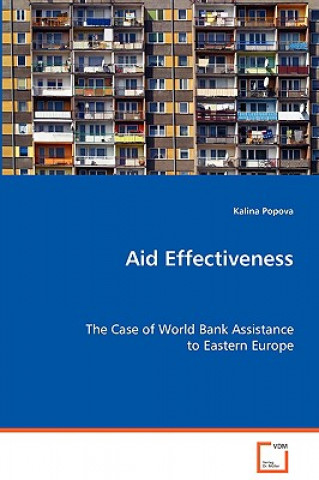
Kód: 06816525
Aid Effectiveness
Autor Kalina Popova
Since the success of the Marshall Plan in theeconomic recovery of Western Europe after WWIIforeign aid has been an important tool of foreignpolicy. Yet there are increasing doubts about theeffectiveness of the aid effort. Critics ... celý popis


- Jazyk:
 Angličtina
 - Väzba: Brožovaná
- Počet strán: 172
Nakladateľ: VDM Verlag Dr. Mueller E.K., 2008
- Viac informácií o knihe

67.39 €
Bežne: 68.74 €
Ušetríte 1.35 €

Skladom u dodávateľa
Odosielame za 9 - 15 dní
Mohlo by sa vám tiež páčiť
-

Bus Driver Who Wanted To Be God & Other Stories
12.52 € -26 % -

Není cesty zpět
9.39 € -

Toilet Training and the Autism Spectrum (ASD)
31.82 € -

Carte Angélus tableau de Millet, lot de 20 ex - F58A
11.31 € -9 % -

Hope Now
31.92 € -

Bad Box
14.84 € -1 % -

Slávni muži o ženách
18.28 € -15 % -

Demon in the wood
24.04 € -

Psychedelic Coloring Book
10.30 € -1 % -

Juventud
11.91 € -8 % -

Zákon o návykových látkách
15.75 € -20 % -

Puccini's Ghosts
11.81 € -25 % -

Works of G. P. R. J., Revised and Corrected by the Author. with an Introductory Preface.
24.95 € -24 % -

From Post-Maoism to Post-Marxism
169.35 € -

Against Apion
20.20 € -1 % -

A Text-Book of Physiological Chemistry
32.02 € -14 % -

Catching the Rain
17.47 € -25 % -

Dunwich Horror
10.30 € -1 % -

Pathway Analysis and Optimization in Metabolic Engineering
147.83 € -

Religion of Thinness
14.04 € -25 % -

Spectacle of Isolation in Horror Films
75.38 € -

Jim Jarmusch
70.32 € -14 % -

Die Zukunft Der Altenpflege
47.18 € -6 % -

Fenian Ideal and Irish Nationalism, 1882-1916
136.31 € -

Basic GIS Coordinates
215.84 € -

Selling Electronic Media
88.31 € -18 % -

Roseland Farm Adventures
13.03 € -2 % -

Dictatorship and Politics
62.44 € -9 %
Darujte túto knihu ešte dnes
- Objednajte knihu a vyberte Zaslať ako darček.
- Obratom obdržíte darovací poukaz na knihu, ktorý môžete ihneď odovzdať obdarovanému.
- Knihu zašleme na adresu obdarovaného, o nič sa nestaráte.
Viac informácií o knihe Aid Effectiveness
Nákupom získate 163 bodov
 Anotácia knihy
Since the success of the Marshall Plan in theeconomic recovery of Western Europe after WWIIforeign aid has been an important tool of foreignpolicy. Yet there are increasing doubts about theeffectiveness of the aid effort. Critics argue thataid is targeted to wasteful regimes and to countrieswhere the environment is not conducive to growth.This book examines aid effectiveness by asking whatdetermines which countries receive aid and how muchand what considerations dominate the donors' and therecipients' decision processes. The focus is onWorld Bank lending to Eastern Europe and thedonor-recipient relations are presented in aprincipal-agent framework. Both donors andrecipients choose to enter into an aid relationshipand the motivations behind these decisions haveimplications for the effectiveness of aid. Thetheoretical hypotheses are tested in an empiricalmodel and two case studies. The analysis shows thatWorldBank involvement has contributed to economicgrowth in Eastern Europe, but both the Bank andrecipient countries face constraints that limit theirability to meet their commitments and this in turnlimits the effectiveness of aid.
Parametre knihy
Zaradenie knihy Knihy po anglicky Economics, finance, business & management Economics
67.39 €
- Celý názov: Aid Effectiveness
- Podnázov: The Case of World Bank Assistance to Eastern Europe
- Autor: Kalina Popova
- Jazyk: Angličtina
- Väzba: Brožovaná
- Počet strán: 172
- EAN: 9783639072440
- ISBN: 3639072448
- ID: 06816525
- Nakladateľ: VDM Verlag Dr. Mueller E.K.
- Hmotnosť: 236 g
- Rozmery: 229 × 152 × 9 mm
- Dátum vydania: 03. September 2008
Obľúbené z iného súdka
-

Why Nations Fail
13.43 € -18 % -

Principles for Dealing with the Changing World Order
25.35 € -23 % -

Irrational Exuberance
19.90 € -7 % -

Liar's Poker
13.03 € -26 % -

Principles of Economics
13.94 € -17 % -

Art of Statistics
13.53 € -22 % -

Animal Spirits
26.47 € -5 % -
Economics In One Lesson
14.84 € -24 % -

Misbehaving - The Making of Behavioral Economics
11.91 € -16 % -

Economics: The User's Guide
13.03 € -25 % -

J R
21.62 € -25 % -

Capitalism, Socialism, and Democracy
18.48 € -6 % -

Rational Optimist
10.80 € -29 % -

Misbehaving - The Making of Behavioral Economics
25.05 € -25 % -

Economic Facts and Fallacies
14.74 € -25 % -

Freakonomics
7.27 € -28 % -

Predictably Irrational
13.73 € -29 % -

Price of Inequality
10.10 € -22 % -

How I Made One Million Dollars Last Year Trading Commodities
35.46 € -24 % -

Misbehavior of Markets
22.22 € -

Richest Man in Babylon
27.38 € -2 % -

Cartoon Introduction to Economics
14.84 € -24 % -

Undercover Economist Strikes Back
12.92 € -30 % -

Holy Grail of Macroeconomics - Lessons From Japan'S Great Recession (Revised Edition)
28.59 € -24 % -

Economics Rules - The Rights and Wrongs of the Dismal Science
12.02 € -13 % -

Economic Naturalist
16.87 € -30 % -

Project Management for IT-Related Projects
36.87 € -10 % -

Scientific Method
33.54 € -

Business School
15.75 € -15 % -

Economics for Business, 6e
90.33 € -

101 Top Tips on How to Grow Your Business Through Referral and Word of Mouth Marketing
22.73 € -2 % -

Commodity Exchanges And Futures Trading - Principles And Operating Methods
37.28 € -10 % -

Can Scorpions Smoke? Creative Adventures in the Corporate World
13.03 € -2 % -

Return of The Economic Naturalist
26.97 € -

Beyond Sovietology
129.94 € -

Debt, 10th Anniversary Edition
25.05 € -25 % -

Start-Up Nation
10.10 € -17 % -

Phishing for Phools
14.74 € -25 % -

Breakthrough Copywriter
19.29 € -2 % -

Analysis of Charles P. Kindleberger's Manias, Panics, and Crashes
10.40 € -

Little Book of Economics, Revised and Updated - How the Economy Works in the Real World
20.30 € -24 % -

Essential Mathematics for Economic Analysis
61.83 € -21 % -

Armchair Economist
11.81 € -25 % -

Applied Economics
37.28 € -

Who Gets What - and Why
11.21 € -29 % -

Team Topologies
23.94 € -

Currency Wars
15.05 € -18 % -

Human Action
37.99 € -

Freakonomics
6.05 € -29 %
Osobný odber Bratislava a 12820 dalších
Copyright ©2008-26 najlacnejsie-knihy.sk Všetky práva vyhradenéSúkromieCookies

 24 miliónov titulov
 Vrátenie do mesiaca
 02/210 210 99 (8-15.30h)