Kód: 49742421
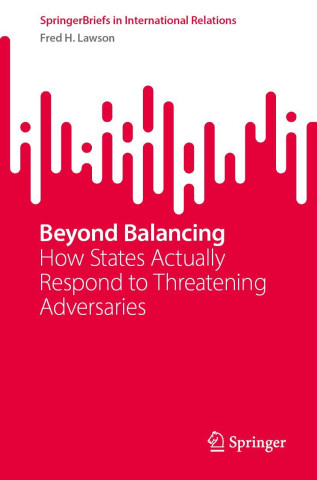
Beyond Balancing
Autor Fred H. Lawson
This Brief revisits the question of whether states tend to resist a threatening adversary. It begins by assessing one influential contribution to the debate that offers an elegant reformulation of the problem, and then advances a ... celý popis


- Jazyk:
 Angličtina
 - Väzba: Brožovaná
- Počet strán: 40
Nakladateľ: Springer-Verlag GmbH, 2026
- Viac informácií o knihe


Mohlo by sa vám tiež páčiť
-

Beste Freunde Plus A2.1 Podręcznik + kod online. Edycja niemiecka
11.53 € -30 % -

Biblia Reina Valera 1960 Letra Grande. Piel Verde Con Flores, Tama?o Manual
21.25 € -26 % -

Better Energy
24.39 € -6 % -

Biblia de Margen Amplio Ntv Con Filament (Sentipiel, Floral, Letra Roja)
30.67 € -24 % -

Beyond the Standard Model of Particle Physics
150.36 € -

Between the Wires
34.32 € -9 % -

Bien faire & le faire savoir
34.52 €
Darujte túto knihu ešte dnes
- Objednajte knihu a vyberte Zaslať ako darček.
- Obratom obdržíte darovací poukaz na knihu, ktorý môžete ihneď odovzdať obdarovanému.
- Knihu zašleme na adresu obdarovaného, o nič sa nestaráte.
Viac informácií o knihe Beyond Balancing
Nákupom získate 126 bodov
 Anotácia knihy
This Brief revisits the question of whether states tend to resist a threatening adversary. It begins by assessing one influential contribution to the debate that offers an elegant reformulation of the problem, and then advances a plausible alternative analytical framework. It surveys three situations in which several states faced the choice of mobilizing against or aligning with a prospective aggressor. In each case, proximity to the expansionist state and the clarity of the danger it posed to the existing order might well have prompted adjacent states to engage in balancing. The fact that balancing did not predominate in any of these situations challenges the orthodox view of how states respond to evident threats and compels a reconsideration of the circumstances under which bandwagoning is likely to occur in the anarchic international arena.
Building on influential studies of bandwagoning in international politics, the volume reassesses states' responses to aggressive adversaries. It offers an alternative explanation for why states often indeed, usually choose not to resist aggressors, and illustrates this argument by revisiting East Asia in 1931 and Central and Eastern Europe in 1938. It also provides a new perspective on the reactions of the Arab Gulf states to the abrogation of the Joint Comprehensive Plan of Action.
Parametre knihy
Zaradenie knihy Knihy po nemecky Sozialwissenschaften, Recht, Wirtschaft Medien, Kommunikation Buchhandel, Bibliothekswesen
52.24 €
- Celý názov: Beyond Balancing
- Autor: Fred H. Lawson
- Jazyk: Angličtina
- Väzba: Brožovaná
- Počet strán: 40
- EAN: 9783032103291
- ISBN: 3032103290
- ID: 49742421
- Nakladateľ: Springer-Verlag GmbH
- Hmotnosť: 125 g
- Dátum vydania: 25. January 2026
Obľúbené z iného súdka
-

The Silent Dominion
21.46 € -18 % -

The Triangle of Power
13.46 € -24 % -

The Road Map
21.76 € -24 % -

Project Maven
23.08 € -25 % -

The Parasitic Mind: How Infectious Ideas Are Killing Common Sense
14.77 € -25 % -

The Technological Republic
10.82 € -29 % -

The Society of the Spectacle
7.89 € -25 % -

Hyperpolitics
14.77 € -14 % -
On Freedom
10.12 € -29 % -

Statecraft
18.01 € -20 % -
Goliath's Curse
13.05 € -25 % -

Right Wing Revolution: How to Beat the Woke and Save the West
26.93 € -7 % -

Nikephoros II Phokas, 912-969
36.95 € -24 % -

I Am Giorgia
23.79 € -24 % -

The Hour of the Predator
12.24 € -30 % -

The War for Peace
21.46 € -27 % -

Decolonizing Methodologies: Research and Indigenous Peoples
26.12 € -9 % -

The Blind Spot
21.46 € -27 % -

New Dark Age
11.13 € -19 % -

World War in Syria
26.12 € -9 % -

What's Our Problem?
38.77 € -60 % -

The Least of Us: True Tales of America and Hope in the Time of Fentanyl and Meth
14.77 € -28 % -
Why Nothing Works
16.19 € -25 % -

The Rise of the Reich
23.99 € -2 % -

Spies and Lies
18.12 € -25 % -

The Law of Capitalism and How to Transform It
21.76 € -24 % -

The Conservative Mind
6.77 € -1 % -

Mutual Aid A Factor in Evolution
20.24 € -2 % -

The Price Is Wrong: Why Capitalism Won't Save the Planet
21.66 € -25 % -

Bioleninism
11.33 € -25 % -

Stolen Revolution
17.81 € -29 % -

Geografia Y Destino
36.24 € -5 % -

China Whisperers
22.57 € -29 % -

War and Money
18.22 € -25 % -

What Conservatives Believe
23.38 € -28 % -

Splendid and the Vile
10.12 € -29 % -
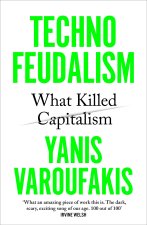
Technofeudalism
12.85 € -26 % -

One Day, Everyone Will Have Always Been Against This
16.39 € -27 % -

The CIA World Factbook 2026-2027
21.25 € -25 % -

Perfect Victims
13.05 € -29 % -

Abundance
13.15 € -20 % -

Escape from Capitalism
18.93 € -25 % -

Killing Hope
20.34 € -24 % -

Chokepoints
10.82 € -29 % -

The Ultimate Guide to Rebuilding a Civilization
15.79 € -20 % -

Politics Without Politicians
26.93 € -7 % -

Propaganda
7.69 € -

Goliath's Curse
18.01 € -20 % -

Reform or Revolution
6.88 €
Osobný odber Bratislava a 12742 dalších
Copyright ©2008-26 najlacnejsie-knihy.sk Všetky práva vyhradenéSúkromieCookies

 24 miliónov titulov
 Vrátenie do mesiaca
 02/210 210 99 (8-15.30h)