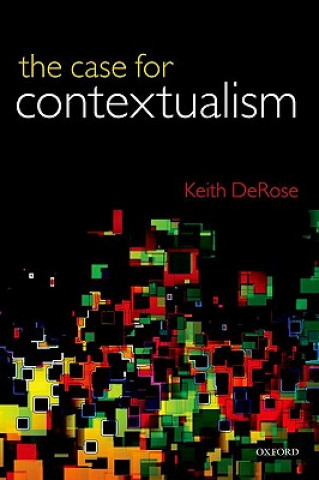
Kód: 04534959
Case for Contextualism
Autor Keith DeRose
It's an obvious enough observation that the standards that govern whether ordinary speakers will say that someone knows something vary with context: What we are happy to call "knowledge" in some ("low-standards") contexts we'll de ... celý popis


- Jazyk:
 Angličtina
 - Väzba: Brožovaná
- Počet strán: 304
Nakladateľ: Oxford University Press, 2011
- Viac informácií o knihe


Mohlo by sa vám tiež páčiť
-

Hochbegabung bei Schulern
31.28 € -11 % -

Graphomania
11.84 € -25 % -

Objets d'Art, Curiosites Et Tableaux Composant La Collection de M. de Norzy, Agent de Change
13.86 € -2 % -

Amateurfunk-Lehrgang für das Amateurfunkzeugnis Klasse A
33.61 € -16 % -

Epsom Past
17.10 € -24 % -

Pictorial History of Paisley
27.63 € -4 % -

Mammoth Book of Insults
32.19 € -5 %
Darujte túto knihu ešte dnes
- Objednajte knihu a vyberte Zaslať ako darček.
- Obratom obdržíte darovací poukaz na knihu, ktorý môžete ihneď odovzdať obdarovanému.
- Knihu zašleme na adresu obdarovaného, o nič sa nestaráte.
Viac informácií o knihe Case for Contextualism
Nákupom získate 109 bodov
 Anotácia knihy
It's an obvious enough observation that the standards that govern whether ordinary speakers will say that someone knows something vary with context: What we are happy to call "knowledge" in some ("low-standards") contexts we'll deny is "knowledge" in other ("high-standards") contexts. But do these varying standards for when ordinary speakers will attribute knowledge, and for when they are in some important sense warranted in attributing knowledge, reflect varying standards for when it is or would be true for them to attribute knowledge? Or are the standards that govern whether such claims are true always the same? And what are the implications for epistemology if these truth-conditions for knowledge claims shift with context? Contextualism is the view that the epistemic standards a subject must meet, in order for a claim attributing "knowledge" to her to be true, do vary with context. This has been hotly debated in epistemology and philosophy of language during the last few decades. In The Case for Contextualism Keith DeRose offers a sustained state-of-the-art exposition and defense of the contextualist position, presenting and advancing the most powerful arguments in favor of the view and against its "invariantist" rivals, and responding to the most pressing objections facing contextualism.
Parametre knihy
Zaradenie knihy Knihy po anglicky Language linguistics Philosophy of language
45.05 €
- Celý názov: Case for Contextualism
- Podnázov: Knowledge, Skepticism, and Context, Vol. 1
- Autor: Keith DeRose
- Jazyk: Angličtina
- Väzba: Brožovaná
- Počet strán: 304
- EAN: 9780199692255
- ISBN: 0199692254
- ID: 04534959
- Nakladateľ: Oxford University Press
- Hmotnosť: 474 g
- Rozmery: 232 × 158 × 17 mm
- Dátum vydania: 05. May 2011
Obľúbené z iného súdka
-
Practice Makes Perfect English Pronouns and Prepositions, Second Edition
14.67 € -18 % -

Adam's Tongue
16.19 € -25 % -
What Kind of Creatures Are We?
12.75 € -24 % -

Trivium
19.33 € -

Construction of Social Reality
13.96 € -24 % -
Semiotics and the Philosophy of Language
22.98 € -2 % -

Making the Social World
14.67 € -9 % -

The Natural History of the Sign
16.19 € -25 % -
Reference
58.52 € -

Documentality
45.15 € -

Language Instinct
16.09 € -24 % -

How Language Works
13.05 € -29 % -

Rosicrucian Manual
13.05 € -

Image Music Text
11.84 € -25 % -

Infancy and History
13.15 € -18 % -

Atoms Of Language
14.77 € -25 % -

Introduction to Cognitive Linguistics
73.10 € -
Naming and Necessity
29.46 € -5 % -
Logic of Sense
19.63 € -24 % -

Making It Explicit
57.61 € -
Philosophy of Language
26.52 € -1 % -

Handbook of Semiotics
61.25 € -

Inquiry into Modes of Existence
21.76 € -24 % -

Language Animal
42.72 € -

When the Word Becomes Flesh
13.76 € -26 % -

Critical Introduction to the Philosophy of Language
59.03 € -

Philosophy of Language
59.03 € -

Rhetoric of Motives
33.51 € -

Language and Reality
19.53 € -22 % -
LOT 2
42.32 € -

Soul and Form
38.47 € -

Essential Chomsky
21.25 € -25 % -

Practice Makes Perfect English Articles and Determiners Up Close
12.14 € -20 % -
Philosophy of Language
44.75 € -

More than Cool Reason
31.99 € -

Language Hoax
12.75 € -25 % -

Lectures on Rhetoric & Belles Lettres
14.17 € -10 % -
Authority of Law
67.03 € -

Scandal of the Speaking Body
15.18 € -37 % -

Literary Mind
24.50 € -
Speaking from Elsewhere
39.38 € -

Practice Makes Perfect English Verb Tenses Up Close
17 € -17 % -

Latin
29.25 € -

Language, Proof, and Logic
100.24 € -

Metaphor
39.28 € -

How to Do Things with Words
54.77 € -
Signs
30.98 € -2 % -

Being Realistic about Reasons
29.15 € -

Introduction to the Philosophy of Language
48.80 €
Osobný odber Bratislava a 12542 dalších
Copyright ©2008-26 najlacnejsie-knihy.sk Všetky práva vyhradenéSúkromieCookies

 24 miliónov titulov
 Vrátenie do mesiaca
 02/210 210 99 (8-15.30h)