Kód: 43423048
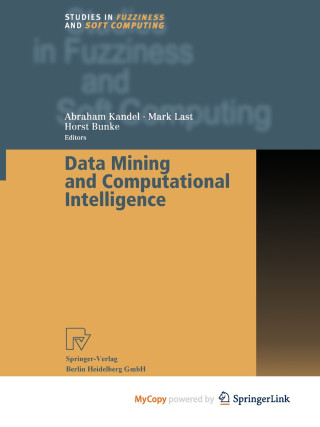
Data Mining and Computational Intelligence
Autor Abraham Kandel, Mark Last, Horst Bunke
Many business decisions are made in the absence of complete information about the decision consequences. Credit lines are approved without knowing the future behavior of the customers; stocks are bought and sold without knowing th ... celý popis


- Jazyk:
 Angličtina
 - Väzba: Brožovaná
- Počet strán: 372
Nakladateľ: Springer Nature B.V., 2014
- Viac informácií o knihe

56.95 €
Bežne: 56.97 €
Ušetríte 0.01 €

Skladom u dodávateľa
Odosielame za 10 - 18 dní
Mohlo by sa vám tiež páčiť
-

Moonwalk
14.05 € -

Berserk Deluxe Volume 1
35.91 € -25 % -

Murdoku
13.55 € -27 % -

Threshing Day (Wing and Claw Collection)
18.10 € -29 % -

The Score
12.33 € -19 % -

Berserk Deluxe Volume 2
35.30 € -32 % -

The Mistake
11.32 € -16 % -

The Deal
12.33 € -19 % -

Berserk Deluxe Volume 3
55.33 € -

Dancing The Dream
21.34 € -26 % -

Jujutsu Kaisen, Vol. 30
9.70 € -25 % -

White Nights
4.54 € -14 % -

Threshing Day (Limited Deluxe Edition)
20.12 € -26 % -

Kid's Box New Generation Level 2 Activity Book with Digital Pack British English
10.92 € -8 % -

The Goal
12.94 € -4 % -

Murdoku Volume 2: Back in Time
13.55 € -27 % -

Jujutsu Kaisen, Vol. 26
9.91 € -20 % -

Onyx Storm (Deluxe Limited Edition) (The Empyrean, 3)
24.07 € -25 % -

Berserk Deluxe Volume 5
55.03 € -
The Odyssey
14.05 € -25 % -

Lord of Mysteries, Vol. 1: The Clown, Part I
15.37 € -22 %
Darujte túto knihu ešte dnes
- Objednajte knihu a vyberte Zaslať ako darček.
- Obratom obdržíte darovací poukaz na knihu, ktorý môžete ihneď odovzdať obdarovanému.
- Knihu zašleme na adresu obdarovaného, o nič sa nestaráte.
Viac informácií o knihe Data Mining and Computational Intelligence
Nákupom získate 138 bodov
 Anotácia knihy
Many business decisions are made in the absence of complete information about the decision consequences. Credit lines are approved without knowing the future behavior of the customers; stocks are bought and sold without knowing their future prices; parts are manufactured without knowing all the factors affecting their final quality; etc. All these cases can be categorized as decision making under uncertainty. Decision makers (human or automated) can handle uncertainty in different ways. Deferring the decision due to the lack of sufficient information may not be an option, especially in real-time systems. Sometimes expert rules, based on experience and intuition, are used. Decision tree is a popular form of representing a set of mutually exclusive rules. An example of a two-branch tree is: if a credit applicant is a student, approve; otherwise, decline. Expert rules are usually based on some hidden assumptions, which are trying to predict the decision consequences. A hidden assumption of the last rule set is: a student will be a profitable customer. Since the direct predictions of the future may not be accurate, a decision maker can consider using some information from the past. The idea is to utilize the potential similarity between the patterns of the past (e.g., "most students used to be profitable") and the patterns of the future (e.g., "students will be profitable").
Parametre knihy
56.95 €
- Celý názov: Data Mining and Computational Intelligence
- Autor: Abraham Kandel, Mark Last, Horst Bunke
- Jazyk: Angličtina
- Väzba: Brožovaná
- Počet strán: 372
- EAN: 9783662003589
- ID: 43423048
- Nakladateľ: Springer Nature B.V.
- Hmotnosť: 837 g
- Rozmery: 279 × 210 mm
- Dátum vydania: 12. March 2014
Osobný odber Bratislava a 12848 dalších
Copyright ©2008-26 najlacnejsie-knihy.sk Všetky práva vyhradenéSúkromieCookies

 24 miliónov titulov
 Vrátenie do mesiaca
 02/210 210 99 (8-15.30h)