Kód: 04723574
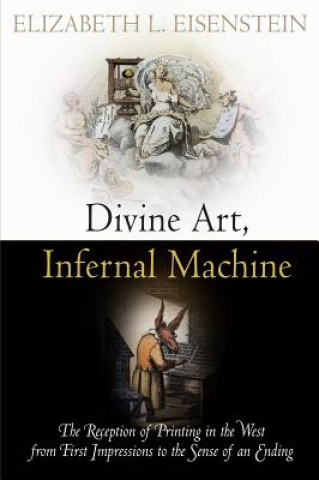
Divine Art, Infernal Machine
Autor Elizabeth L. Eisenstein
There is a longstanding confusion of Johann Fust, Gutenberg's one-time business partner, with the notorious Doctor Faustus. The association is not surprising to Elizabeth L. Eisenstein, for from its very early days the printing pr ... celý popis


- Jazyk:
 Angličtina
 - Väzba: Brožovaná
- Počet strán: 384
Nakladateľ: University of Pennsylvania Press, 2012
- Viac informácií o knihe

31.18 €
Bežne: 33.51 €
Ušetríte 2.33 €

Skladom u dodávateľa
Odosielame za 9 - 15 dní
Mohlo by sa vám tiež páčiť
-

Erstwhile
11.84 € -25 % -

Wielka Szachownica. Geostrategia amerykańskiego przywództwa
16.39 € -

Printing Press as an Agent of Change
53.46 € -

Paratexts
39.28 € -

Didi-Huberman and the Image
31.28 € -9 % -

Recepty z terasky
20.44 € -25 % -

Letters on Familiar Matters (Rerum Familiarium Libri), Vol. 1, Books I-VIII
37.36 € -2 % -

An Entire MBA in 1 Book: From the Author of the Online Course "An Entire MBA in 1 Course"
85.96 € -6 % -

Blade Girl 3
12.45 € -17 % -

Architecture in the Age of Printing
34.12 € -

La Cassette Verte De Monsieur De Sartine, Trouvee Chez Mademoiselle Du The (1779)
19.33 € -2 % -

In meiner Bi-Ba-Badewanne - 20 Spiel-, Spaß- und Bewegungslieder für fröhliche Kinder
12.65 € -10 % -

Viewer and the Printed Image in Late Medieval Europe
223.27 € -

Calendar of inquisitions post mortem and other analogous documents preserved in the Public Record Office (Volume IV) Edward I
49.61 € -18 % -

Les Fastes de l'Eglise. Les Douze Pilotes
18.42 € -1 % -

Topographie Medicale de Bordj-Menaiel Issers
13.05 € -1 % -

Manual de VHDL: Sntesis lógica para PLDs
19.43 € -

Schöne, schwere Zeit
9 € -10 % -

¡SUBE, RATONCITO!
15.18 € -

FIDDLE CHORD CHART
14.88 € -

Nonmanuale Di Informatica Per Noninformatici
19.03 € -1 %
Darujte túto knihu ešte dnes
- Objednajte knihu a vyberte Zaslať ako darček.
- Obratom obdržíte darovací poukaz na knihu, ktorý môžete ihneď odovzdať obdarovanému.
- Knihu zašleme na adresu obdarovaného, o nič sa nestaráte.
Viac informácií o knihe Divine Art, Infernal Machine
Nákupom získate 75 bodov
 Anotácia knihy
There is a longstanding confusion of Johann Fust, Gutenberg's one-time business partner, with the notorious Doctor Faustus. The association is not surprising to Elizabeth L. Eisenstein, for from its very early days the printing press was viewed by some as black magic. For the most part, however, it was welcomed as a "divine art" by Western churchmen and statesmen. Sixteenth-century Lutherans hailed it for emancipating Germans from papal rule, and seventeenth-century English radicals viewed it as a weapon against bishops and kings. While an early colonial governor of Virginia thanked God for the absence of printing in his colony, a century later, revolutionaries on both sides of the Atlantic paid tribute to Gutenberg for setting in motion an irreversible movement that undermined the rule of priests and kings. Yet scholars continued to praise printing as a peaceful art. They celebrated the advancement of learning while expressing concern about information overload. In Divine Art, Infernal Machine, Eisenstein, author of the hugely influential The Printing Press as an Agent of Change, has written a magisterial and highly readable account of five centuries of ambivalent attitudes toward printing and printers. Once again, she makes a compelling case for the ways in which technological developments and cultural shifts are intimately related. Always keeping an eye on the present, she recalls how, in the nineteenth century, the steam press was seen both as a giant engine of progress and as signaling the end of a golden age. Predictions that the newspaper would supersede the book proved to be false, and Eisenstein is equally skeptical of pronouncements of the supersession of print by the digital. The use of print has always entailed ambivalence about serving the muses as opposed to profiting from the marketing of commodities. Somewhat newer is the tension between the perceived need to preserve an ever-increasing mass of texts against the very real space and resource constraints of bricks-and-mortar libraries. Whatever the multimedia future may hold, Eisenstein notes, our attitudes toward print will never be monolithic. For now, however, reports of its death are greatly exaggerated.
Parametre knihy
Zaradenie knihy Knihy po anglicky Society & social sciences Society & culture: general Cultural studies
31.18 €
- Celý názov: Divine Art, Infernal Machine
- Podnázov: The Reception of Printing in the West from First Impressions to the Sense of an Ending
- Autor: Elizabeth L. Eisenstein
- Jazyk: Angličtina
- Väzba: Brožovaná
- Počet strán: 384
- EAN: 9780812222166
- ISBN: 0812222164
- ID: 04723574
- Nakladateľ: University of Pennsylvania Press
- Hmotnosť: 608 g
- Rozmery: 229 × 158 × 24 mm
- Dátum vydania: 10. September 2012
Obľúbené z iného súdka
-

All About Love
12.95 € -12 % -

Sapiens
12.24 € -25 % -

The Chalice and the Blade
14.07 € -25 % -

Pihkal
25.10 € -25 % -

Self-Made Man
12.24 € -30 % -

Origins and History of Consciousness
19.63 € -24 % -

Tudor Tailor
26.52 € -24 % -

The Year of Living Danishly
11.23 € -29 % -

Icons of Men's Style mini
12.75 € -25 % -

Danse Macabre
13.96 € -30 % -

Kinesthetic Empathy in Creative and Cultural Practices
51.84 € -

Sekiro: The Second Life Of Souls
21.66 € -25 % -

Tihkal
23.79 € -25 % -

Cosmos and Psyche
16.19 € -25 % -

Wabi-Sabi for Artists, Designers, Poets & Philosophers
14.77 € -25 % -

The Conquest of Bread
11.84 € -25 % -

Ghosts of My Life
16.80 € -25 % -

Medieval Costume and How to Recreate it
11.33 € -24 % -

Berserk: With Darkness Ink
21.66 € -25 % -

Notes on Camp
4.24 € -13 % -

Japanese Tattoos
13.36 € -25 % -

Homo Ludens
11.23 € -2 % -

Utopia for Realists
13.56 € -22 % -

How to Invent Everything
26.93 € -18 % -

Gastrophysics
13.86 € -20 % -

Ways of Curating
11.84 € -25 % -

Postmodernism
27.43 € -

The Tipping Point
13.05 € -29 % -

Posthuman
19.43 € -1 % -

Egregores
12.75 € -25 % -

Sapiens
14.57 € -27 % -

Greatest Minds and Ideas of All Time
16.50 € -17 % -

Energy Flash
21.25 € -25 % -

Revolution in the Head
14.07 € -25 % -

Argentina Reader
22.37 € -25 % -

Culture Industry
27.63 € -

Fourier: 'The Theory of the Four Movements'
18.32 € -24 % -

Resistance
33.71 € -2 % -

Telling Lies
13.05 € -26 % -

Vader's Little Princess
13.76 € -18 % -

Art of Memory
20.24 € -24 % -

Cultures and Organizations: Software of the Mind, Third Edition
31.99 € -18 % -

Communion
11.84 € -25 % -
Understanding Media
25.61 € -5 % -

Origin of the Family, Private Property and the State
13.46 € -24 % -

TechGnosis
16.19 € -24 % -

Why We Love Dogs, Eat Pigs and Wear Cows
13.76 € -26 % -

Seinfeldia
10.82 € -25 % -

Proudhon: What is Property?
18.32 € -24 %
Osobný odber Bratislava a 12542 dalších
Copyright ©2008-26 najlacnejsie-knihy.sk Všetky práva vyhradenéSúkromieCookies

 24 miliónov titulov
 Vrátenie do mesiaca
 02/210 210 99 (8-15.30h)