Kód: 08127946
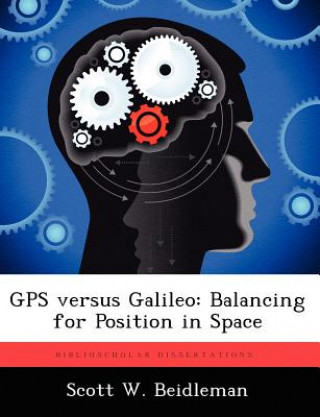
GPS Versus Galileo
Autor Scott W Beidleman
This study investigates Europe's motives to develop the independent satellite navigation system known as Galileo despite the existence of America's successful global positioning system (GPS). It begins by analyzing both systems to ... celý popis


- Jazyk:
 Angličtina
 - Väzba: Brožovaná
- Počet strán: 96
Nakladateľ: Biblioscholar, 2012
- Viac informácií o knihe

15.69 €
Bežne: 16.05 €
Ušetríte 0.37 €

Skladom u dodávateľa
Odosielame za 9 - 15 dní
Mohlo by sa vám tiež páčiť
-

The Deal
12.34 € -21 % -
Uniforms of the Ancient Greek World, An Illustrated Encyclopedia of
21.25 € -25 % -

EUGY - 3D Bastelset Weihnachtsmann
13.76 € -5 % -

Porno ham
13.76 € -4 % -

Popol Vuh
9.91 € -25 % -

Effective Psychotherapists
38.17 € -

Sex and Your Stars: A Sexologist's Guide to the Erotic Energy of the Zodiac
15.18 € -26 % -

Proofs of the Cantor-Bernstein Theorem
109.45 € -

Poemes i cançons de la Bíblia (llibre i CD)
24.90 € -

Bug Club Guided Fiction Reception Red A Eco Apes Use Rubbish
9.31 € -

Thinking Like a Lawyer – A New Introduction to Legal Reasoning
2.22 € -

Until the End
23.58 € -25 % -

Moore. Flashcards de Anatomía con orientación clínica
52.65 € -

Autismo y Diagnostico Psicopedagogico
50.01 € -3 % -

La pianta dei sospiri con alcuni cenni su la vita e su le opere dell'autore
6.98 € -7 % -

Rethinking Historical Genres in the Twenty-First Century
214.77 € -

Day's Ride from De Bullion
34.72 € -

Lilly and Her Slave
13.46 € -24 % -

Social Leadership in Early Childhood Education and Care
102.06 € -

Etude Sur Les Peines Disciplinaires En Campagne
13.05 € -1 % -

No Great Magic
10.82 € -

Ka-Mi-Akin, the Last Hero of the Yakimas
44.04 € -9 % -

Stepping From Fear Into Wisdom
18.42 € -6 % -

Histoire Et Description de la Tour de Crest En Dauphine
13.86 € -2 % -

Darkest Days of the Civil War, 1864 and 1865
20.75 € -1 % -

Unconventional Counterinsurgency
15.69 € -2 % -

Cape Crusaders
21.15 € -2 % -

Platonic Questions
39.58 € -

Lifelong Learning and the University
33.20 € -

The Works of Benjamin Franklin
45.66 € -6 % -

Psychosemiosis as a Key to Body-Mind Continuum
217.20 € -10 % -

Advanced Technology in Textiles
170.21 € -
The Ministry of Lectors
8.90 € -

Mana Khemia 2: The Official Strategy Guide
38.98 € -7 % -

Speaking Strategies Used at the Intermediate English Level
36.85 € -4 % -

Relationship Counselling for Children, Young People and Families
41.30 € -9 % -
Rrou
9.10 € -

Dogmata Theologica Dionysii Petavii E Societate Jesu, Volume 2
30.06 € -2 % -

Great Events: The Gunpowder Plot
9.71 € -4 % -

Get the Dance - Ergänzungskurs
31.28 € -

Procés a l'atzar
15.79 € -
Unitary Reflection Groups
111.88 €
Darujte túto knihu ešte dnes
- Objednajte knihu a vyberte Zaslať ako darček.
- Obratom obdržíte darovací poukaz na knihu, ktorý môžete ihneď odovzdať obdarovanému.
- Knihu zašleme na adresu obdarovaného, o nič sa nestaráte.
Viac informácií o knihe GPS Versus Galileo
Nákupom získate 38 bodov
 Anotácia knihy
This study investigates Europe's motives to develop the independent satellite navigation system known as Galileo despite the existence of America's successful global positioning system (GPS). It begins by analyzing both systems to familiarize the reader with global navigation satellite systems (GNSS) and to provide an understanding of the strengths and weaknesses of GPS and Galileo, as well as the systems' similarities and differences. Although the two systems have different founding principles, they employ similar infrastructures and operational concepts. In the short term, Galileo will provide better accuracy for civilian users until GPS upgrades take effect. But performance is only part of the rationale. The author contends that Europe's pursuit of Galileo is driven by a combination of reasons, including performance, independence, and economic incentive. With Galileo, Europe hopes to achieve political, security, and technological independence from the United States. Additionally, Europe envisions overcoming the US monopoly on GNSS by seizing a sizable share of the expanding GNSS market and setting a new world standard for satellite navigation. Finally, the author explores Galileo's impact on the United States and reviews US policy towards Galileo. The paper concludes with recommendations to strengthen the competitiveness of GPS.
Parametre knihy
Zaradenie knihy Knihy po anglicky Society & social sciences Education
15.69 €
- Celý názov: GPS Versus Galileo
- Podnázov: Balancing for Position in Space
- Autor: Scott W Beidleman
- Jazyk: Angličtina
- Väzba: Brožovaná
- Počet strán: 96
- EAN: 9781249327103
- ISBN: 9781249327103
- ID: 08127946
- Nakladateľ: Biblioscholar
- Hmotnosť: 186 g
- Rozmery: 246 × 189 × 5 mm
- Dátum vydania: 11. September 2012
Obľúbené z iného súdka
-

Pearson Edexcel International GCSE (9-1) English Language B Student Book
59.03 € -

Oet Pharmacy Prep: Speaking Sub-Test
21.96 € -1 % -
Oxford IB Diploma Programme: IB Theory of Knowledge Course Book
68.75 € -

Cambridge IGCSE (R) & O Level Complete Physics: Student Book Fourth Edition
42.01 € -4 % -

Imagine If...
12.34 € -29 % -
Oxford International Primary Maths Second Edition: Student Book 5
33 € -

Cambridge IGCSE (R) & O Level Complete Chemistry: Student Book Fourth Edition
42.01 € -4 % -

OET Preparation
9.31 € -

Maria Montessori's Erdkinder
40.49 € -4 % -

KS3 Maths 10-Minute Weekly Workouts - Year 7
8.90 € -12 % -

Speed and Accuracy: Multiplication
5.86 € -24 % -

Oxford International Primary Maths Second Edition: Practice Book 5
16.50 € -
geog.2 Workbook
13.05 € -

My Book of Measurement: Length
6.57 € -24 % -

My Book of Measurement: Weight
6.57 € -24 % -

Deutsch Ferienhefte - 2. Klasse - Volksschule
10.12 € -8 % -

Guerrilla Warfare Tactics in Urban Environments
17.31 € -2 % -

iPrimary Building Blocks: Spelling, Punctuation, Grammar and Handwriting Year 1
18.32 € -

Identifying Japanese Seal Script
34.62 € -9 % -

Friendly Introduction to Mathematical Logic
31.48 € -2 % -

Curse of Capistrano
14.88 € -2 % -

Abenaki Dictionary
16.60 € -2 % -

Educational Achievement in Japan
60.75 € -

Teaching Young Singers
9.41 € -1 % -

Einkorn
18.32 € -24 % -

Powerful Teaching: Unleash the Science of Learning
24.60 € -26 % -

Business Partner B2 Workbook
19.13 € -
Oxford International Primary Maths Second Edition: Practice Book 2
19.03 € -

MOWIE PO POLSKU DWICZENIA POZIOM B1 I B2
16.60 € -

Cambridge IGCSE (R) & O Level Complete Biology: Student Book Fourth Edition
42.01 € -4 % -

Blue Book of Grammar and Punctuation: An Easy- to-Use Guide with Clear Rules, Real-World Examples , and Reproducible Quizzes, Twelfth Edition
14.88 € -24 % -

Business Partner B1 Workbook
18.82 € -1 % -
Oxford IB Study Guides: Economics for the IB Diploma
45.46 € -4 % -

Deep Healing and Transformation
41.81 € -2 % -

Read Write Inc. Phonics: Red Ditty Book Bag Books (Mixed Pack of 10)
83.83 € -
Oxford International Primary Maths Second Edition: Practice Book 1
13.76 € -

Growth Mindset Classroom-ready Resource Book
17.41 € -27 % -

Freedom Writers Diary Teacher's Guide
17.91 € -26 % -

Numicon: Numicon Pupil Book 4
19.03 € -

Education
10.82 € -18 % -

240 Vocabulary Words Kids Need to Know: Grade 3
10.01 € -24 % -
Oxford International Primary Maths Second Edition: Student Book 2
33 € -
VINES & VINIFICATION
48.09 € -

They Don't Teach This at School
21.25 € -25 % -
Euclidean Geometry
27.84 € -25 % -

Positive Discipline Tools for Teachers
16.09 € -24 % -
(ISC) SSCP SG & SSCP Practice Test Kit, 3e
68.24 € -25 % -

Power of Making Thinking Visible - Practices to Engage and Empower All Learners
23.08 € -25 % -

Teach Reading With Orton-gillingham
14.77 € -28 %
Osobný odber Bratislava a 12742 dalších
Copyright ©2008-26 najlacnejsie-knihy.sk Všetky práva vyhradenéSúkromieCookies

 24 miliónov titulov
 Vrátenie do mesiaca
 02/210 210 99 (8-15.30h)