Kód: 52385174
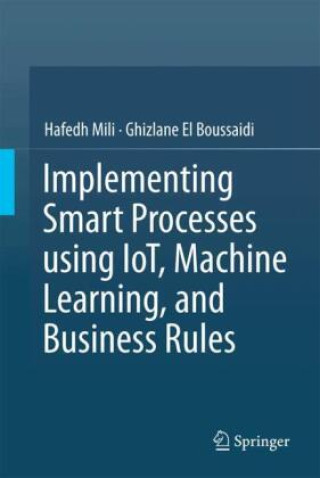
Implementing Smart Processes using IoT, Machine Learning, and Business Rules
Autor Hafedh Mili, Ghizlane El Boussaidi
This book is about implementing Smart Process Applications (SPAs), which are software applications that rely on a powerful combination of IT technologies to implement 'smart processes', i.e. novel context-aware, ubiquitous, self-a ... celý popis


- Jazyk:
 Angličtina
 - Väzba: Pevná
- Počet strán: 519
Nakladateľ: Springer, Berlin, 2026
- Viac informácií o knihe


Mohlo by sa vám tiež páčiť
-

Moonwalk
14.17 € -

The Score
13.97 € -19 % -

The Deal
12.45 € -24 % -

The Mistake
14.57 € -11 % -

Jujutsu Kaisen, Vol. 30
9.92 € -20 % -

Witch Hat Atelier: Grimoire Edition 1
34.63 € -29 % -

Invincible Compendium Volume 2
48.30 € -22 % -

Berserk Deluxe Volume 1
35.54 € -26 % -

Invincible Compendium Volume 1
45.87 € -24 % -

The Goal
14.68 € -10 % -

Berserk Deluxe Volume 2
33.31 € -30 % -

Witch Hat Atelier Manga Box Set 1
56.20 € -25 % -

Heated Rivalry
12.65 € -7 % -

Jujutsu Kaisen, Vol. 25
9.92 € -20 % -

Lord of Mysteries, Vol. 3: The Clown, Part III
14.98 € -29 % -

Jujutsu Kaisen, Vol. 26
9.92 € -20 % -

Moonwalk: A Memoir
21.77 € -24 % -

Jujutsu Kaisen, Vol. 29
9.92 € -20 % -

Invincible Compendium Volume 3
45.87 € -24 % -

Murdoku
17.01 € -25 % -

Berserk Deluxe Volume 3
55.19 €
Darčekový poukaz: Radosť zaručená
- Darujte poukaz v ľubovoľnej hodnote, a my sa postaráme o zvyšok.
- Poukaz sa vzťahuje na všetky produkty v našej ponuke.
- Elektronický poukaz si vytlačíte z e-mailu a môžete ho ihneď darovať.
- Platnosť poukazu je 12 mesiacov od dátumu vystavenia.
Informovať o naskladnení knihy
Zadajte do formulára e-mailovú adresu a akonáhle knihu naskladníme, zašleme vám o tom správu. Postrážime všetko za vás.
Viac informácií o knihe Implementing Smart Processes using IoT, Machine Learning, and Business Rules
Nákupom získate 209 bodov
 Anotácia knihy
This book is about implementing Smart Process Applications (SPAs), which are software applications that rely on a powerful combination of IT technologies to implement 'smart processes', i.e. novel context-aware, ubiquitous, self-adaptive processes: the Internet of Things (IoT) for context-awareness, a distributed and virtualized computing infrastructure, for ubiquity, and a mix of AI technologies to gain insights from data and act on them. While we have been using subsets of these technologies in traditional business applications (banking, insurance, manufacturing, retail, etc.) for decades, the combination of the three technologies (IoT, cloud, and AI) enables to develop
applications that implement novel processes that instrument independently running processes, with the goal of ensuring or preventing specific outcomes. Think of patient monitoring, a fast-growing market estimated at $ 60 billion in 2026. Patient monitoring applications do not implement or automate patients' biological processes: they monitor them in the background and react when they sense trouble. The same is true for an application that monitors a road infrastructure: if traffic is fluid, it does nothing. If it senses pun intended a developing traffic jam, it may adjust traffic light timing, change directions of traffic lanes, display messages to commuters to suggest alternate routes, etc. We argue that such applications have unique domain and architectural requirements that call for a distinct methodology. We also argue that the enabling technologies need to be considered in an integrated fashion, as opposed to point solutions. That is what the book is about.
The book is organized in 6 parts. The introductory part explains what smart process applications, (SPAs) are and why they require a distinct development methodology (chapter 1) and presents case studies from various sectors (chapter 2). Part II (methodology) presents a high-level development methodology where we focus on requirements and architecture (chapter 3) and introduces two case studies that are used throughout the book to illustrate the methodology and the design choices related to the various technologies (Chapter 4). Part III deals with the computational infrastructure of such applications, namely cloud computing (Chapter 5) and IoT frameworks (Chapter 6); it revisits the case studies to discuss the architectural choices (Chapter 7). Part IV deals with analytics and machine learning, giving a whirlwind tour of the main machine learning algorithm families (Chapter 8), then presenting three detailed case studies of the use of analytics and machine learning in industry, with proven value (Chapter 9), then revisits the case studies to explore the decisions that warrant machine learning techniques (Chapter 10). Part V deals with the business rules technology, starting with an introduction of the business rules approach and its methodological tenets (Chapter 11), introduces the Decision Model and Notation (DMN) standard (Chapter 12), explores the range of design issues raised by the business rules approach (Chapter 13), presents the business rules tools landscape (Chapter 14), and revisits the case study to discuss business rule design issues raised by the case studies, spanning the full lifecycle from rule elicitation to rule testing (Chapter 15). Part IV wraps up the book by exploring SPA maintenance scenarios (Chapter 16) and goes over the main takeaways from the book (Chapter 17).
Parametre knihy
86.28 €
- Celý názov: Implementing Smart Processes using IoT, Machine Learning, and Business Rules
- Podnázov: DE
- Autor: Hafedh Mili, Ghizlane El Boussaidi
- Jazyk: Angličtina
- Väzba: Pevná
- Počet strán: 519
- EAN: 9783032293060
- ID: 52385174
- Nakladateľ: Springer, Berlin
- Rozmery: 235 × 155 mm
- Dátum vydania: 24. October 2026
Osobný odber Bratislava a 12762 dalších
Copyright ©2008-26 najlacnejsie-knihy.sk Všetky práva vyhradenéSúkromieCookies

 24 miliónov titulov
 Vrátenie do mesiaca
 02/210 210 99 (8-15.30h)