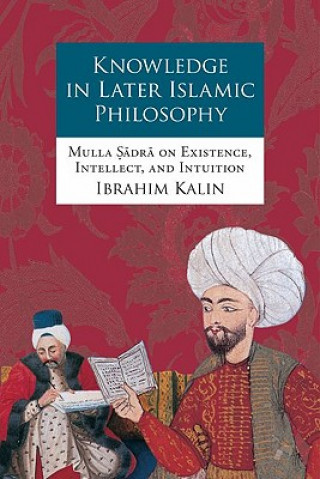
Kód: 04535238
Knowledge in Later Islamic Philosophy
Autor Ibrahim Kalin
This study looks at how the seventeenth-century philosopher Sadr al-Din al-Shirazi, known as Mulla Sadra, attempted to reconcile the three major forms of knowledge in Islamic philosophical discourses: revelation (Qur'an), demonstr ... celý popis


- Jazyk:
 Angličtina
 - Väzba: Pevná
- Počet strán: 344
Nakladateľ: Oxford University Press Inc, 2010
- Viac informácií o knihe


Mohlo by sa vám tiež páčiť
-

Death Note (All-in-One Edition)
38.87 € -25 % -

Hideaway: Devil's Night
11.84 € -25 % -
The Complete Mediterranean Cookbook
25.31 € -28 % -

Semantic Error (Comic), Vol. 3
17.61 € -24 % -

Gateway to the World B2 Workbook with Digital Workbook
17.91 € -
Greek Myths
17.91 € -25 % -

You Can Heal Your Life
14.88 € -20 % -

Post Office
10.12 € -29 % -

Little Book of Behavioral Investing - How not to be your own worst enemy
19.23 € -24 % -

Dooku: Jedi Lost
12.04 € -30 % -

Fry's Ties
14.07 € -30 % -

US Navy's Fast-Attack Submarines, Vol. 2: Seawolf Class SSN-21-Virginia Class SSN-774
31.28 € -9 % -

Perfume
12.04 € -25 % -

Suffering of Light
52.54 € -25 % -

Gantz Omnibus Volume 1
21.46 € -27 % -

Frank Miller's Sin City Volume 1: The Hard Goodbye (fourth Edition)
18.32 € -24 % -

Hilma af Klint
25.10 € -25 % -

Anne of Green Gables
10.12 € -29 % -

The Umbrella Academy Volume 1: Apocalypse Suite
13.05 € -29 % -

Wind-up Train
21.25 € -25 % -

Light - Science & Magic
66.82 € -6 % -
Les petits carrés d'Art-thérapie Boules de poils
12.85 € -

Meateater Fish and Game Cookbook
24.70 € -28 % -

Metal Patination Techniques for Jewelers and Metalsmiths
35.43 € -14 % -

Lightfall: The Girl & the Galdurian
13.36 € -17 % -

The Hunger Games 1
9 € -

Batman: The Imposter
27.53 € -24 % -
Shallows - What the Internet Is Doing to Our Brains
11.84 € -9 % -

ReWork
16.70 € -16 % -

Dictionary of Biology
18.22 € -11 % -

Bluey: Fun and Games: A Colouring Book
7.69 € -25 % -

How To Feminize Your Body: A helpful guide for Crossdressers
15.18 € -6 % -

La Bete humaine
9.71 € -25 % -

Clete
11.84 € -25 % -

Legend of Zelda: Breath of the Wild
38.17 € -

Cute Little Lenormand
16.09 € -28 % -

Engineering Management for the Rest of Us
13.46 € -24 % -

Storyfun Level 5 Home Fun Booklet
11.74 € -8 % -

Calm Workbook
15.58 € -29 % -
Celestial Tarot Deck
16.09 € -27 % -

Tell-Tale Heart
5.66 € -30 % -

The Balthazar Cookbook
28.04 € -27 % -

Advances in Turbocharged Racing Engines
86.87 € -2 % -
Silver Spoon Classic
41 € -24 % -

Painting in Watercolor
25.10 € -25 % -

Insatiable
13.46 € -24 % -

Birds of India
48.49 € -5 % -

1000 TRIOS or gapped sentences for Cambridge Advanced and Proficiency Exams
12.85 € -

Introduction to Mathematical Thinking
11.74 € -6 % -

Bulletproof Diet
25.10 € -7 % -

What Adults Don't Know About Art
15.18 € -24 % -

Fairchild Republic A-10 Thunderbolt II
44.65 € -22 % -

Io, «Lucky» Luciano. L'ultimo testamento
31.89 € -

These Feathered Flames
11.53 € -10 % -

Ogień i lód. Wojownicy. Tom 2 wyd. 2023
10.93 € -19 % -

Supersportwagen
12.75 € -16 % -

Mysteries of Vedic Face Reading
22.06 € -1 % -

Stoic Warriors
19.63 € -

Ultimate Guide to the Witch's Wheel of the Year
20.34 € -24 % -

Why Christianity Must Change or Die
13.15 € -18 % -

Zen Golf
20.34 € -24 % -

Ketamine
13.15 € -25 % -

Irish Champion Peter Maher
17.41 € -20 % -

Responsive Web Design with HTML5 and CSS
46.87 € -
The Perfect Present, with the Present Perfect (Reading Comprehension and Grammar Worksheets): Level B1-B2
6.37 € -7 % -

Writing Song Lyrics
100.75 € -

State Debate
108.44 € -

French Language for Beginners: An Easy Step by Step Guide to Improve Your French, Learning New Skills with Phrases and Lessons From a Basic French to
9.81 € -6 % -

Relationship Marketing
69.05 € -

Lots of Things to Know about Bugs
10.01 € -24 % -

God's Word Heard Bible-GW
10.52 € -9 % -

Beats
9.81 € -6 % -

Advanced Human-Robot Collaboration in Manufacturing
185.30 € -7 % -

Economic Development of South Korea
63.99 € -

Ethnicity, Equality of Opportunity and the British National Health Service
167.58 € -

Economic History of Modern Britain: Volume 2
15.69 € -

Traidores
14.57 € -

Anthropology of Pregnancy Loss
199.98 € -

Are You Walking in Your Assignment?
31.28 € -

English Idylls, and Other Poems
23.28 € -

Economic Development Strategies and the Evolution of Violence in Latin America
55.89 € -

Surgical Diseases of the Kidney and Ureter Including Injuries, Malformations and Misplacements Volume 2
40.90 € -2 % -

Our Elusive Constitution
39.38 € -

Phedre: Tragedie En Cinq Actes, En Vers (1908)
20.24 € -1 %
Darujte túto knihu ešte dnes
- Objednajte knihu a vyberte Zaslať ako darček.
- Obratom obdržíte darovací poukaz na knihu, ktorý môžete ihneď odovzdať obdarovanému.
- Knihu zašleme na adresu obdarovaného, o nič sa nestaráte.
Viac informácií o knihe Knowledge in Later Islamic Philosophy
Nákupom získate 278 bodov
 Anotácia knihy
This study looks at how the seventeenth-century philosopher Sadr al-Din al-Shirazi, known as Mulla Sadra, attempted to reconcile the three major forms of knowledge in Islamic philosophical discourses: revelation (Qur'an), demonstration (burhan), and gnosis or intuitive knowledge ('irfan). In his grand synthesis, which he calls the 'Transcendent Wisdom', Mulla Sadra bases his epistemological considerations on a robust analysis of existence and its modalities. His key claim that knowledge is a mode of existence rejects and revises the Kalam definitions of knowledge as relation and as a property of the knower on the one hand, and the Avicennan notions of knowledge as abstraction and representation on the other. For Sadra, all these theories land us in a subjectivist theory of knowledge where the knowing subject is defined as the primary locus of all epistemic claims. To explore the possibilities of a 'non-subjectivist' epistemology, Sadra seeks to shift the focus from knowledge as a mental act of representation to knowledge as presence and unveiling. The concept of knowledge has occupied a central place in the Islamic intellectual tradition. While Muslim philosophers have adopted the Greek ideas of knowledge, they have also developed new approaches and broadened the study of knowledge. The challenge of reconciling revealed knowledge with unaided reason and intuitive knowledge has led to an extremely productive debate among Muslims intellectuals in the classical period. In a culture where knowledge has provided both spiritual perfection and social status, Muslim scholars have created a remarkable discourse of knowledge and vastly widened the scope of what it means to know. For Sadra, in knowing things, we unveil an aspect of existence and thus engage with the countless modalities and colours of the all-inclusive reality of existence. In such a framework, we give up the subjectivist claims of ownership of meaning. The intrinsic intelligibility of existence, an argument Sadra establishes through his elaborate ontology, strips the knowing subject of its privileged position of being the sole creator of meaning. Instead, meaning and intelligibility are defined as functions of existence to be deciphered and unveiled by the knowing subject. This leads to a redefinition of the relationship between subject and object or what Muslim philosophers call the knower and the known.
Parametre knihy
Zaradenie knihy Knihy po anglicky Humanities Philosophy Non-Western philosophy
115.12 €
- Celý názov: Knowledge in Later Islamic Philosophy
- Podnázov: Mulla Sadra on Existence, Intellect, and Intuition
- Autor: Ibrahim Kalin
- Jazyk: Angličtina
- Väzba: Pevná
- Počet strán: 344
- EAN: 9780199735242
- ISBN: 0199735247
- ID: 04535238
- Nakladateľ: Oxford University Press Inc
- Hmotnosť: 532 g
- Rozmery: 218 × 147 × 29 mm
- Dátum vydania: 29. April 2010
Obľúbené z iného súdka
-

Light on Yoga
19.03 € -21 % -

Book of Five Rings
16.09 € -24 % -

Art of War
16.09 € -24 % -

Meditations
11.13 € -35 % -
Mencius
13.76 € -26 % -

Four Chinese Classics
18.93 € -25 % -

Songs of Kabir
7.48 € -

Lao-Tzu: Te-Tao Ching
17.71 € -17 % -

Layayoga
21.76 € -24 % -

Heart of Yoga
14.47 € -29 % -
Conference of the Birds
12.45 € -26 % -

Freedom from the Known
13.96 € -24 % -

Zhuangzi: The Complete Writings
35.53 € -9 % -

Little Book of Ikigai
10.42 € -30 % -

Be As You Are
11.84 € -25 % -

Art of War
25.10 € -25 % -

Tao Te Ching (The Way) by Lao-Tzu
20.04 € -

Han Feizi
29.86 € -

Analects
13.96 € -24 % -

Light on Pranayama
13.96 € -24 % -

Magus of Java
12.75 € -25 % -

Light on Yoga
21.25 € -25 % -
Roots of Yoga
15.48 € -16 % -
Doctrine of the Awakening
14.07 € -25 % -

Total Freedom
14.77 € -25 % -

Kashmir Shaivism
16.19 € -24 % -
What Are You Doing With Your Life?
13.26 € -24 % -
Think on These Things
12.75 € -25 % -

Manual for Self Realization
25.10 € -25 % -

Hyperobjects
18.22 € -25 % -

Taoism
18.52 € -7 % -

Heart of Awareness
22.57 € -4 % -

Yoga Tradition
25.10 € -25 % -

Ethics
21.76 € -9 % -

Biography of Guru Dev
22.37 € -9 % -

Course in Buddhist Reasoning and Debate
55.99 € -26 % -

Zhuangzi: The Essential Writings
25.51 € -9 % -

ZEN and the Art of Happiness
9.91 € -25 % -

Krishnamacharya
17.20 € -26 % -

Guruji
24.50 € -24 % -

Yoga for Body, Breath, and Mind
25.31 € -26 % -

Yoga and Psychotherapy
12.04 € -24 % -

Bhakti-Yoga
7.18 € -

Vampyroteuthis Infernalis
24.90 € -

Heaven and Hell
20.24 € -2 % -

Zen in English Literature and Oriental Classics
22.88 € -2 % -

Sounds of Tantra
14.37 € -27 % -

Am I - I am
20.24 € -2 % -

Exploits of the Incomparable Mulla Nasrudin
9.81 € -6 %
Osobný odber Bratislava a 12882 dalších
Copyright ©2008-26 najlacnejsie-knihy.sk Všetky práva vyhradenéSúkromieCookies

 24 miliónov titulov
 Vrátenie do mesiaca
 02/210 210 99 (8-15.30h)