Kód: 04322857
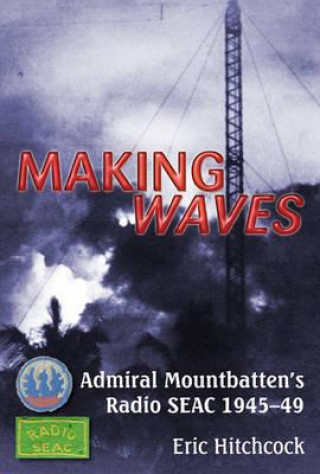
Making Waves
Autor Eric Hitchcock
The story of British Forces Broadcasting began officially on 1st January 1944 in North Africa. Mobile stations were used in the advance northwards through Italy, and followed closely behind the troops after D-Day as they fought th ... celý popis


- Jazyk:
 Angličtina
 - Väzba: Brožovaná
- Počet strán: 224
Nakladateľ: Helion & Company Limited, 2011
- Viac informácií o knihe

52.45 €
Bežne: 58.10 €
Ušetríte 5.65 €
Dostupnosť:
50 % šanca Máme informáciu, že by titul mohol byť dostupný. Na základe vašej objednávky sa ho pokúsime do 6 týždňov zabezpečiť.
Prehľadáme celý svet
Mohlo by sa vám tiež páčiť
-

Gateways Through Light and Shadow: A True Relation of What Transpired Between Frater Ashen Chassan, His Scryer Benn mac Stiofán and the Spirits
53.47 € -

Hamlet
4.55 € -25 % -

La Liga / La Liga: Official Book of the 2021-2022 Season
19.94 € -26 % -

Building Vocabulary with Greek and Latin Roots: A Professional Guide to Word Knowledge and Vocabulary Development
30.37 € -21 % -

The Routledge Handbook of Islam and Race
299.38 € -

Johannine Question
48.61 € -

Matter, Energy and Mentality: Exploring Metaphysical Reality
7.89 € -2 % -

Die Phileasson Saga - Die Wölfin
15.79 € -5 % -

Green Line Transition, m. 1 Beilage
18.73 € -

Artistic Dynamos: An Ethnography on Music in Central African Kingdoms
59.04 € -

Macmillan Readers Macbeth Upper Intermediate Reader Without CD
7.99 € -8 % -

Portuguese
60.46 € -

Maria
23.79 € -24 % -

Mindsight
24.70 € -2 % -

Der Tod in Rom
38.48 € -9 % -

Macrophages
103.40 € -

3 Commando Brigade in the Falklands: No Picnic
17.11 € -24 % -

Woman Of No Importance
27.13 € -

Hippo and the Unicorn
9.92 € -25 % -

La Main Aux Dames ! 3e Edition
24.10 € -

Theories and Techniques of Crystal Structure Determination
130.95 €
Darčekový poukaz: Radosť zaručená
- Darujte poukaz v ľubovoľnej hodnote, a my sa postaráme o zvyšok.
- Poukaz sa vzťahuje na všetky produkty v našej ponuke.
- Elektronický poukaz si vytlačíte z e-mailu a môžete ho ihneď darovať.
- Platnosť poukazu je 12 mesiacov od dátumu vystavenia.
Informovať o naskladnení knihy
Zadajte do formulára e-mailovú adresu a akonáhle knihu naskladníme, zašleme vám o tom správu. Postrážime všetko za vás.
Viac informácií o knihe Making Waves
Nákupom získate 127 bodov
 Anotácia knihy
The story of British Forces Broadcasting began officially on 1st January 1944 in North Africa. Mobile stations were used in the advance northwards through Italy, and followed closely behind the troops after D-Day as they fought their way across Europe into Germany. However, this approach was not suitable for the war east of Suez. The India and South-East Asia Commands (SEAC) covered such a huge area that other means were needed to deliver programmes to the forces in that theatre. A start had been made in Delhi in 1944, where a station had been set up which used air time provided by All-India Radio on one of its transmitters. Efforts to improve welfare facilities were made by Vice-Admiral Mountbatten, soon after he arrived to take up his appointment as Supreme Allied Commander, South East Asia. He set up a forces newspaper, and started experimental radio transmissions, but found there were financial constraints on what could be achieved. Friends and relatives back home became unhappy about the forces' living conditions, and articles appeared in the English press. These came to Churchill's notice, and he was persuaded to send Lord Munster on a fact-finding tour to establish what improvements were needed. His report was made available to M.P.'s just before Christmas 1944, when Churchill addressed the Commons on the situation. Lord Munster had noted the station in Delhi, but wrote that transmitters were needed for forces broadcasting, and that many more receiving sets were required. Discussions involving the War Office and the BBC reached the conclusion that the best option was a powerful short wave transmitter, supported by another with less power. This was approved by the War Cabinet, along with most of Munster's recommendations. What was much more difficult to resolve was the disagreement between those who wished to have the station in Delhi, and Mountbatten who wanted it under his command, in Ceylon. The text of a signal is included in which he set out his reasons. The furious argument was decided in his favour, and the result was Radio SEAC. Early estimates of targets for when the station might go on the air proved to be optimistic. They underestimated the difficulty of shipping, from England to Ceylon, the components of a big transmitter, complete with its own power supply. Several aerial towers (300 feet high) had to be dismantled, shipped and re-erected. In order to provide some broadcasting as soon as possible, the small transmitter was used for about a year before the powerful one went on the air in May 1946 - long after the war was over. Even readers with some knowledge of the technical details of radio receivers may be surprised by photographs showing the sheer size of the components used in the big transmitter. One could justify the huge expense of the transmitting station on the grounds that when it was not longer needed for forces broadcasting it could serve as a relay station for the BBC. This would mean, for example, that the BBC Overseas Service would be received well in Australia. It was used in this way for a short time, but independence for Ceylon led to the station being handed over to the country's new government. The story of Radio SEAC, and Mountbatten's pivotal involvement in it, has remained untold until now. Eric Hitchcock presents a balanced and fascinating account, blending military, social, political and scientific history together to produce an important account.
Parametre knihy
Zaradenie knihy Knihy po anglicky Humanities History History: earliest times to present day
52.45 €
- Celý názov: Making Waves
- Autor: Eric Hitchcock
- Jazyk: Angličtina
- Väzba: Brožovaná
- Počet strán: 224
- EAN: 9781906033958
- ISBN: 1906033951
- ID: 04322857
- Nakladateľ: Helion & Company Limited
- Hmotnosť: 332 g
- Rozmery: 234 × 156 mm
- Dátum vydania: 15. March 2011
Obľúbené z iného súdka
-

The Origins of Totalitarianism
13.16 € -34 % -

Tuesdays With Morrie
9.81 € -34 % -
Medieval Costume and How to Make It
11.23 € -2 % -

On Tyranny
10.02 € -27 % -

The Art of Combat
26.53 € -24 % -
Peloponnesian War
14.17 € -19 % -

Swerve
14.17 € -

Distant Mirror
15.08 € -29 % -

Penguin History of the Twentieth Century
20.25 € -24 % -
Ancient Greece
22.78 € -10 % -

Road to Sparta
11.84 € -25 % -

Creation of Patriarchy
22.27 € -

Nixonland
20.96 € -

History of Ancient Egypt
16.09 € -24 % -

Victorian Lady's Guide to Fashion and Beauty
16.09 € -24 % -

Son Also Rises
16.80 € -25 % -

Crossfire
24.30 € -3 % -

Tuesdays With Morrie
12.24 € -10 % -

Henry III
12.85 € -25 % -

Inescapable Questions
22.27 € -23 % -

Liberty & Order
25.51 € -11 % -

Woodstock
18.22 € -25 % -

Gardens of Hell
28.55 € -25 % -
Chronicles of the First Crusade
14.57 € -25 % -

Revolution 1989
15.59 € -27 % -

Epics of Sumerian Kings
24.40 € -6 % -

From Third World to First
19.94 € -

Guns, Germs, and Steel
10.93 € -10 % -

Illustrated Encyclopedia of Uniforms of World War I
21.26 € -25 % -

History of the Decline and Fall of the Roman Empire
14.88 € -24 % -

Learn to Read Ancient Sumerian
28.35 € -2 % -

Book of Margery Kempe
10.83 € -25 % -

Secret Team
18.32 € -24 % -

History of the Ancient World
26.12 € -22 % -
Gallic War
9.61 € -8 % -

Fall of Carthage
14.98 € -29 % -

Oxford Illustrated History of Prehistoric Europe
38.98 € -10 % -
24 Hours in Ancient Athens
9.11 € -30 % -

Oxford Handbook of Neolithic Europe
67.75 € -

Alexander the Great
14.17 € -23 % -
Egyptian Book of the Dead: The Book of Going Forth by Day : The Complete Papyrus of Ani Featuring Integrated Text and Full-Color Images (History ... M
32.81 € -8 % -

Complete Roman Army
21.26 € -25 % -

Caesar
19.23 € -20 % -

Life in a Medieval Castle
13.16 € -30 % -

Fear and Loathing on the Campaign Trail '72
13.06 € -29 % -

Electric Kool-Aid Acid Test
10.42 € -30 % -

Streams of Gold, Rivers of Blood
30.27 € -12 % -

Safe Area Gorazde
20.25 € -24 % -

Swords of the Viking Age
30.07 € -14 %
Osobný odber Bratislava a 12840 dalších
Copyright ©2008-26 najlacnejsie-knihy.sk Všetky práva vyhradenéSúkromieCookies

 24 miliónov titulov
 Vrátenie do mesiaca
 02/210 210 99 (8-15.30h)