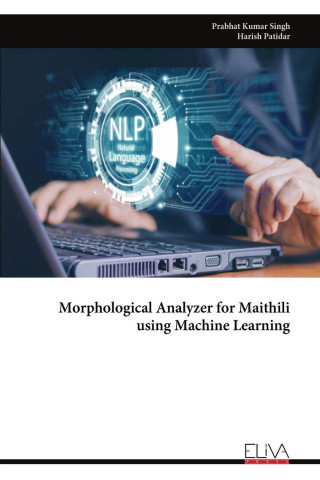
Kód: 50185615
Morphological Analyzer for Maithili using Machine Learning
Autor Prabhat Kumar Singh
I n the ever-expanding landscape of Natural Language Processing (NLP), the ability to dissect and understand the building blocks of a language is a foundational step. While powerful tools for morphological analysis exist for globa ... celý popis


- Jazyk:
 Angličtina
 - Väzba: Brožovaná
- Počet strán: 150
Nakladateľ: Eliva Press, 2025
- Viac informácií o knihe

55.27 €
Bežne: 56.40 €
Ušetríte 1.13 €

Skladom u dodávateľa
Odosielame za 9 - 15 dní
Mohlo by sa vám tiež páčiť
-

Moonwalk
14.14 € -17 % -

The Deal
13.94 € -19 % -

The Score
13.63 € -13 % -

The Mistake
14.54 € -

Jujutsu Kaisen, Vol. 30
9.89 € -20 % -

Witch Hat Atelier: Grimoire Edition 1
34.55 € -29 % -

Invincible Compendium Volume 2
48.19 € -22 % -

Invincible Compendium Volume 1
45.77 € -24 % -

Berserk Deluxe Volume 1
35.56 € -25 % -

Berserk Deluxe Volume 2
33.24 € -30 % -

Heated Rivalry
12.62 € -7 % -

The Goal
14.64 € -

Witch Hat Atelier Manga Box Set 1
54.46 € -27 % -

Invincible Compendium Volume 3
45.77 € -24 % -

Jujutsu Kaisen, Vol. 25
9.89 € -20 % -

Jujutsu Kaisen, Vol. 26
9.89 € -20 % -

Jujutsu Kaisen, Vol. 29
9.29 € -25 % -

Lord of Mysteries, Vol. 3: The Clown, Part III
14.95 € -29 % -

Moonwalk: A Memoir
21.72 € -24 % -

Murdoku
17.07 € -24 % -

Berserk Deluxe Volume 3
55.06 €
Darujte túto knihu ešte dnes
- Objednajte knihu a vyberte Zaslať ako darček.
- Obratom obdržíte darovací poukaz na knihu, ktorý môžete ihneď odovzdať obdarovanému.
- Knihu zašleme na adresu obdarovaného, o nič sa nestaráte.
Viac informácií o knihe Morphological Analyzer for Maithili using Machine Learning
Nákupom získate 134 bodov
 Anotácia knihy
I n the ever-expanding landscape of Natural Language Processing (NLP), the ability to dissect and understand the building blocks of a language is a foundational step. While powerful tools for morphological analysis exist for globally dominant languages like English, a vast number of the world's languages, particularly those with rich oral traditions and distinct linguistic structures, have been left behind in the digital revolution. This is especially true for Maithili, a language spoken by millions across the Mithila region of India and Nepal, yet one that has remained largely underrepresented in the digital sphere. The development of a robust morphological analyzer for Maithili is not just a technological feat; it is a critical step toward preserving and promoting its unique heritage in the modern age.
Morphological analysis is the process of breaking down words into their constituent morphemes-the smallest units of meaning. For a language like Maithili, with its complex system of verb conjugations, case markers, and grammatical agreements, this task is particularly challenging. A word like "पढैछी" (paṛhaichī) must be broken down to its root, "पढ" (paṛha), meaning "to read," and the suffix "-ैछी" (-aichī), which denotes the first-person singular present tense. Similarly, "विद्यार्थीहरूले" (vidyārthīharūle) contains the base word "विद्यार्थी" (vidyārthī) for "student," the plural marker "-हरू" (-harū), and the case marker "-ले" (-le) that indicates the agent of an action. Accurately parsing these structures is essential for any advanced language processing application.
Traditional rule-based approaches, which rely on manually created dictionaries and a fixed set of grammatical rules, often fall short when dealing with Maithili. Its extensive irregularities, nuanced phonetic shifts, and a wide array of dialectal variations make it difficult to create a comprehensive and scalable rule set. Any small change or new word would require a manual update to the system, making it brittle and high-maintenance. This is where the power of machine learning provides a transformative solution.
Parametre knihy
Zaradenie knihy Knihy po nemecky Naturwissenschaften, Medizin, Informatik, Technik Informatik, EDV Informatik, EDV - Sonstiges
55.27 €
- Celý názov: Morphological Analyzer for Maithili using Machine Learning
- Autor: Prabhat Kumar Singh
- Jazyk: Angličtina
- Väzba: Brožovaná
- Počet strán: 150
- EAN: 9789999329897
- ISBN: 9999329896
- ID: 50185615
- Nakladateľ: Eliva Press
- Hmotnosť: 228 g
- Rozmery: 229 × 152 × 8 mm
- Dátum vydania: 05. December 2025
Osobný odber Bratislava a 12820 dalších
Copyright ©2008-26 najlacnejsie-knihy.sk Všetky práva vyhradenéSúkromieCookies

 24 miliónov titulov
 Vrátenie do mesiaca
 02/210 210 99 (8-15.30h)