Kód: 04529543
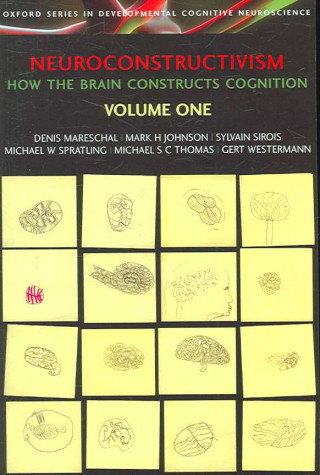
Neuroconstructivism - I & II
Autor Denis Mareschal, Mark Johnson, Sylvain Sirois, Michael Spratling, Michael Thomas, Gert Westermann
What are the processes, from conception to adulthood, that enable a single cell to grow into a sentient adult? The processes that occur along the way are so complex that any attempt to understand development necessitates a multi-d ... celý popis


- Jazyk:
 Angličtina
 - Väzba: Brožovaná
- Počet strán: 576
Nakladateľ: Oxford University Press, 2007
- Viac informácií o knihe


Mohlo by sa vám tiež páčiť
-

Don Troiani's American Battles
32.40 € -6 % -

Encyclopaedia of Psychological Astrology
14.07 € -25 % -

Fourier Transform
11.33 € -24 % -

The Book of Memory
14.17 € -29 % -

Chvála pravdy
7.89 € -

Ju-jitsu, la force millénaire
34.53 € -

Java Persistence API 2
37.77 € -6 % -

Tierra en Peligro
21.46 € -

terraQuest Adventure Map Iceland
18.12 € -9 % -

Italy and its Monarchy
57.01 € -

Germany's Social Market Economy
168.02 € -

Villes-jardins - Vers une fusion entre le végétal et la ville
59.85 € -

El periodisme digital amb valor
23.99 € -

Diseases, Diagnosis and Treatment
22.68 € -6 % -

Cave of Fontechevade
49.72 € -

As a Decade Fades
15.79 € -7 % -

TroubleShooting: Perfeccionando La Tecnica del Tiro con Pistola
14.07 € -7 % -

Hambre de cine
21.36 € -

Race, Religion, and A Curriculum of Reparation
76.86 € -25 % -

Comment analyser la création de valeur du dirigeant ?
94.28 € -14 % -

Mills Freiheitskonzeption - eine zeitlos aktuelle Verteidigung individueller Freiheit
16.20 € -10 % -

IUTAM Symposium on Statistical Energy Analysis
411.60 € -7 % -

Law, Reason, and Morality in Medieval Jewish Philosophy
125.07 € -

Biblical Love, Biblically Applied
8.09 € -7 % -

Hudson's Bay Company's Land Tenures and the Occupation of Assiniboia by Lord Selkirk's Settlers, with a List of Grantees Under the Earl and the Compan
20.15 € -25 % -

TBI-To Be Injured
18.42 € -

Jugar a pensar con cuentos
14.68 € -

Ralentir
16.09 € -

First Thessalonians, Philippians, Second Thessalonians, Colossians, Ephesians
13.87 € -18 % -

Analytic Tomography
73.42 € -

Adrenal Glands
119.30 € -

Cancionero
25.31 € -

Kolumbus
7.38 € -8 % -

Freidenker (Puzzle)
30.48 € -4 % -

Jefferson Davis
47.29 € -1 %
Darujte túto knihu ešte dnes
- Objednajte knihu a vyberte Zaslať ako darček.
- Obratom obdržíte darovací poukaz na knihu, ktorý môžete ihneď odovzdať obdarovanému.
- Knihu zašleme na adresu obdarovaného, o nič sa nestaráte.
Viac informácií o knihe Neuroconstructivism - I & II
Nákupom získate 332 bodov
 Anotácia knihy
What are the processes, from conception to adulthood, that enable a single cell to grow into a sentient adult? The processes that occur along the way are so complex that any attempt to understand development necessitates a multi-disciplinary approach, integrating data from cognitive studies, computational work, and neuroimaging - an approach till now seldom taken in the study of child development. Neuroconstructivism is a major new 2 volume publication that seeks to redress this balance, presenting an integrative new framework for considering development. In the first volume, the authors review up-to-to date findings from neurobiology, brain imaging, child development, computer and robotic modelling to consider why children's thinking develops the way it does. They propose a new synthesis of development that is based on 5 key principles found to operate at many levels of descriptions. They use these principles to explain what causes a number of key developmental phenomena, including infants' interacting with objects, early social cognitive interactions, and the causes of dyslexia. The "neuroconstructivist" framework also shows how developmental disorders do not arise from selective damage to normal cognitive systems, but instead arise from developmental processes that operate under atypical constraints. How these principles work is illustrated in several case studies ranging from perceptual to social and reading development. Finally, the authors use neuroimaging, behavioural analyses, computational simulations and robotic models to provide a way of understanding the mechanisms and processes that cause development to occur. Computer and robotic models provide concrete tools for investigating the processes and mechanisms involved in learning and development. Volume 2 illustrates the principles of 'Neuroconstructivist' development, with contributions from 9 different labs across the world. Each of the contributions illustrates how models play a central role in understanding development. The models presented include standard connectionist neural network models as well as multi-agent models. Also included are robotic models emphasizing the need to take embodiment and brain-system interactions seriously. A model of Autism and one of Specific Language Impairment also illustrate how atypical development can be understood in terms of the typical processes of development but operating under restricted conditions. This volume complements Volume 1 by providing concrete examples of how the 'Neuroconstructivist' principles can be grounded within a diverse range of domains, thereby shaping the research agenda in those domains.
Parametre knihy
Zaradenie knihy Knihy po anglicky Mathematics & science Biology, life sciences Life sciences: general issues
137.53 €
- Celý názov: Neuroconstructivism - I & II
- Autor: Denis Mareschal, Mark Johnson, Sylvain Sirois, Michael Spratling, Michael Thomas, Gert Westermann
- Jazyk: Angličtina
- Väzba: Brožovaná
- Počet strán: 576
- EAN: 9780199214822
- ISBN: 0199214824
- ID: 04529543
- Nakladateľ: Oxford University Press
- Hmotnosť: 896 g
- Rozmery: 232 × 156 × 29 mm
- Dátum vydania: 25. January 2007
Obľúbené z iného súdka
-

The Selfish Gene
13.97 € -22 % -

Homo Deus
9.71 € -29 % -

The Molecule of More
20.04 € -

The Storytelling Animal
19.03 € -

On the Origin of Species
10.12 € -27 % -

Stealing Fire
11.84 € -25 % -

Life Ascending
16.40 € -26 % -

Hidden Spring
13.16 € -24 % -

Life on a Young Planet
22.88 € -5 % -

Hidden History of the Human Race
15.28 € -9 % -

New History of Life
15.18 € -26 % -

Genesis, Zen and Quantum Physics - A Fresh Look at the Theology and Science of Creation
17.51 € -2 % -

Mean Genes
22.27 € -
Fundamentals of Cognitive Neuroscience
74.13 € -2 % -

Improbable Destinies
21.46 € -18 % -

Improbable Destinies
11.03 € -30 % -

Mutants
14.88 € -24 % -

Real Planet of the Apes
27.94 € -

Conscious Mind
19.64 € -29 % -
Beautiful Brain
35.54 € -24 % -

Oxygen
12.95 € -23 % -

Why Evolution Is True
14.88 € -20 % -

Descartes' Error
15.39 € -17 % -

Story Genius
13.46 € -24 % -

Feeling Of What Happens
13.97 € -24 % -

Epigenetics Revolution
13.16 € -23 % -

Symbiotic Planet
14.07 € -25 % -

Problem of Increasing Human Energy
7.89 € -25 % -
Brain
11.23 € -27 % -

Incognito
12.75 € -27 % -

Greatest Show on Earth
10.73 € -34 % -

Systems View of Life
24.80 € -29 % -

Speculations on the Evolution of Human Intelligence
7.89 € -25 % -

Power, Sex, Suicide
12.75 € -25 % -

The Story of the Human Body
15.39 € -28 % -

Brain Rules (Updated and Expanded)
11.23 € -30 % -

River Out of Eden
11.64 € -26 % -

On the Origin of Species
8.90 € -27 % -

On the Origin of Species
11.03 € -25 % -

Pocket Guide to the Polyvagal Theory
33.72 € -7 % -

Inferior
10.93 € -26 % -

Power of Habit
13.76 € -7 % -

Into the Magic Shop
13.46 € -24 % -

Sapiens
29.16 € -20 % -

Moral Animal
16.09 € -24 % -

Your Brain Is a Time Machine
14.57 € -22 % -

Astrobiology: A Very Short Introduction
10.02 € -24 % -

Climbing Mount Improbable
12.95 € -30 % -

Wonderful Life
13.97 € -24 %
Osobný odber Bratislava a 12792 dalších
Copyright ©2008-26 najlacnejsie-knihy.sk Všetky práva vyhradenéSúkromieCookies

 24 miliónov titulov
 Vrátenie do mesiaca
 02/210 210 99 (8-15.30h)