Kód: 05191964
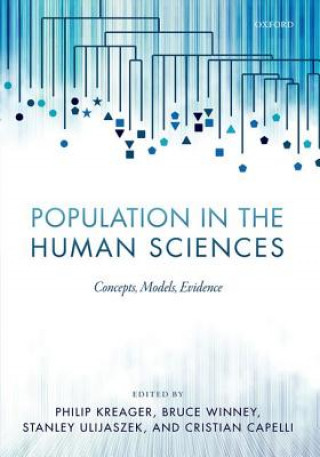
Population in the Human Sciences
Autor Philip Kreager
The Human Sciences address problems in nature and society that often require coordinated approaches of several scientific disciplines and scholarly research, embracing the social and biological sciences, and history. When we wish, ... celý popis


- Jazyk:
 Angličtina
 - Väzba: Pevná
- Počet strán: 640
Nakladateľ: Oxford University Press, 2015
- Viac informácií o knihe


Mohlo by sa vám tiež páčiť
-

Moonwalk
14.17 € -

The Score
13.66 € -13 % -

The Deal
12.65 € -23 % -

The Mistake
14.57 € -12 % -

Jujutsu Kaisen, Vol. 30
9.92 € -20 % -

Witch Hat Atelier: Grimoire Edition 1
34.63 € -29 % -

Invincible Compendium Volume 1
45.87 € -24 % -

Invincible Compendium Volume 2
48.30 € -22 % -

Berserk Deluxe Volume 1
35.54 € -26 % -

The Goal
14.68 € -11 % -

Berserk Deluxe Volume 2
33.31 € -30 % -

Witch Hat Atelier Manga Box Set 1
56.20 € -25 % -

Heated Rivalry
12.65 € -7 % -

Jujutsu Kaisen, Vol. 25
9.92 € -20 % -

Jujutsu Kaisen, Vol. 26
9.92 € -20 % -

Lord of Mysteries, Vol. 3: The Clown, Part III
14.98 € -29 % -

Invincible Compendium Volume 3
45.87 € -24 % -

Jujutsu Kaisen, Vol. 29
9.92 € -20 % -

Moonwalk: A Memoir
21.77 € -24 % -

Murdoku
17.01 € -25 % -

Berserk Deluxe Volume 3
55.19 €
Darujte túto knihu ešte dnes
- Objednajte knihu a vyberte Zaslať ako darček.
- Obratom obdržíte darovací poukaz na knihu, ktorý môžete ihneď odovzdať obdarovanému.
- Knihu zašleme na adresu obdarovaného, o nič sa nestaráte.
Viac informácií o knihe Population in the Human Sciences
Nákupom získate 355 bodov
 Anotácia knihy
The Human Sciences address problems in nature and society that often require coordinated approaches of several scientific disciplines and scholarly research, embracing the social and biological sciences, and history. When we wish, for example, to understand how some sub-populations and not others come to be vulnerable, why a disease spreads in one part of a population and not another, or which gene variants are transmitted across generations, then a remarkable range of disciplinary perspectives need to be brought together, from the study of institutional structures, cultural boundaries, and social networks down to the micro-biology of cellular pathways, and gene expression. The need to explain and address differential impacts of pressing contemporary issues like AIDS, ageing, social and economic inequalities, and environmental change, are well-known cases in point. Population concepts, models, and evidence lie at the core of approaches to all of these problems, if only because accurate differentiation and identification of groups, their structures, constituents, and relations between sub-populations, are necessary to specify their nature and extent. The study of population thus draws both on statistical methodologies of demography and population genetics and sustained observation of the ways in which populations and sub-populations are formed, maintained, or broken up in nature, in the laboratory, and in society. In an era in which research needs to operate on multiple levels, population thinking thus provides a common ground for communication and critical thought across disciplines. Population in the Human Sciences addresses the need for review and assessment of the framework of interdisciplinary population studies. Limitations to prevailing postwar paradigms like the Evolutionary Synthesis and Demographic Transition were becoming evident by the 1970s. Subsequent decades have witnessed an immense expansion of population modelling and related empirical inquiry, with new genetic developments that have reshaped evolutionary, population, and developmental biology. The rise of anthropological and historical demography, and social network analysis, are playing major roles in rethinking modern and earlier population history. More recently, the emergence of sub-disciplines like biodemography and evolutionary anthropology, and growing links between evolutionary and developmental biology, indicate a growing convergence of biological and social approaches to population.
Parametre knihy
Zaradenie knihy Knihy po anglicky Society & social sciences Sociology & anthropology Sociology
147.05 €
- Celý názov: Population in the Human Sciences
- Autor: Philip Kreager
- Jazyk: Angličtina
- Väzba: Pevná
- Počet strán: 640
- EAN: 9780199688203
- ISBN: 0199688206
- ID: 05191964
- Nakladateľ: Oxford University Press
- Hmotnosť: 1254 g
- Rozmery: 255 × 182 × 43 mm
- Dátum vydania: 05. March 2015
Osobný odber Bratislava a 12792 dalších
Copyright ©2008-26 najlacnejsie-knihy.sk Všetky práva vyhradenéSúkromieCookies

 24 miliónov titulov
 Vrátenie do mesiaca
 02/210 210 99 (8-15.30h)